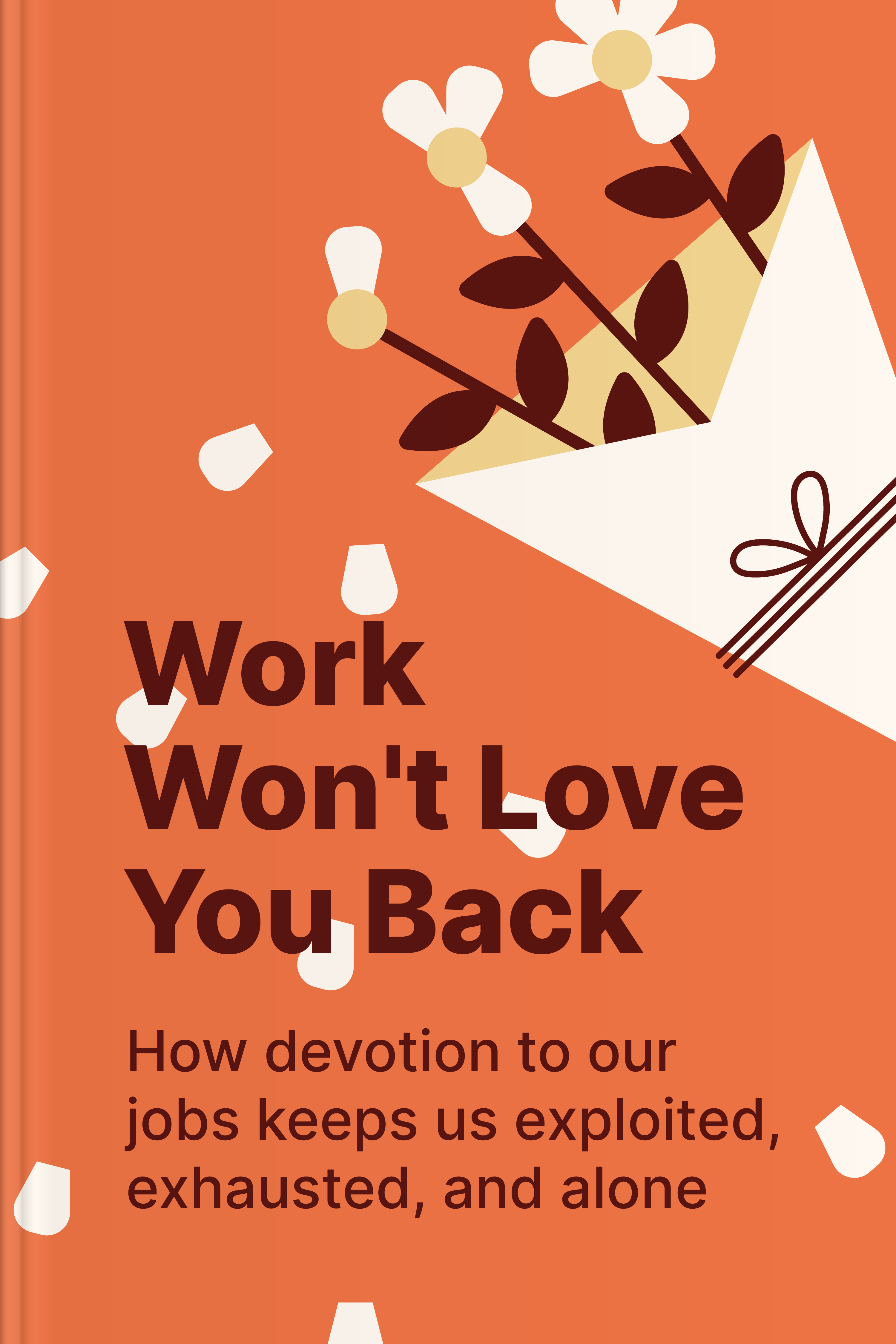
Work Won’t Love You Back audiobook cover - This warm, clear-eyed guide explores how the idea that people should “love what they do” can quietly turn into pressure, underpay, and overwork—and how workers across many fields are learning to name exploitation, set boundaries, and demand fairness together.

Work Won’t Love You Back

This warm, clear-eyed guide explores how the idea that people should “love what they do” can quietly turn into pressure, underpay, and overwork—and how workers across many fields are learning to name exploitation, set boundaries, and demand fairness together.

Sarah Jaffe

4.3 / 5(4 ratings)

If You're Curious About These Questions...

You should listen to this audiobook

Listen to Work Won’t Love You Back — Free Audiobook

Loading player...

Key Takeaways from Work Won’t Love You Back

Learning Tools

Reinforce what you learned from Work Won’t Love You Back

Mind Map

Work Won't Love You Back
The Labor-of-Love Ethic+
Historical Evolution+
Gendered Work Spheres+
Exploitation & Devaluation+
Isolation & Anti-Union Tactics+
Reclaiming Our Lives+

Quiz — Test Your Understanding

Question 1 of 8
What characterized a 'good job' in the US during the early-to-mid-twentieth century under the Fordist compromise?
  • A. It required deep emotional devotion and passion for the company's mission.
  • B. It provided enough free time, resources, stability, and a wage high enough to support a family.
  • C. It offered flexible working hours and the ability to work remotely.
  • D. It was primarily focused on creative fulfillment and personal growth.
Question 2 of 8
According to the text, what was a primary consequence of the rise of neoliberalism in the 1970s?
  • A. The expansion of the Fordist compromise to include women and people of color.
  • B. A decrease in working hours due to the automation of factory jobs.
  • C. The aggressive maximization of corporate profits through union-busting and privatization.
  • D. A widespread cultural shift towards valuing care work over creative work.
Question 3 of 8
How does the modern conception of labor divide work into two gendered spheres under the labor-of-love ethic?
  • A. 'Female' care work requires sacrifice to others, while 'male' creative work demands devotion to a craft.
  • B. 'Female' creative work focuses on emotional intelligence, while 'male' care work focuses on physical protection.
  • C. Women are expected to lead non-profit organizations, while men are expected to dominate the service and retail sectors.
  • D. Both spheres require equal emotional sacrifice, but 'male' work is historically compensated with higher benefits.
Question 4 of 8
How is the labor-of-love ethic used by employers to justify poor working conditions?
  • A. It suggests that because workers are passionate, they require more frequent vacations to avoid burnout.
  • B. It argues that the fulfillment derived from the work itself replaces the need for fair compensation and reasonable hours.
  • C. It implies that only workers who show no emotion should be compensated financially.
  • D. It promotes the idea that workers should only be paid based on the emotional value they bring to customers.
Question 5 of 8
Why does the author argue that the metaphor of the 'workplace as family' is problematic?
  • A. It creates unnecessary competition among coworkers trying to be the 'favorite child.'
  • B. It discourages unionizing and masks the unequal, financially-driven contractual relationship between employer and employee.
  • C. It forces employers to provide comprehensive healthcare and childcare benefits, hurting corporate profits.
  • D. It makes it legally impossible for employers to fire underperforming workers.
Question 6 of 8
What is a major personal consequence of internalizing the labor-of-love ethic and the resulting overwork?
  • A. Workers develop a deeper, more meaningful appreciation for their actual families.
  • B. Workers are left with so little time and energy that their personal relationships become rushed and transactional.
  • C. Workers tend to retire earlier because they find their jobs so emotionally exhausting.
  • D. Workers begin to treat their friends and family members like coworkers or clients.
Question 7 of 8
What radical reform is mentioned as a way to empower people to say 'no' to bad wages and working conditions?
  • A. Implementing a mandatory four-day workweek across all industries.
  • B. Transitioning all service sector jobs into unionized factory jobs.
  • C. Providing a universal basic income so people are no longer dependent on a job to survive.
  • D. Banning the use of the word 'passion' in job descriptions and interviews.
Question 8 of 8
What is the overarching message of 'Work Won't Love You Back' regarding the concept of 'doing what you love'?
  • A. It is a harmless cliché that provides necessary motivation for modern workers.
  • B. It is a realistic goal that everyone can achieve if they find the right career path.
  • C. It is an exploitative ethic used to manipulate workers into accepting longer hours and lower pay in the name of passion.
  • D. It is a concept that only applies to the tech and creative industries, leaving care workers unaffected.

Work Won’t Love You Back — Full Chapter Overview

Work Won’t Love You Back Summary & Overview

Across history and across industries, the belief that “good workers” should feel passion, devotion, and gratitude has been used to justify low pay, long hours, and disrespect—especially for work that looks like caregiving or service. Sarah Jaffe traces how this labor-of-love myth formed, how it spread through family life and culture, and how it shows up in modern workplaces from teaching to retail to nonprofit jobs.

Along the way, this summary highlights people and movements that challenged the myth—organizing, unionizing, striking, and reframing what work is worth. The thread running through it all is gentle but firm: passion can exist, but it can’t replace wages, safety, time, and dignity—and real love is something people give each other, not something a job can return.

Who Should Listen to Work Won’t Love You Back?

  • Anyone who feels pressure to prove devotion at work—by working longer, accepting less, or tolerating disrespect—because the job is supposed to be a “calling.”
  • People in caregiving, service, creative, nonprofit, or education roles who want language for why their work is often undervalued and what collective change can look like.
  • Managers, organizers, and leaders who want a more humane way to think about motivation, compensation, boundaries, and respect at work.

About the Author: Sarah Jaffe

Sarah Jaffe is a journalist and author who writes about labor, politics, and social movements. Her work focuses on how economic systems shape everyday life—and how workers organize to demand dignity, safety, and fair compensation.

🎧
Listen in the AppOffline playback & background play
Get App