If You're Curious About These Questions...
You should listen to this audiobook
- Have you ever wondered why modern societies are fracturing despite unprecedented market wealth and state power?
- What’s the secret to a stable civilization, and why has a crucial ‘third pillar’ been dangerously neglected in the digital age?
- Are you curious about how the decline of local communities is providing the hidden ‘jet fuel’ for today’s most disruptive populist movements?
Listen to The Third Pillar — Free Audiobook
Loading player...
Key Takeaways from The Third Pillar
- Understand the delicate balance between society's three pillars—the state, markets, and communities—and why neglecting any single pillar leads to instability.
- Discover how modern inequality and anti-establishment populism are the direct results of prioritizing efficiency and profit-making over community well-being.
- Learn how 15th-century military technology forced the collapse of community-driven feudal manors and gave rise to powerful, centralized nation-states.
- Explore the historical cycle of free markets, from their liberating expansion in the seventeenth century to the monopoly-driven abuses that sparked a community backlash.
- Find out how the unprecedented economic growth following the Second World War allowed Western governments to create modern welfare systems.
Learning Tools
Reinforce what you learned from The Third Pillar
Mind Map
The Third Pillar
The Three Pillars+
Historical Evolution+
Modern Imbalance & Crises+
Emerging Markets Challenges+
The Blueprint: Inclusive Localism+
Quiz — Test Your Understanding
Question 1 of 10
According to Raghuram Rajan, what are the three foundational 'pillars' of society?
Question 2 of 10
What technological innovation in the fifteenth century disrupted the community-dominated medieval social order and spurred the rise of nation-states?
Question 3 of 10
Why did the community pillar return to the forefront of social and economic life in the early twentieth century?
Question 4 of 10
How did the US and UK governments respond to the economic slowdowns, high unemployment, and inflation of the 1970s?
Question 5 of 10
How has technological innovation contributed to a 'winner-takes-most' economy?
Question 6 of 10
What is 'residential sorting' and how does it exacerbate social inequality?
Question 7 of 10
According to the text, what major challenge is currently threatening the progress of market liberalization in India?
Question 8 of 10
What is the primary feature of 'inclusive localism' proposed by Raghuram Rajan?
Question 9 of 10
How can the state use technology to facilitate social mobility under the framework of inclusive localism?
Question 10 of 10
Why does the author argue that data rights laws need to be reformed to give individuals ownership of their data?
The Third Pillar — Full Chapter Overview
- 1Recommendation
- 2The feudal manors across medieval Europe were absorbed by rising new nation-states.
- 3Free markets expanded rapidly for a time, then faced a widespread popular backlash across nations.
- 4World War II ushered in a period of extraordinary growth and prosperity, but it didn’t last long.
- 5Market deregulation created inequalities that subsequent technologies have further worsened.
- 6Social stratification set the stage for populist revolts sparked by recent major upheavals.
- 7So-called emerging markets confront their own challenges.
- 8Inclusive localism provides an alternative to populism and a way to rebalance the three pillars of our economies.
- 9Both the state and local communities play vital roles in renewing communities today.
- 10States ought to promote fair competition domestically and internationally.
The Third Pillar Summary & Overview
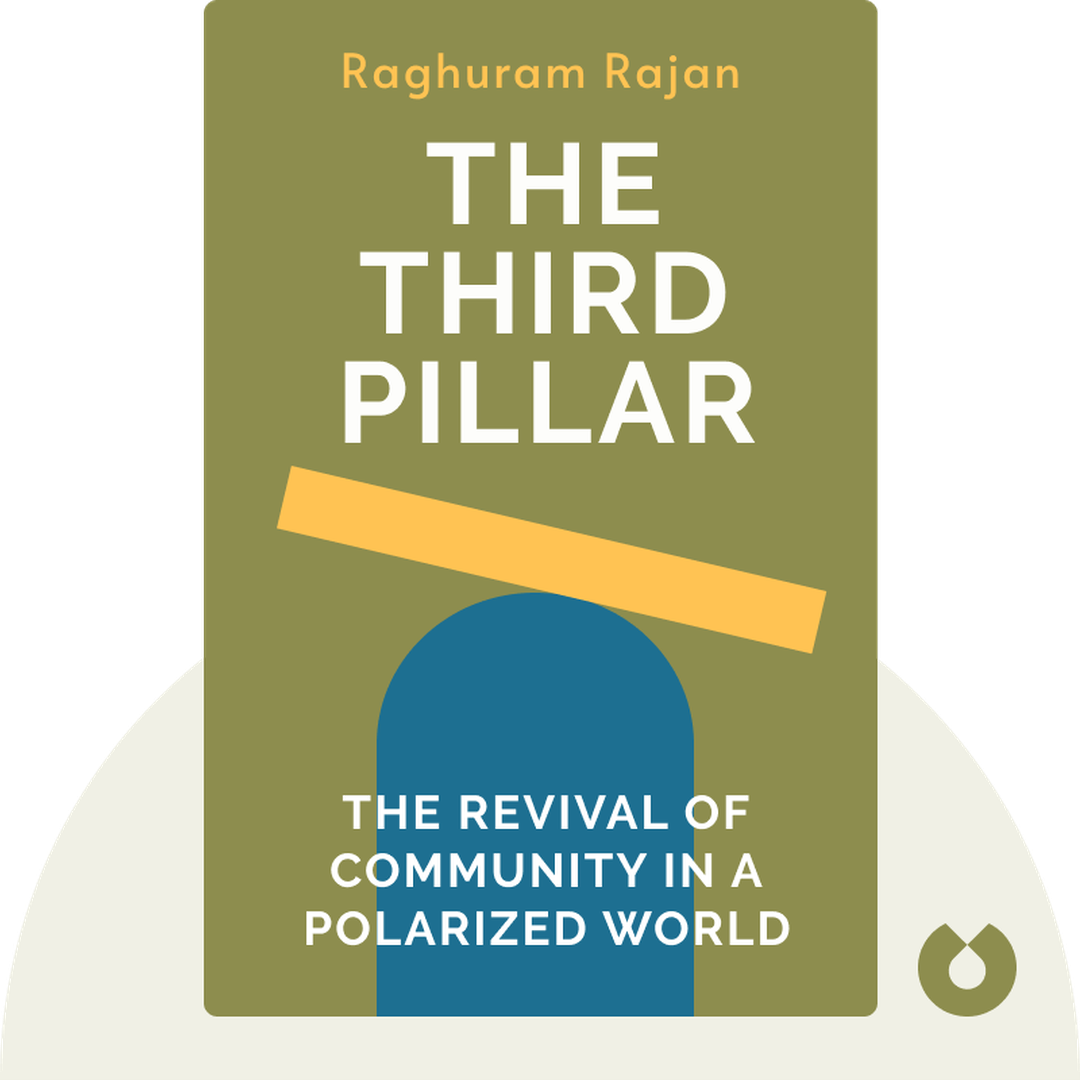
The Third Pillar (2019) traces the evolving relationship between the three “pillars” of human life – the state, markets and communities – from the medieval period to our own age. Economist Raghuram Rajan argues that, throughout history, societies have struggled to find a sustainable balance between these pillars. Today is no different: caught between uncontrolled markets and a discredited state, communities everywhere are in decline. That, Rajan concludes, is jet fuel for populist movements. But a more balanced kind of social order is possible.
Who Should Listen to The Third Pillar?
- Anyone apprehensive about the rise of intolerant political movements
- Historians and economists
- Community organizers and neighborhood activists
Books Similar to The Third Pillar
Readers who enjoyed this also liked these titles.