Theme Song
If You're Curious About These Questions...
You should listen to this audiobook
- Did you know that the 2008 financial crisis was fueled by deep-seated systemic flaws that go far beyond the actions of a few greedy bankers?
- Have you ever wondered what hidden 'fault lines' in the global economy are still putting our financial stability at risk today?
- Are you curious about how fundamental shifts in our social and political systems could be the secret to preventing the next great economic crash?
Listen to Fault Lines — Free Audiobook
Loading player...
Key Takeaways from Fault Lines
- Understand how the 2008 financial crisis was triggered by deep, systemic economic 'fault lines' rather than just the greedy actions of individual bankers.
- Discover why growing income inequality and an education-driven wage gap led politicians to promote cheap credit, fueling a dangerous debt-driven spending spree.
- Learn how the massive export surpluses of nations like Germany, Japan, and China flooded the U.S. with capital, forcing the American economy to dangerously overstimulate global growth.
- Explore the impact of 'jobless recoveries,' which pressured the Federal Reserve to keep interest rates artificially low and ultimately inflated the destructive U.S. housing bubble.
- Find out how subprime mortgages acted as the catastrophic convergence point for these fault lines, serving short-term political goals to mask wage stagnation while causing global economic disaster.
Learning Tools
Reinforce what you learned from Fault Lines
Mind Map
Fault Lines
Core Fault Lines+
The Subprime Catalyst+
Systemic Blindness+
Misaligned Incentives+
Solutions for Stability+
Quiz — Test Your Understanding
Question 1 of 8
According to the book, what was the primary reason U.S. politicians encouraged easy credit and subprime lending prior to the 2008 crisis?
Question 2 of 8
How did exporting nations like Germany, Japan, and China contribute to the global financial crisis?
Question 3 of 8
Why did the Federal Reserve keep interest rates historically low in the years leading up to the crisis?
Question 4 of 8
Why did mathematical financial models fail to accurately assess the risks of subprime mortgage-backed securities?
Question 5 of 8
On what basis did rating agencies justify giving safe 'AAA' ratings to risky subprime mortgage-backed securities?
Question 6 of 8
According to Rajan, who is ultimately to blame for the 2008 financial crisis?
Question 7 of 8
What specific reform does the book suggest to prevent bankers from engaging in excessively risky behavior?
Question 8 of 8
To address the deep roots of the crisis and foster sustainable growth, what long-term solutions does the author advocate?
Fault Lines — Full Chapter Overview
- 1Recommendation
- 2The rise of cheap loans was one fault line in the crisis, with banks and politicians playing a role.
- 3Exporting nations pushed their surpluses toward the U.S., but America could only absorb so much.
- 4Low interest rates fueled a wave of cheap mortgages, overheating the U.S. housing market.
- 5Subprime mortgages met short-term political and personal needs, but caused serious damage.
- 6Financial models use past behavior to predict the future, but this time there was no data to rely on.
- 7Rating agencies also underestimated subprime mortgage risks, treating them as safe bets.
- 8Financial incentives encouraged everyone to take what they could without sounding the alarm.
- 9Irresponsible risk-taking in finance must be restrained to support long-term stability.
- 10Better education and stronger safety nets: sustainable growth needs long-term solutions.
- 11Final summary
Fault Lines Summary & Overview
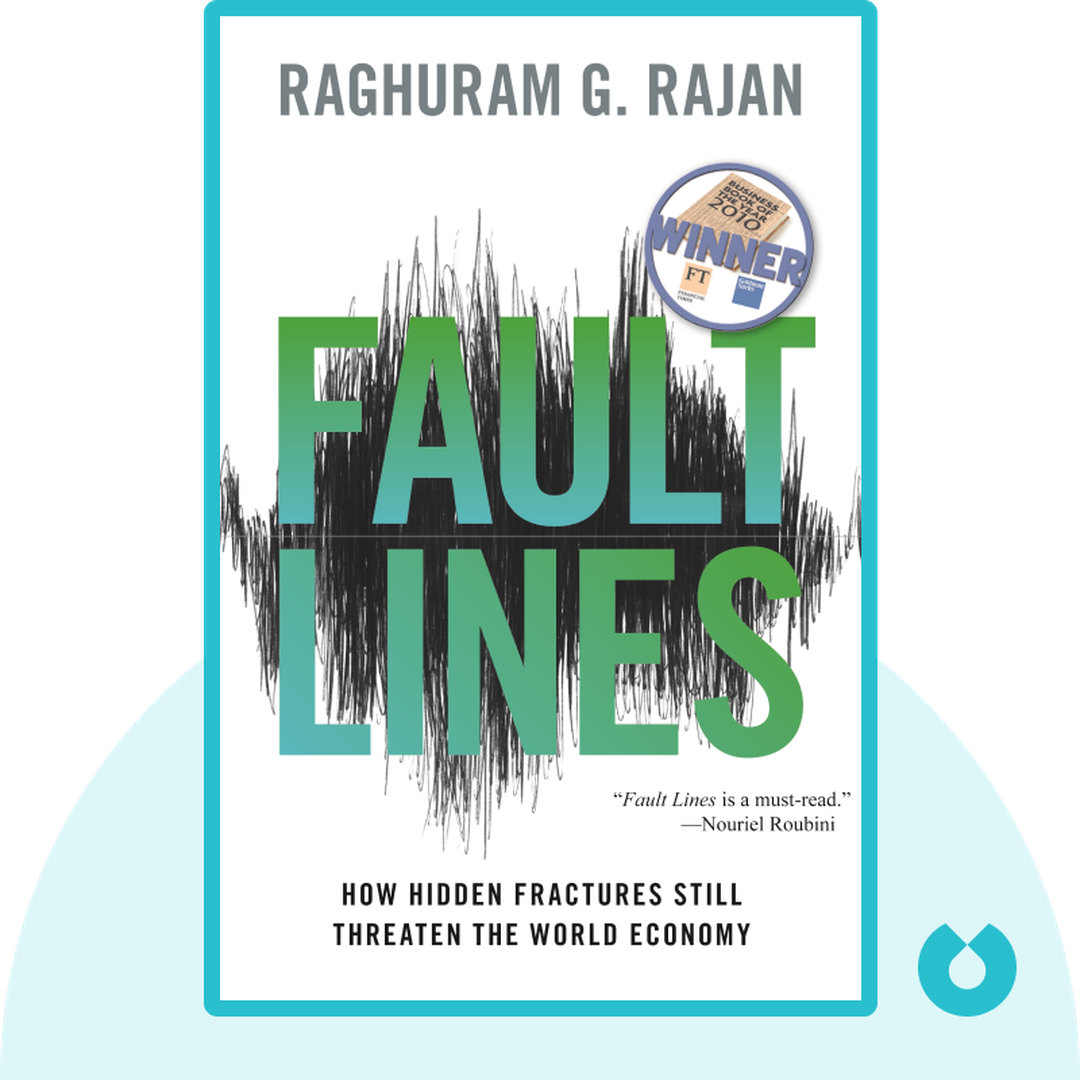
In Fault Lines, author Raghuram Rajan unveils the global economy’s hidden fractures that led to the 2008 financial crisis. These blinks show that greedy bankers weren’t the only ones to blame; our economic system had deep systemic flaws as well. Importantly, they outline what we can do as a society to prevent similar crises in the future.
Who Should Listen to Fault Lines?
- Anyone who wants to understand the financial crisis of 2008
- Anyone curious how future economic crises could be prevented
- Anyone interested in global economics or international trade
Books Similar to Fault Lines
Readers who enjoyed this also liked these titles.