If You're Curious About These Questions...
You should listen to this audiobook
- Did you know that many of the world's largest corporations now hold more power over your daily life than the governments meant to protect you?
- Have you ever wondered why the invisible "social contract" that once provided economic stability has completely broken down in the 2020s?
- Are you curious about what it would actually take to rewrite the rules of capitalism and restore the balance of power between citizens and CEOs?
Listen to The Raging 2020s — Free Audiobook
Loading player...
Key Takeaways from The Raging 2020s
- Understand why modern developed nations are stuck in a second 'Engels' Pause,' a transitional era where outdated social contracts are driving skyrocketing inequality.
- Discover how Milton Friedman's theory of shareholder capitalism warped corporate incentives, and why transitioning to stakeholder capitalism is essential for true corporate responsibility.
- Learn how the relentless pursuit of shareholder profit allows corporate cartels to prioritize wealth over human lives, exemplified by the monopolization of life-saving drugs like insulin.
- Explore how decades of deregulation have crippled the efficiency of governments while empowering multinational corporations to rival the geopolitical influence of entire countries.
- Find out why citizens are increasingly bypassing weak governments to successfully demand better wages and social policies directly from massive corporations.
Learning Tools
Reinforce what you learned from The Raging 2020s
Mind Map
The Raging 2020s
The Broken Social Contract+
Corporate Power & Capitalism+
Weakened Government+
Labor & Employee Rights+
Global Tax Evasion & Reform+
Technological Might & Cyberwarfare+
The Future: Open vs. Closed Models+
Quiz — Test Your Understanding
Question 1 of 8
What does the book mean when it states that developed societies are currently in a 'second Engels' Pause'?
Question 2 of 8
According to the text, what is the primary difference between shareholder capitalism and stakeholder capitalism?
Question 3 of 8
What does the book identify as the most important issue to tackle in order to help the government regain its strength against corporate power?
Question 4 of 8
How does the 'Nordic model' successfully organize labor to benefit employees?
Question 5 of 8
What solution does the book propose to combat highly complex corporate tax avoidance schemes like the 'Double Irish with a Dutch Sandwich'?
Question 6 of 8
Why is it essential for the US government to develop stronger partnerships with private tech companies?
Question 7 of 8
How does the book characterize China's 'closed model' social contract?
Question 8 of 8
According to the final summary, which of the following is NOT listed as a necessary step to rebalance the broken social contract?
The Raging 2020s — Full Chapter Overview
- 1Recommendation
- 2Social contracts keep societies working, but they can break down.
- 3Today’s companies care about little beyond shareholder profit.
- 4Governments have grown weak and ineffective as companies have become stronger.
- 5Employees need a greater voice in the workplace.
- 6Corporations use highly complex tax avoidance schemes.
- 7The global tax system can — and should — be reformed.
- 8Businesses and governments need to collaborate to build digital power.
- 9Countries around the world must choose between closed and open social contracts.
- 10Final summary
The Raging 2020s Summary & Overview
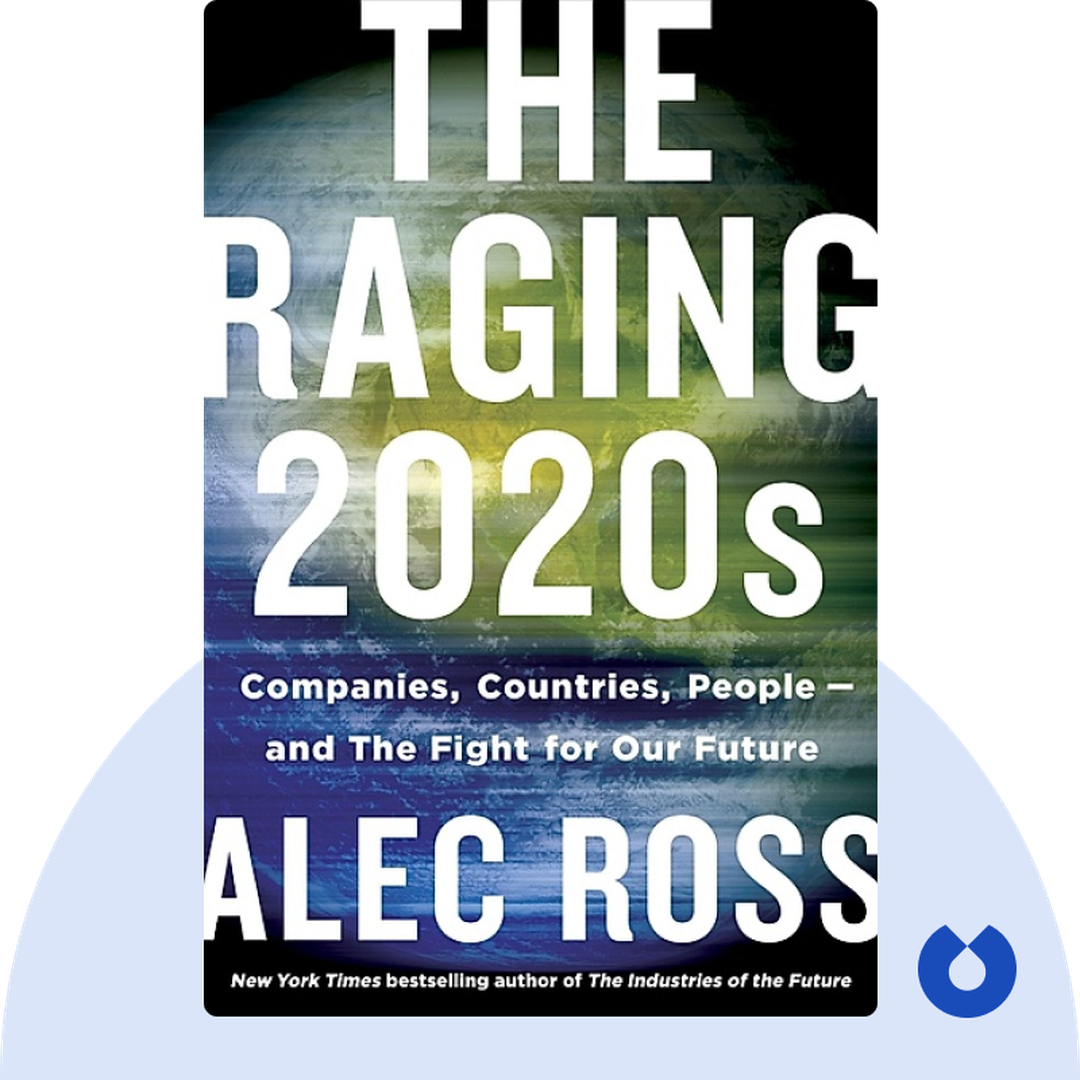
The Raging 2020s (2021) is an autopsy of the American social contract, which once kept companies, governments, and individuals in stable harmony but has since broken down. In particular, it describes how the power of corporations has expanded in recent years while federal might has waned – and how the result is that companies have more control over people’s lives than ever before. We must work to restore the balance and write a new social contract for the modern age.
Who Should Listen to The Raging 2020s?
- Citizens concerned about the increasing power of corporations
- Current or aspiring politicians and activists
- Anyone who sees the value in capitalism but thinks it can be improved
Books Similar to The Raging 2020s
Readers who enjoyed this also liked these titles.