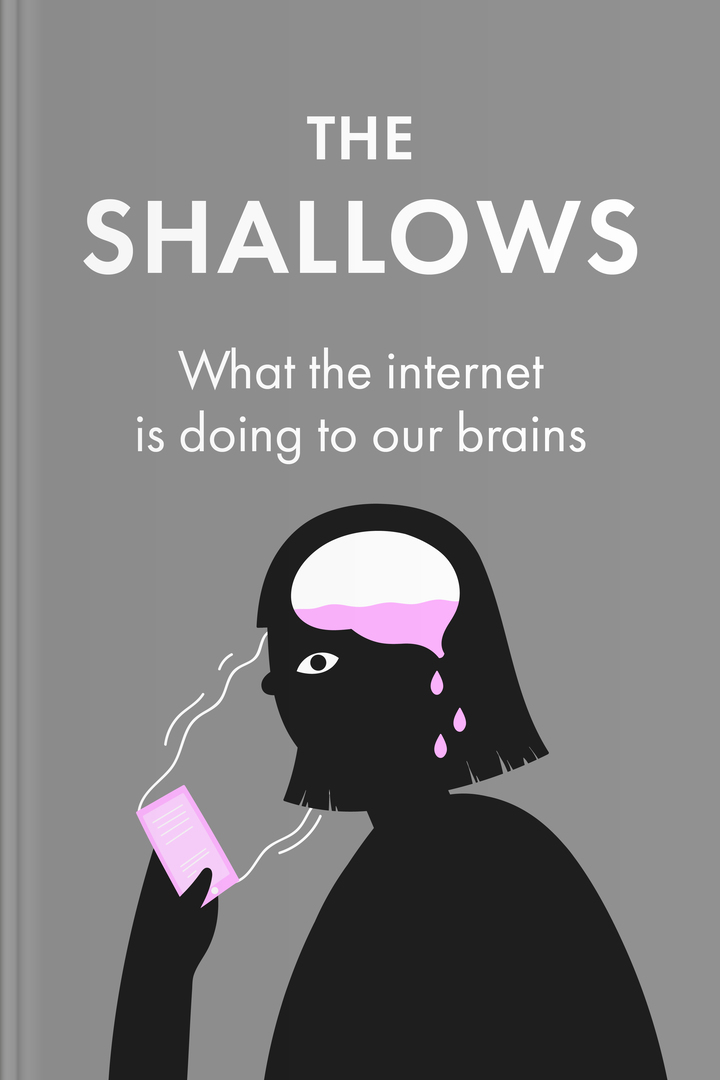
If You're Curious About These Questions...
You should listen to this audiobook
- Have you ever wondered why it feels increasingly difficult to focus on a long book or a deep conversation, even when you’re genuinely interested?
- Did you know that everyday tools like clocks and maps didn't just help us navigate the world—they actually fundamentally rewired how the human brain processes information?
- What if the convenience and speed of the internet are secretly coming at the cost of your ability to think deeply and retain long-term memories?
Listen to The Shallows — Cinematic Audio Edition
Key Takeaways from The Shallows
- Discover why losing focus online isn't a personal flaw, but the result of a deliberate system designed to exploit human curiosity with an endless stream of choices.
- Learn how recognizing the internet's attention-grabbing architecture is the first practical step toward taking back control and choosing deep focus over accidental scrolling.
- Understand how the constant convenience and rapid rewards of the digital world quietly condition your brain to default to scattered attention rather than sustained concentration.
- Find out how the tools you use shape your actual thinking patterns, mirroring historical shifts like how a simple switch to a typewriter subtly altered Friedrich Nietzsche's expression.
- Explore the fascinating history of human technology—from early maps to mechanical clocks—to see how tools don't just record reality, but fundamentally train the mind to perceive the world differently.
Learning Tools
Reinforce what you learned from The Shallows
Mind Map
The Shallows — Full Chapter Overview
- 1Recommendation
- 2Designed to Pull Attention, Not Just to Serve It
- 3Convenience That Quietly Costs Focus
- 4How Tools Have Always Rewritten Human Thinking
- 5When Computers Made Speed the New Normal
- 6Why Paper Still Holds a Quiet Kind of Focus
- 7The Internet’s Loop: Reward, Craving, Repeat
- 8Google and the Rise of the Efficiency Mindset
- 9Learning to Live With Technology Without Losing Reality
The Shallows Summary & Overview
This narration explores a simple but powerful idea: people don’t get pulled into the internet only because they visit it often, but because it was designed to capture and hold attention. Across eight chapters, it traces how tools—from maps and clocks to computers and search engines—have always shaped the way humans think, focus, and remember.
Along the way, Nicholas Carr’s observations about distraction, reading, and digital life are paired with historical examples and research that highlight a real tradeoff: convenience and speed can come at the cost of sustained concentration. The goal isn’t to reject technology, but to understand it clearly enough to use it with intention.
Who Should Listen to The Shallows?
- Listeners who feel their attention has changed—especially their ability to read deeply or focus for long stretches—and want a calm explanation of why.
- Students, educators, and knowledge workers who rely on the internet daily and want to understand its cognitive effects without panic or blame.
- Anyone who wants a balanced, humane perspective on technology: appreciative of its benefits, honest about its costs, and practical about adapting well.
Books Similar to The Shallows
Readers who enjoyed this also liked these titles.