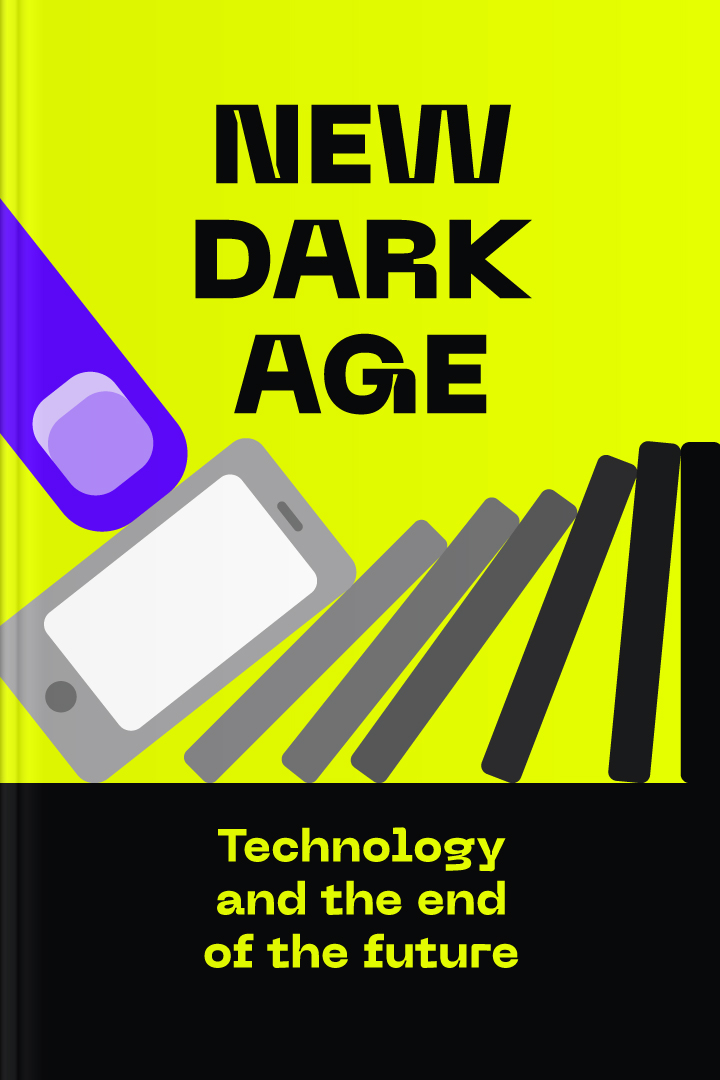
New Dark Age audiobook cover - This gentle audio guide explores how modern technology quietly shapes attention, money, climate strain, surveillance, and misinformation—inviting listeners to ask better questions, seek fairness, and rebuild a healthier relationship with the tools that now surround daily life.

New Dark Age

This gentle audio guide explores how modern technology quietly shapes attention, money, climate strain, surveillance, and misinformation—inviting listeners to ask better questions, seek fairness, and rebuild a healthier relationship with the tools that now surround daily life.

James Bridle

4.3 / 5(4 ratings)
Start ListeningDownloadQR code that opens AudiobookHub on the App StoreTry free on iPhoneScan to start in 5 seconds

If You're Curious About These Questions...

You should listen to this audiobook

Listen to New Dark Age — Free Audiobook

Loading player...

Key Takeaways from New Dark Age

Learning Tools

Reinforce what you learned from New Dark Age

Mind Map

New Dark Age
The Illusion of Computation+
The Big Data Fallacy+
Climate Change & Technology+
Capitalism, Inequality & Bias+
Secrecy & Surveillance+
Sense-Making in a Complex World+

Quiz — Test Your Understanding

Question 1 of 9
What was the primary historical project that spurred the origin of modern computation?
  • A. Military attempts to predict and control the weather
  • B. The need to automate global financial markets
  • C. Academic efforts to map the human genome
  • D. The creation of early artificial intelligence for space exploration
Question 2 of 9
How does the book describe the relationship between digital technology and climate change?
  • A. Digital technology exists entirely in the 'cloud,' making it immune to physical climate impacts.
  • B. Digital technologies are the only viable solution to mapping and reversing global warming.
  • C. The physical infrastructure of the internet is vulnerable to extreme weather, and data centers contribute heavily to carbon emissions.
  • D. High-frequency trading algorithms are primarily responsible for the economic fallout of climate disasters.
Question 3 of 9
What does 'Eroom's law' illustrate about the current state of scientific research?
  • A. Computing power reliably doubles every two years, making scientific research exponentially faster.
  • B. Despite massive increases in data and automated testing, the number of new drugs approved per billion dollars spent has halved every nine years.
  • C. Machine learning algorithms inevitably replicate the human biases of the scientists who program them.
  • D. Scientific studies must be replicated at least twice by independent researchers to be considered statistically valid.
Question 4 of 9
What does the 2010 Dow Jones 'flash crash' demonstrate about modern financial technologies?
  • A. High-frequency trading networks are highly susceptible to foreign cyberattacks.
  • B. Human traders frequently input bad data, causing automated systems to fail catastrophically.
  • C. The physical fiber-optic cables used for trading are easily disrupted by extreme weather events.
  • D. Financial markets have become so hyper-accelerated by computers that humans can no longer understand or pinpoint the causes of sudden crashes.
Question 5 of 9
What did the US Army's attempt to train an AI to recognize camouflaged tanks reveal about machine learning?
  • A. AI is inherently free of bias and can recognize physical patterns that humans easily miss.
  • B. Machines build their own multidimensional simulations of the world, often solving problems in ways humans don't expect, such as detecting the weather instead of the tank.
  • C. AI requires significantly more high-resolution data than human analysts to perform the exact same cognitive tasks.
  • D. Military algorithms are too complex to be run on standard computer hardware and require specialized servers.
Question 6 of 9
How did the British government's handling of documents regarding 1950s Kenyan concentration camps demonstrate the control of data?
  • A. They locked away over a million documents in secret facilities, showing that even in an age of abundant data, historical truth is still deliberately suppressed.
  • B. They used high-frequency algorithms to digitally alter the historical records before releasing them to the public.
  • C. They published all the raw data online at once to overwhelm the public and hide the truth in a sea of information.
  • D. They relied on machine learning to automatically redact sensitive information, resulting in the accidental deletion of history.
Question 7 of 9
According to the book, why do conspiracy theories like 'chemtrails' or 'gang stalking' thrive in the digital age?
  • A. They are secretly funded by intelligence agencies to distract the public from actual mass surveillance programs.
  • B. They are automatically generated by malicious AI bots designed to disrupt democratic elections.
  • C. They provide comforting, simple black-and-white narratives that reduce the overwhelming complexity of the modern world.
  • D. They are the only narratives that successfully bypass the rigorous fact-checking algorithms of major tech companies.
Question 8 of 9
What is the primary cause of the disturbing, nonsensical children's videos proliferating on YouTube?
  • A. Malicious hackers intentionally trying to traumatize young children through cyber warfare.
  • B. The fateful combination of capitalist financial incentives and automated algorithms that generate and promote content without human oversight.
  • C. A lack of physical servers to properly host and categorize high-quality children's entertainment.
  • D. Government intelligence agencies testing psychological operations on the general public.
Question 9 of 9
Why does the author reject Eric Schmidt’s claim that smartphones and social media would have prevented the 1994 Rwandan genocide?
  • A. Because making a crisis visible through data does not automatically fix it; governments already had satellite data of the genocide but chose not to act.
  • B. Because the internet infrastructure in Rwanda in 1994 would not have supported high-speed video sharing.
  • C. Because social media algorithms would have automatically censored the violent videos before they reached the international public.
  • D. Because smartphones would likely have been used by the perpetrators to better coordinate their attacks.

New Dark Age — Full Chapter Overview

New Dark Age Summary & Overview

This narration is a warm, reflective walk through the unsettling side of technological progress—how it can concentrate power, deepen inequality, strain the planet’s infrastructure, erode privacy, and amplify misinformation. Rather than rejecting technology, it encourages a steadier kind of literacy: the ability to ask clear questions about what digital systems do, who benefits, and what they cost.

Across seven chapters, the focus stays practical and human. Listeners are invited to notice subtle forms of dependence, to consider the social and ethical blind spots created by automation and speed, and to think compassionately about how society might respond—with accountability, regulation, and personal habits that restore a sense of agency.

Who Should Listen to New Dark Age?

  • Listeners who feel uneasy about the digital world—surveillance, misinformation, addiction, and the sense that technology is “deciding” too much.
  • Students, workers, and citizens who want language for asking better questions about who holds power in modern systems, and how to advocate for fairness.
  • Anyone seeking gentle, doable ways to reset their relationship with phones, social media, and online information.

About the Author: James Bridle

This audio summary draws on ideas commonly associated with writer and artist James Bridle, including the quoted passages included in the provided text. The narration itself is an adaptation of the supplied chapter content, reshaped for a warm and listenable experience.

🎧
Listen in the AppOffline playback & background play
Get App