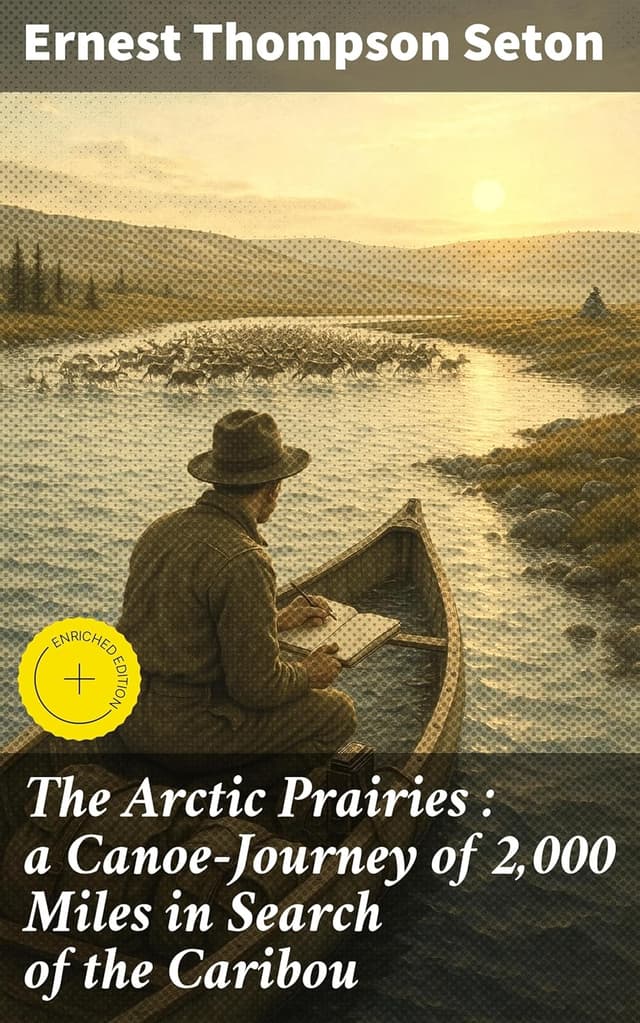
The Arctic Prairies (Full Version) audiobook cover - In 1907 Ernest Thompson Seton launches a canoe into Canada’s immense northern river system, chasing the caribou into the Barren Grounds—only to find that endurance, human character, and the hard beauty of the land become the real quarry.

The Arctic Prairies (Full Version)

In 1907 Ernest Thompson Seton launches a canoe into Canada’s immense northern river system, chasing the caribou into the Barren Grounds—only to find that endurance, human character, and the hard beauty of the land become the real quarry.

Ernest Thompson Seton

4.7 / 5(2807 ratings)
Categories:

Listen to The Arctic Prairies (Full Version) — Free Audiobook

Loading player...

Historical Background

Written in the years following his grueling 1907 canoe expedition and published in 1911, Ernest Thompson Seton’s *The Arctic Prairies* emerged during a pivotal era in North American history. As the Industrial Revolution rapidly transformed the continent and the western frontier effectively closed, a growing anxiety about the loss of pristine wilderness gave rise to the early conservation movement. Seton, writing from his home in the United States but documenting the largely unmapped Mackenzie River and Aylmer Lake regions of Canada's Northwest Territories, captured the public imagination at a time when figures like Theodore Roosevelt were championing the preservation of natural spaces.

Upon its publication, the book was highly significant for its rigorous geographical and biological documentation, offering one of the first detailed scientific accounts of the region's caribou herds, flora, and topography. However, it also carried a quietly controversial undertone for its era. Seton provided a deeply sympathetic and respectful portrayal of the Indigenous peoples he encountered, notably the First Nations and Métis guides who made his journey possible. In an age dominated by colonialist narratives and aggressive government policies of assimilation, Seton’s admiration for Indigenous ecological knowledge and his sharp critiques of encroaching white civilization stood in stark contrast to prevailing societal attitudes.

The lasting impact of *The Arctic Prairies* extends far beyond early twentieth-century travel literature. Seton’s evocative prose and meticulous field observations helped cement the foundations of modern nature writing and ecological consciousness. Furthermore, his profound respect for wilderness and Indigenous survival skills heavily influenced the ethos of the scouting movement, of which he was a founding pioneer. Today, the text remains an invaluable historical baseline for scientists studying the Canadian Arctic and a timeless testament to the enduring power of the North American wilderness.


Study Questions

  1. Seton writes extensively about the abundance of wildlife, particularly the massive caribou herds, yet there is an underlying awareness of encroaching civilization. How does Seton balance his romanticized view of the 'untamed' wilderness with his scientific observations, and what does the text suggest about early 20th-century attitudes toward wildlife conservation?

  2. Throughout his journey, Seton relies heavily on First Nations and Métis guides, frequently documenting their customs, skills, and the impact of European settlement on their way of life. Analyze Seton's portrayal of Indigenous peoples in the text: to what extent does he subvert or reinforce the cultural tropes of his era, and how do these interactions shape his understanding of the North?

  3. The physical journey into the far North serves as both a geographical exploration and a psychological test. In what ways does the grueling, unpredictable landscape of the Arctic prairies function as a character itself, and how does Seton's evolving relationship with this harsh environment reflect a broader philosophical shift regarding humanity's vulnerability and place in the natural world?

What Critics and Readers Say

First published in 1911, The Arctic Prairies is a travel narrative and natural history account documenting Ernest Thompson Seton’s six-month, 2,000-mile canoe expedition across northern Canada in search of caribou. The book combines scientific observation, personal adventure, and vivid descriptions of wildlife and landscape, making it both a record of exploration and a literary work reflecting early 20th-century interest in nature and wilderness. 

Critics and historians of nature writing often view Seton’s work within the broader tradition of popular naturalism, where scientific observation is blended with storytelling. His detailed accounts of animals, ecosystems, and Indigenous life contributed to growing public fascination with the natural world, though later scholarship sometimes critiques writers of his era for romanticizing or simplifying nature and Indigenous cultures. 

Readers and reviewers generally appreciate The Arctic Prairies for its engaging narrative style and rich descriptive detail. Modern reader feedback often highlights the book as a “well-written” and immersive account of Arctic exploration, filled with anecdotes about wildlife, survival, and frontier life, making it especially appealing to fans of nature writing, travel literature, and historical exploration. 

Today, the book is valued both as an adventure narrative and a historical document, offering insight into early 20th-century exploration and environmental perspectives. Its blend of observation and storytelling continues to attract readers interested in wilderness, conservation history, and the development of nature literature. 

Sources:

• Goodreads – overview of the expedition and narrative content: https://www.goodreads.com/book/show/4389477-the-arctic-prairies

• Seton Legacy Project – scholarly discussion of Seton’s work and its interpretation: https://ernestthompsonseton.com/the-indian-writings-of-ernest-thompson-seton

• Alibris – reader review highlighting writing quality and content: https://www.alibris.com/reviews/book/7502941/The-Arctic-Prairies

• Amazon / bibliographic description – genre and expedition context: https://www.amazon.co.uk/Arctic-Prairies-Ernest-Thompson-Seton

The Arctic Prairies (Full Version) — Full Chapter Overview

The Arctic Prairies (Full Version) Summary & Overview

The Arctic Prairies is Ernest Thompson Seton’s vivid record of a 2,000-mile canoe journey down the Athabasca and onward toward the treeless northern plains in search of caribou “in their primitive condition.” Part travel narrative, part natural-history field journal, it blends close observation—birds, mammals, timber, weather, and water—with the practical realities of wilderness travel: rapids, portages, provisions, and the precarious timing of spring breakup.

Seton’s great subject is not only the North’s abundance and austerity, but the people who move through it: voyageurs and river pilots, Indigenous and mixed-blood crews, Hudson’s Bay Company officers, and solitary trappers. The book captures a world poised between older frontiers and modern change, weighing stewardship against exploitation and noting how commerce, custom, and faith shape life on the rivers. As a classic of North American exploration writing, it remains compelling for its descriptive power, its humor and candor, and its enduring sense of a vast landscape still capable of remaking the traveler.

Who Should Listen to The Arctic Prairies (Full Version)?

  • Listeners who love classic expedition and wilderness-travel narratives grounded in real hardship, craft, and geography
  • Readers of nature writing who enjoy careful field observation of animals, birds, and northern ecosystems
  • Fans of early-20th-century North American history interested in frontier economies, river travel, and the Hudson’s Bay world

About the Author: Ernest Thompson Seton

Ernest Thompson Seton (1860–1946) was an Anglo-Canadian writer, artist, and naturalist whose influential animal stories helped shape modern nature writing. Best known for Wild Animals I Have Known and other works that combine narrative with close observation, he was also a skilled illustrator and a serious field researcher, producing detailed records of North American wildlife. Seton co-founded the Woodcraft movement and was an important figure in the early conservation-minded outdoor tradition. His travel books, including The Arctic Prairies, fuse expedition narrative with scientific curiosity and remain valued for their descriptive clarity and enduring sense of place.

Can You Survive the AI Era?