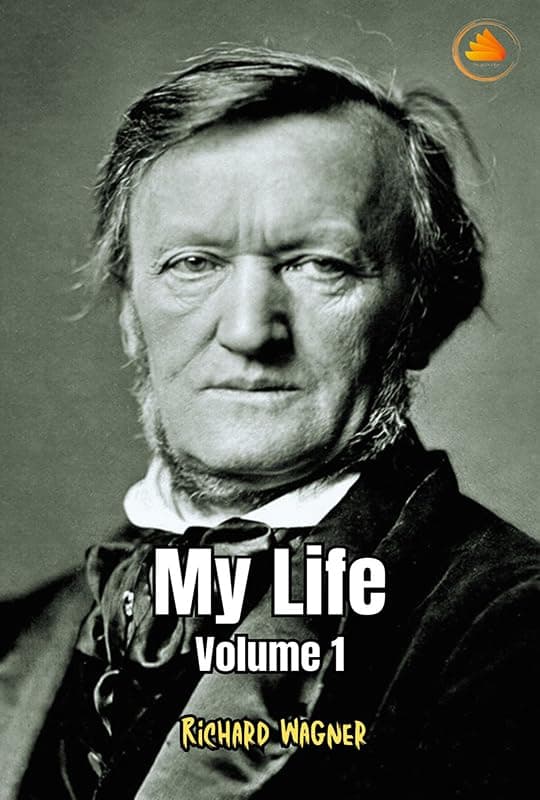
Richard Wagner dictated his monumental autobiography, *My Life* (*Mein Leben*), to his future wife, Cosima von Bülow, between 1865 and 1880, primarily while living in Tribschen, Switzerland, and later in Bayreuth. Commissioned by his devoted patron, King Ludwig II of Bavaria, the work emerged during a profoundly turbulent era in European history. Volume 1 chronicles Wagner’s early years against the backdrop of the burgeoning Romantic movement and the simmering unrest that culminated in the 1848–1849 revolutions. Wagner himself was deeply entangled in these political upheavals, having participated in the 1849 May Uprising in Dresden, an act of radicalism that forced him into a prolonged and bitter exile. This period was characterized by a fervent quest for German national and cultural identity, an ideology that Wagner both absorbed and fiercely championed.
Upon its highly restricted private printing, and its eventual public release in 1911, the autobiography proved immensely controversial. Wagner’s narrative is notoriously subjective, characterized by profound egotism, the harsh disparagement of musical rivals such as Giacomo Meyerbeer, and the infusion of his virulent anti-Semitism. Furthermore, his unapologetic chronicling of chronic indebtedness and romantic indiscretions scandalized readers. For decades, the text was heavily sanitized by his family; a full, unexpurgated version was not widely accessible until late in the twentieth century. Despite its distortions, *My Life* has left an indelible mark on literature and cultural history. It remains an unparalleled primary source for understanding the psychological architecture of one of history's most polarizing figures. By framing his life as an epic drama of destiny and artistic struggle, Wagner shaped the modern archetype of the tormented, uncompromising genius, profoundly influencing the biographical genre and our understanding of nineteenth-century European culture.