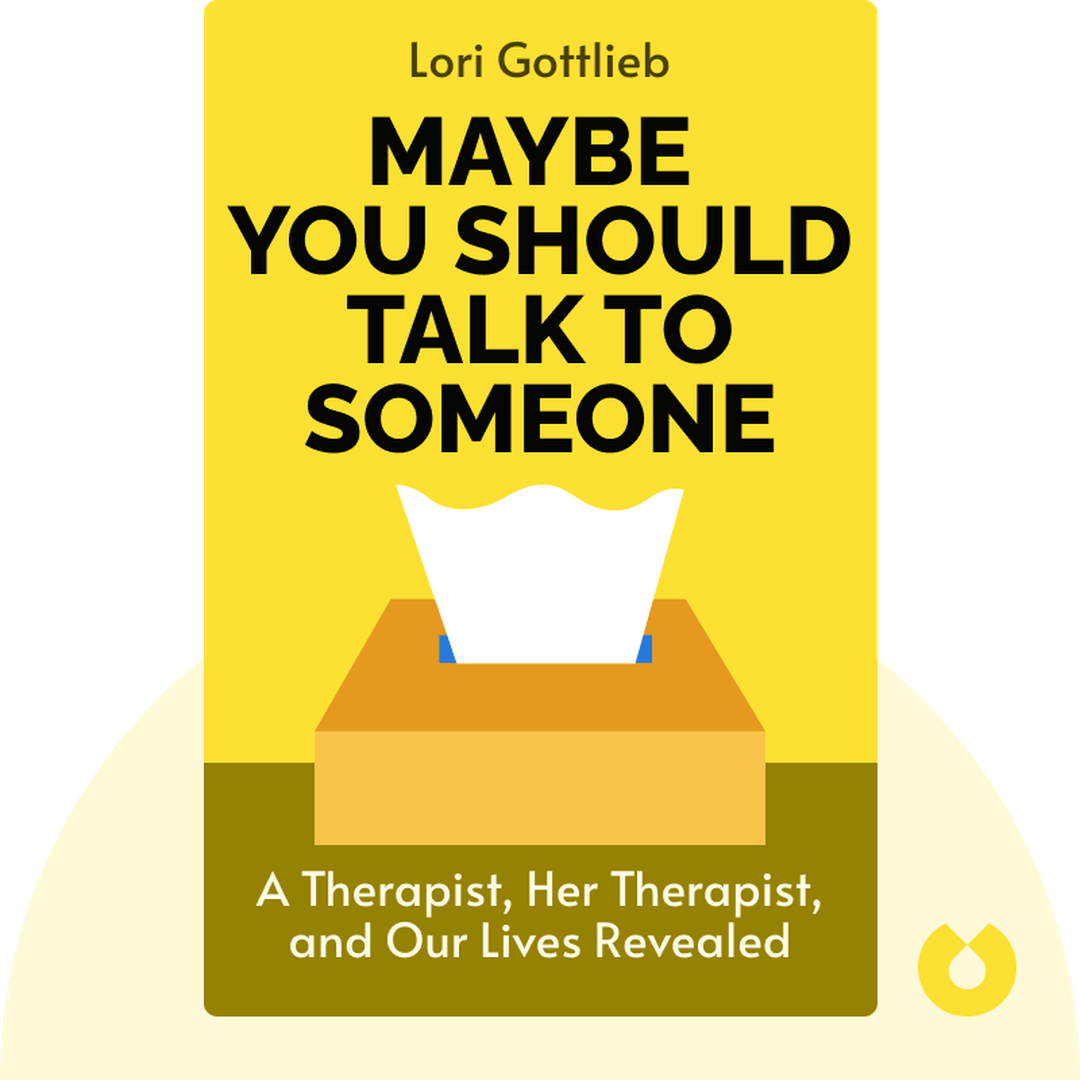
Maybe You Should Talk To Someone
Start ListeningDownload Try free on iPhoneScan to start in 5 seconds
Categories:
If You're Curious About These Questions...
You should listen to this audiobook
- Have you ever wondered what’s really going on in your therapist’s head—and what happens when they find themselves needing a therapist of their own?
- Did you know that the stories we tell ourselves about our problems are often the biggest obstacles preventing us from actually solving them?
- Are you curious about the surprising secret that connects every person’s struggle, whether they’re a high-powered professional or someone just trying to get through the day?
Listen to Maybe You Should Talk To Someone — Cinematic Audio Edition
Loading player...
Key Takeaways from Maybe You Should Talk To Someone
- Discover why building emotional walls to look strong actually blocks the connection you need most, and learn how vulnerability acts as a doorway to real support.
- Understand why even trained mental health professionals seek therapy to process their own struggles, proving that you have permission to stop pretending everything is fine.
- Learn how to use your relationships as reflecting mirrors to uncover your own blind spots, especially when you find yourself trapped in a loop of blaming others.
- Discover the radical power of deep empathy by looking beneath a person's defensive armor to find their positive qualities and understand their full, complex story.
- Uncover why the 'presenting problem' that brings someone to therapy is usually just the tip of the iceberg, and learn to look for the deeper, unspoken fears beneath the surface.
Learning Tools
Reinforce what you learned from Maybe You Should Talk To Someone
Mind Map
Maybe You Should Talk To Someone
The Presenting Problem+
Defense Mechanisms+
The Four Underlying Fears+
The Power of Connection+
The Freedom to Choose+
Resistance to Change+
Emotional Breakthroughs+
Quiz — Test Your Understanding
Question 1 of 8
What is a patient's 'presenting problem' in the context of therapy?
Question 2 of 8
When the author first started seeing her therapist, Wendell, what was her primary goal regarding the narrative of her breakup?
Question 3 of 8
According to Wendell's observations, what deeper fear was the author masking by fixating on her ex-boyfriend's flaws?
Question 4 of 8
Why did the author's elderly patient, Rita, start getting regular pedicures?
Question 5 of 8
What realization caused the author to experience severe anxiety over her lucrative book contract?
Question 6 of 8
How did Julie, the 33-year-old college professor diagnosed with terminal cancer, demonstrate the concept of freedom in therapy?
Question 7 of 8
Why did Charlotte consistently find herself attracted to emotionally unstable men?
Question 8 of 8
What generally triggers a major breakthrough moment for a patient in therapy, according to the text?
Maybe You Should Talk To Someone — Full Chapter Overview
- 1Recommendation
- 2When patients start therapy, their problems are often deeper than they first seem.
- 3Patients often enter therapy believing unhelpful stories they’ve built around their problems.
- 4Therapy patients rely on defense mechanisms to avoid the truth, and therapists must look past them.
- 5Therapy often centers on losing and restoring human connection.
- 6Therapy also often centers on losing and restoring a sense of meaning in a patient’s life.
- 7Regaining a sense of freedom is one key to recovery.
- 8Our resistance to change can make it hard to use our freedom and choose a healthier path.
- 9Letting our emotions out is the key to lowering our guard.
- 10Final summary
Maybe You Should Talk To Someone Summary & Overview
Maybe You Should Talk to Someone (2019) is a unique memoir in which the author, a psychotherapist, tells the story of how she herself ended up on a therapist’s couch after descending into a personal crisis of her own. By reflecting on her experiences as both a therapist and a patient, and by relating them to the stories of four of her patients, she came to a better understanding of both her profession and herself.
Who Should Listen to Maybe You Should Talk To Someone?
- Curious minds interested in how therapy works in practice
- People suffering from personal, emotional or psychological problems
- Those who are feeling lost and looking for some direction
Books Similar to Maybe You Should Talk To Someone
Readers who enjoyed this also liked these titles.