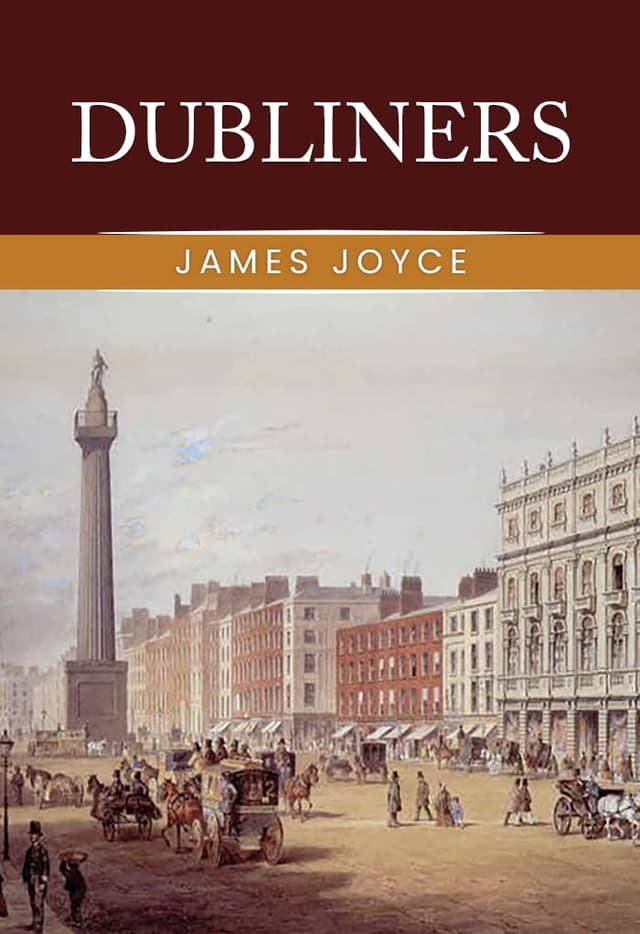
Dubliners (Full Version) audiobook cover - In fifteen piercing stories of ordinary lives, Joyce turns Dublin’s streets, parlours, and pubs into a moral map—where small desires, quiet humiliations, and sudden recognitions accumulate until a single moment of “epiphany” reveals what has been endured, avoided, or lost.

Dubliners (Full Version)

In fifteen piercing stories of ordinary lives, Joyce turns Dublin’s streets, parlours, and pubs into a moral map—where small desires, quiet humiliations, and sudden recognitions accumulate until a single moment of “epiphany” reveals what has been endured, avoided, or lost.

James Joyce

4.8 / 5(2977 ratings)
Categories:

Listen to Dubliners (Full Version)

Loading player...

Historical Background

James Joyce composed the fifteen short stories of *Dubliners* primarily between 1904 and 1907. Although the collection is intimately anchored in the geography and culture of Ireland's capital, Joyce wrote the majority of the work while in self-imposed exile across Europe, residing in cities such as Trieste, Pola, and Rome. At the time of its composition, Ireland was caught in a profound cultural and political transitional period. The nation was grappling with British colonial rule, the dominant moral authority of the Catholic Church, and the rising tide of Irish nationalism. However, unlike contemporaries such as W.B. Yeats who romanticized Ireland’s mythic past during the Celtic Revival, Joyce viewed turn-of-the-century Dublin as the "centre of paralysis," a stagnant city trapped by restrictive social conventions, political disillusionment, and spiritual decay.

This unvarnished, hyper-realistic depiction of the city made *Dubliners* highly controversial. The book endured a tortuous nine-year journey to publication, finally appearing in print in 1914. Publishers and printers repeatedly rejected or destroyed the manuscript, fearing libel suits and public outrage over Joyce’s use of actual Dublin locations, real businesses, and mild profanity. Furthermore, his refusal to provide neat, moralizing conclusions deeply challenged the conservative literary norms of the Edwardian era.

Upon its eventual release, *Dubliners* revolutionized the modern short story. Joyce eschewed traditional, plot-driven narratives in favor of psychological depth and atmospheric detail, formally introducing the literary concept of the "epiphany"—a sudden, profound moment of realization experienced by a character. By capturing the quiet, everyday tragedies of ordinary citizens with uncompromising honesty, *Dubliners* laid the foundational groundwork for literary modernism and Joyce’s later masterpieces, fundamentally altering how human consciousness and urban life are represented in world literature.

Study Questions

  1. James Joyce famously described his intention with 'Dubliners' as writing a chapter of the moral history of his country, choosing Dublin because it seemed to be the 'centre of paralysis.' How does this theme of paralysis manifest across the different stages of life (childhood, adolescence, maturity, and public life) depicted in the collection, and do any characters truly achieve a liberating 'epiphany' from it?

  2. Throughout the collection, overarching institutions such as the Catholic Church and the British Empire cast long shadows over the characters' everyday lives. How do these forces of religion and colonialism contribute to the characters' feelings of entrapment, as seen in stories like 'Eveline' or 'Ivy Day in the Committee Room,' and how do they impact the formation of Irish identity?

  3. The final and most famous novella, 'The Dead,' concludes the collection with Gabriel Conroy's profound meditation on memory, mortality, and marriage. How does Gabriel's final epiphany recontextualize the preceding stories, and what is the symbolic significance of the snow that falls 'upon all the living and the dead' at the end of the book?

What Critics and Readers Say

Dubliners by James Joyce is widely regarded as a foundational masterpiece of literary modernism and one of the most influential short-story collections of the 20th century. First published in 1914, the book presents a naturalistic and unflinching portrait of Irish middle-class life in Dublin, depicting everyday characters and moments with psychological depth, restraint, and symbolic resonance. Joyce intended Dubliners to be a “nicely polished looking-glass” held up to the Irish, reflecting both the beauty and paralysis of their lives. 

Critics highlight Joyce’s use of epiphany — brief, revelatory moments where characters gain sudden self-understanding — as one of the collection’s major literary innovations, influencing generations of writers and shaping the development of the modern short story. Reviewers note that Dubliners marked a significant departure from the didactic, plot-driven tales of earlier periods toward an insightful psychological realism focused on the internal lives of ordinary people. 

Reader communities praise the book for its authentic voice and emotional precision, finding its stories both intimate and universal. Many also observe how the theme of paralysis — emotional, social, and spiritual — pervades the collection, portraying characters trapped by convention, circumstance, or self-doubt, which resonates with readers across eras and cultures. 

While some scholarly debate continues about the subtlety and difficulty of interpretation in certain stories, Dubliners remains a central text in modern literature courses worldwide and is frequently cited as an essential work for understanding the evolution of 20th-century fiction. 

Sources:

• Wikipedia – overview of Dubliners and its themes: https://en.wikipedia.org/wiki/Dubliners

• Dubliners analysis – importance of epiphany and literary modernism: https://readever.app/book/dubliners-james-joyce

• Literary review – characterisation, paralysis, and poetic prose: https://foxedquarterly.com/gordon-bowker-james-joyce-dubliners-literary-review/

Dubliners (Full Version) Chapter Overview

About Dubliners (Full Version)

Dubliners (1914) is James Joyce’s landmark collection of short stories tracing the inner lives of Dublin’s citizens—children, clerks, artists, spouses, and strivers—caught between longing and limitation. With extraordinary restraint and clarity, Joyce depicts everyday scenes that gradually tighten into revelation: a death watched from a window, a boy’s day of truancy, a conversation that turns into accusation, a hope that collapses under habit.

Across these meticulously observed narratives, Joyce develops his signature “epiphany,” the sudden disclosure of truth that arrives not as melodrama but as a chill of recognition. Themes of paralysis, religion, respectability, colonial pressure, and stalled ambition run through the book, while its exacting realism and musical prose helped reshape modern fiction. The sequence culminates in “The Dead,” widely regarded as one of the greatest short stories in English, where memory and desire meet the inexorable presence of time.

Who Should Listen to Dubliners (Full Version)

  • Listeners who love psychologically sharp realism—stories where the drama is inward and the payoff is a quiet, devastating recognition.
  • Fans of modernist literature curious to hear Joyce before Ulysses: precise, accessible, and brimming with technique.
  • Anyone interested in Irish cultural history, Catholic social life, and the textures of turn-of-the-century Dublin.

About James Joyce

James Joyce (1882–1941) was an Irish modernist whose innovations transformed twentieth-century literature. Born in Dublin, he left Ireland as a young man but returned obsessively in his art, recreating the city with unmatched specificity. His major works include Dubliners, A Portrait of the Artist as a Young Man (1916), Ulysses (1922), and Finnegans Wake (1939). Joyce pioneered interior narration, linguistic experimentation, and the crafted “epiphany,” combining scrupulous realism with radical form. Though often controversial in his lifetime, he is now regarded as one of the most influential writers in English.