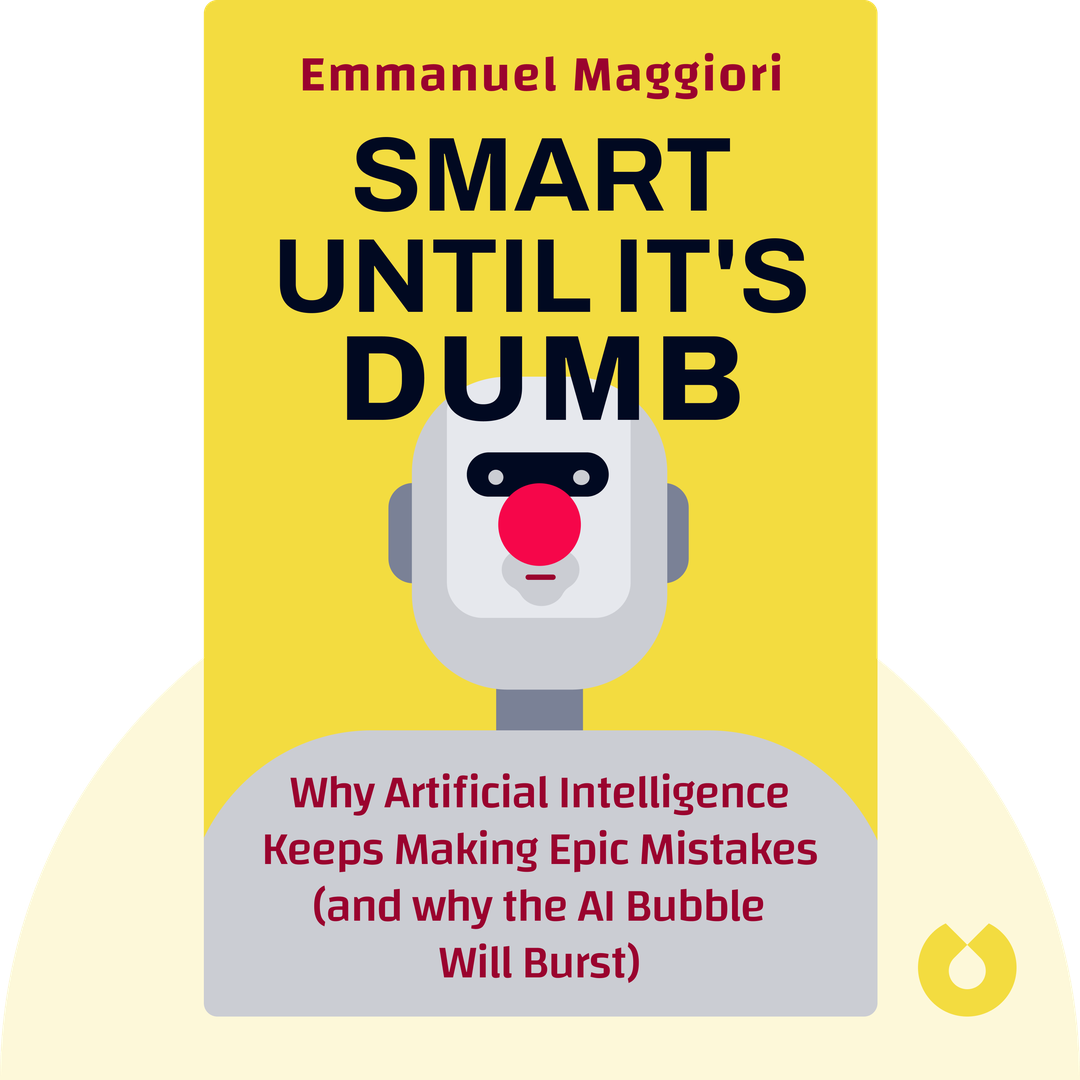
If You're Curious About These Questions...
You should listen to this audiobook
- Have you ever wondered why an AI that can pass complex exams might still fail at simple logic tasks a young child could solve?
- Did you know that much of what we call 'artificial intelligence' relies on shallow shortcuts that can lead to unpredictable and costly failures?
- Are you curious about the hidden gap between an AI's convincing performance and its actual lack of understanding—and what that means for the future of automation?
Listen to Smart Until It's Dumb — Free Audiobook
Loading player...
Key Takeaways from Smart Until It's Dumb
- Discover why modern AI mimics intelligence rather than possessing it, relying on statistical pattern-matching instead of true reasoning.
- Learn how deep learning achieves surface-level success through brute-force data processing, causing it to fail spectacularly when faced with real-world ambiguity.
- Understand the hidden human labor behind AI breakthroughs, from carefully labeling massive datasets to structuring the rigid rules that allow models to function.
- Find out why AI constantly stumbles over basic context and meaning, relying on statistical guesses that lead to absurd errors when familiar situations change slightly.
- Recognize the historical cycle of AI hype and disillusionment to cut through today's exaggerated promises and view the technology as a useful but limited tool.
Learning Tools
Reinforce what you learned from Smart Until It's Dumb
Mind Map
Smart Until It's Dumb
The AI Illusion+
Evolution of Machine Learning+
Deep Learning's Limits+
The Missing Element of Meaning+
Business Failures+
Academic & Research Tricks+
The Consciousness Fallacy+
Quiz — Test Your Understanding
Question 1 of 7
What distinguishes today's machine learning from the AI systems that led to the 'AI winters' of the 1960s and 1980s?
Question 2 of 7
Why did a deep learning model confidently label a line drawing of a school bus as an ostrich?
Question 3 of 7
According to the text, why does an AI model correctly identify a cow in a grassy field but fail to recognize the exact same cow on a beach?
Question 4 of 7
What is a common root cause of AI project failures in the corporate world, according to the book?
Question 5 of 7
How do some researchers create the illusion of rapid AI progress when evaluating their models on public datasets?
Question 6 of 7
The belief that a chatbot like LaMDA could be conscious rests on which unproven assumption?
Question 7 of 7
What is the fundamental limitation of modern AI systems described throughout the text?
Smart Until It's Dumb — Full Chapter Overview
- 1Recommendation
- 2Why AI seems smarter than it truly is
- 3How deep learning misleads us with surface-level success
- 4What AI misunderstands about real meaning
- 5The concealed pattern behind AI project failures
- 6The tactics behind AI’s alleged progress
- 7The mind is more than code
Smart Until It's Dumb Summary & Overview
Smart Until It’s Dumb (2023) explores the gap between what artificial intelligence appears to achieve and what it actually understands. It challenges the hype surrounding modern AI by revealing how systems that seem intelligent often rely on shallow tricks and fail in unpredictable ways. It urges a more grounded view of AI’s capabilities and its role in society.
Who Should Listen to Smart Until It's Dumb?
- Curious professionals working in tech or AI
- Skeptical entrepreneurs exploring automation tools
- Cautious investors evaluating AI-driven startups
Books Similar to Smart Until It's Dumb
Readers who enjoyed this also liked these titles.