If You're Curious About These Questions...
You should listen to this audiobook
- Did you know that some of the world’s most legendary investors have made multi-billion dollar blunders that almost ruined their careers?
- Have you ever wondered why even the smartest financial minds fall into the same psychological traps that could be draining your own portfolio right now?
- What’s the secret to turning a catastrophic investment failure into a blueprint for long-term wealth and market success?
Listen to Big Mistakes — Cinematic Audio Edition
Loading player...
Key Takeaways from Big Mistakes
- Discover why studying the massive financial blunders of legendary investors gives you the benefit of their hard-won wisdom without suffering the heavy losses yourself.
- Understand the crucial difference between a company's price and its value, a concept pioneered by Benjamin Graham to explain how human emotion drives market fluctuations.
- Realize that there are no magic formulas in investing by exploring how the father of value investing lost 70 percent of his portfolio by misjudging the market's bottom.
- Learn why failing to manage your risk can be financially fatal, as demonstrated by Jesse Livermore, who amassed a billion-dollar fortune only to bankrupt himself through reckless speculation.
- Recognize the extreme dangers of concentrated investments by seeing how the highly successful Sequoia Fund suffered a catastrophic 90 percent loss due to a lack of diversification.
Learning Tools
Reinforce what you learned from Big Mistakes
Mind Map
Big Mistakes
Core Philosophy+
Limits of Methods (Benjamin Graham)+
Risk Management (Jesse Livermore)+
Concentration Danger (Sequoia Fund)+
Emotional Investing (Mark Twain)+
Market Conditions vs Skill (Jerry Tsai)+
Overconfidence (Warren Buffett)+
Unforced Errors (Stanley Druckenmiller)+
Enduring Volatility (Charlie Munger)+
Actionable Advice+
Quiz — Test Your Understanding
Question 1 of 9
What fundamental observation forms the core of Benjamin Graham's value investing philosophy?
Question 2 of 9
Despite coining the famous maxim 'buy low, sell high,' what critical investing principle did Jesse Livermore repeatedly fail to follow, leading to his bankruptcies?
Question 3 of 9
What does the Sequoia Fund's disastrous investment in Valeant Pharmaceuticals illustrate about portfolio strategy?
Question 4 of 9
How did Mark Twain's emotional nature negatively impact his investment decisions?
Question 5 of 9
Why did Jerry Tsai's highly successful Manhattan Fund ultimately fail during the 1969-1970 price plunge?
Question 6 of 9
Warren Buffett's ill-fated purchase of the Dexter Shoe Company is used in the text to demonstrate which psychological trap?
Question 7 of 9
What 'unforced error' did Stanley Druckenmiller commit while managing the Quantum Fund in the late 1990s?
Question 8 of 9
What key lesson can be learned from Charlie Munger's 1970s investment in Blue Chip Stamps?
Question 9 of 9
According to the final summary, what strategy did Warren Buffett suggest to help investors exercise extreme caution and avoid over-trading?
Big Mistakes — Full Chapter Overview
- 1Recommendation
- 2In investing, methods and techniques are useful—but not foolproof.
- 3Poor risk management can be fatal—even for seasoned investors.
- 4Concentrated investments are risky business.
- 5Emotions can cloud our judgment in business deals.
- 6Traders should never overestimate their abilities.
- 7Overconfidence has cost even top investors millions of dollars.
- 8Reducing unforced errors is vital for investment success.
- 9Investors must take big losses in stride.
- 10Final summary
Big Mistakes Summary & Overview
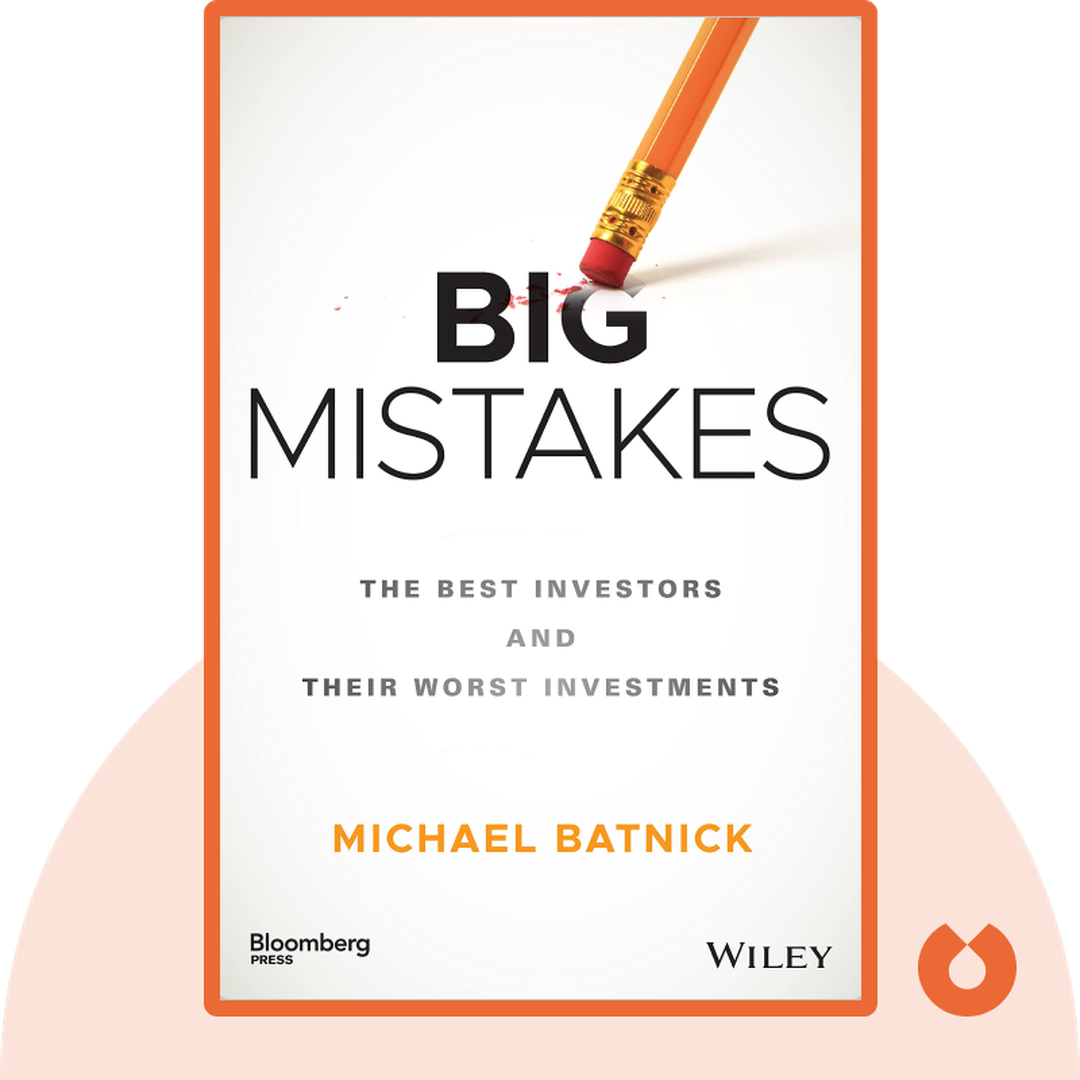
In Big Mistakes (2018), Michael Batnick runs through some of the world’s best-known investors and their high-profile slipups. More than just a catalog of blunders, this book also explains what each error can teach us about managing our own portfolios.
Who Should Listen to Big Mistakes?
- Fledgling investors
- Those fascinated by great investors
- People interested in US investment history
Books Similar to Big Mistakes
Readers who enjoyed this also liked these titles.