Theme Song
If You're Curious About These Questions...
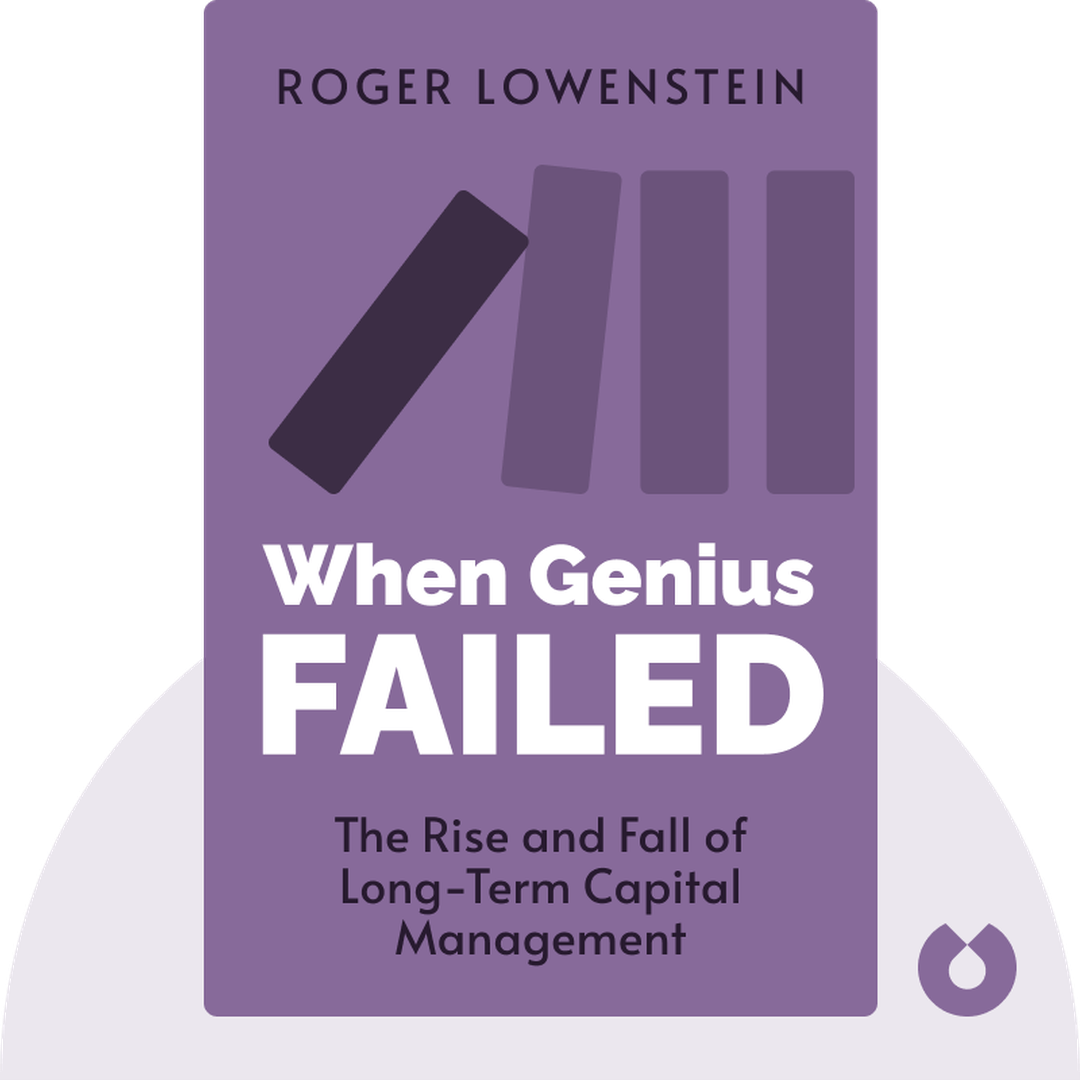
You should listen to this audiobook
- Did you know that a fund run by Nobel Prize-winning geniuses and the ‘kings’ of Wall Street managed to lose nearly $5 billion in just a few weeks?
- Have you ever wondered why even the most advanced mathematical risk models can fail to account for the one thing that drives every market: human behavior?
- Are you curious about how the collapse of a single investment firm nearly brought the entire global financial system to its knees?
Listen to When Genius Failed — Cinematic Audio Edition
Loading player...
Key Takeaways from When Genius Failed
- Discover why the spectacular rise and fall of Long-Term Capital Management serves as a modern Icarus tale, proving that no amount of expertise can cheat the market.
- Understand the mechanics of arbitrage, the core strategy LTCM used to profit from tiny, rapidly disappearing price discrepancies across financial markets.
- Learn how excessive leveraging allowed LTCM to borrow up to 30 times their capital, turning supposedly safe bets into massive financial hazards.
- Find out why relying strictly on academic theories and complex mathematical formulas from Nobel laureates failed to account for the irrational realities of trading.
- Recognize the dangers of blind trust in financial experts, as banks eagerly lent billions to a single hedge fund without ever evaluating its true economic vulnerabilities.
Learning Tools
Reinforce what you learned from When Genius Failed
Mind Map
When Genius Failed
Core Themes+
The LTCM Machine+
Fueling the Fire: Leverage+
The Cracks Appear (1997 Asian Crisis)+
The Black Swan (1998 Russian Default)+
The Bailout & Aftermath+
Quiz — Test Your Understanding
Question 1 of 7
What was Long-Term Capital Management's (LTCM) primary investment strategy?
Question 2 of 7
Why did LTCM rely so heavily on 'leveraging' (borrowing money)?
Question 3 of 7
How did LTCM's academic board members view the concept of financial risk?
Question 4 of 7
What was the fundamental flaw in the mathematical models used by LTCM?
Question 5 of 7
How did LTCM react during the 1997 Asian financial crisis when markets became uncertain?
Question 6 of 7
What unprecedented event in August 1998 triggered a mass market exodus that ultimately shattered LTCM's models?
Question 7 of 7
Why did the Federal Reserve step in to orchestrate a rescue of LTCM by a consortium of banks?
When Genius Failed — Full Chapter Overview
- 1Recommendation
- 2Long-Term Capital Management was a massive hedge fund that profited via arbitrage strategies worldwide.
- 3LTCM borrowed aggressively to amplify and maximize its profits.
- 4LTCM infused academic expertise into investment banking.
- 5Hedge funds boomed throughout the 1990s, yet LTCM surpassed them all in its success by far.
- 6LTCM’s models urged them to pursue risk during the 1997 Asian crisis with conviction.
- 7The true decline started when the models failed.
- 8LTCM’s final weeks of independence were defined by events that, by LTCM’s reckoning, seemed nearly impossible.
- 9Ultimately, fears of a broad financial crisis after LTCM’s potential collapse prompted a coordinated effort to rescue the fund entirely.
When Genius Failed Summary & Overview
When Genius Failed (2001) follows the rise and fall of Long-Term Capital Management, the world’s largest ever investment fund. The book reveals uncomfortable truths about the nature of investment and the fragility of the models we use to assess risk.
Who Should Listen to When Genius Failed?
- Anyone interested or working in investment banking
- Anyone interested in risk calculation
- Anyone thinking about investing in a hedge fund
Books Similar to When Genius Failed
Readers who enjoyed this also liked these titles.