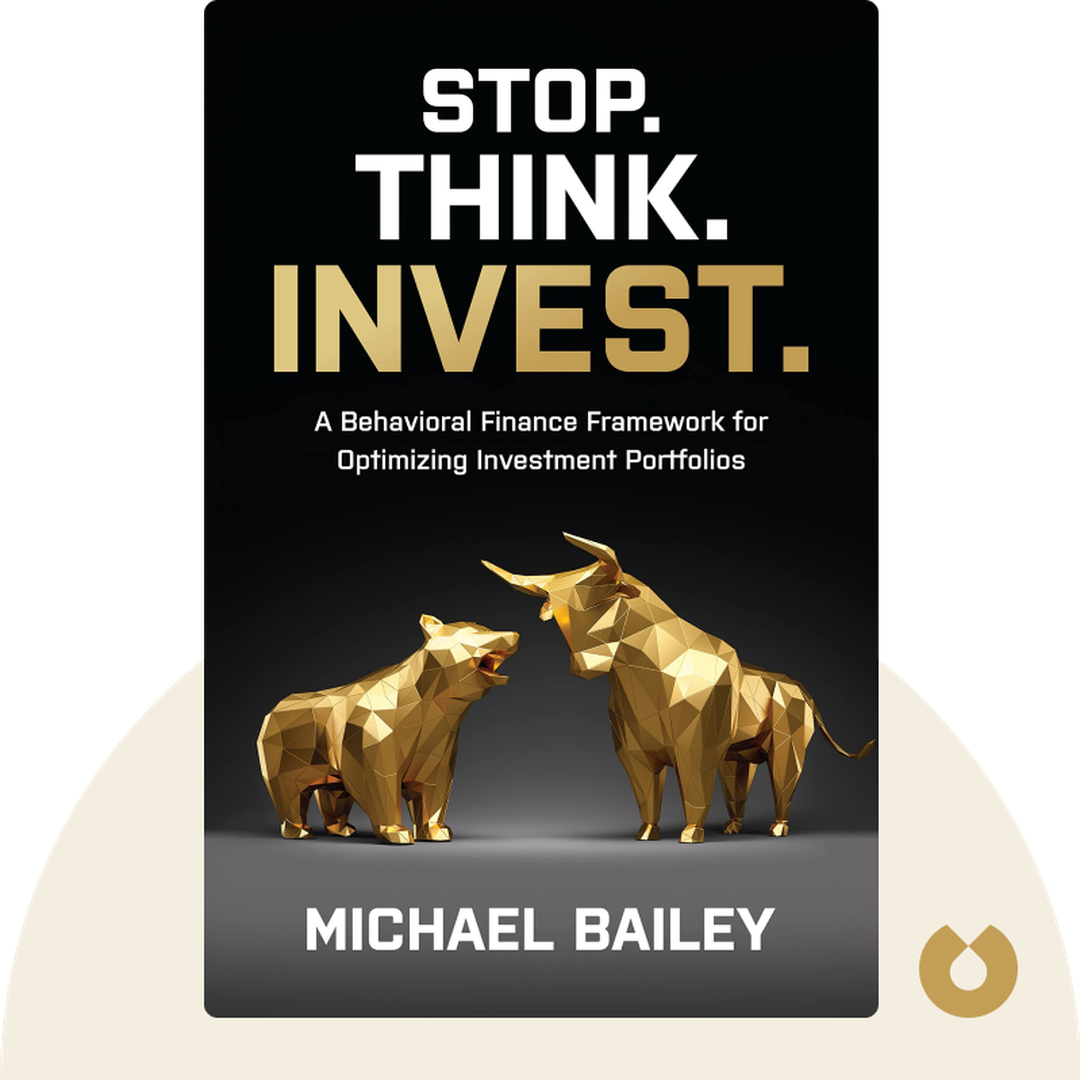
If You're Curious About These Questions...
You should listen to this audiobook
- Did you know that your own brain might be your biggest obstacle to financial success?
- Have you ever wondered why even experienced investors consistently fall for the same psychological traps?
- What if you could master the hidden behavioral triggers that dictate whether you win or lose in the market?
Listen to Stop. Think. Invest. — Free Audiobook
Loading player...
Key Takeaways from Stop. Think. Invest.
- Understand how behavioral economics reveals the hidden emotions and cognitive biases that can blind you to obvious warning signs in your investments.
- Learn how to overcome the paradox of choice by combining open-minded libertarianism with focused paternalism to effectively narrow down your options.
- Discover why seeking out companies undergoing secular change, such as new management or product launches, can help you identify stocks that outperform the market.
- Master the difference between System 1 autopilot thinking and System 2 focused thinking to conduct deep, bias-free investment research.
- Find out how applying a 12-step stock-picking process rooted in cognitive behavioral coaching can help you avoid the fatal pitfalls that sink even seasoned investors.
Learning Tools
Reinforce what you learned from Stop. Think. Invest.
Mind Map
Stop. Think. Invest.
Behavioral Economics Foundation+
Idea Generation+
Unbiased Research+
Essential Investment Tools+
Monitoring Investments+
Selling & Continuous Improvement+
Quiz — Test Your Understanding
Question 1 of 9
According to the book, why did many investors stubbornly hold onto General Electric (GE) stock between 2015 and 2018 despite obvious warning signs?
Question 2 of 9
How does the concept of 'libertarian paternalism' apply to the initial stage of seeking new investment ideas?
Question 3 of 9
What does author Michael Bailey mean when he suggests looking for 'secular change' to find stocks that can outperform the market?
Question 4 of 9
Which of the following best describes 'System 2' thinking in the context of investment research?
Question 5 of 9
According to behavioral economics, how do people generally experience the psychological impact of financial losses compared to gains?
Question 6 of 9
When crafting an investment thesis, why does Bailey recommend creating a 'three-legged stool'?
Question 7 of 9
What is a common behavioral pitfall of large investment committees, and how can it be mitigated?
Question 8 of 9
In the context of knowing when to sell a stock, what does the behavioral trap of 'anchoring' refer to?
Question 9 of 9
Which of the following is NOT one of the four questions Nobel laureate Richard Thaler recommends asking when researching a company?
Stop. Think. Invest. — Full Chapter Overview
- 1Recommendation
- 2Behavioral economics can help you make smarter investment decisions.
- 3Trim your choices using a balanced blend of libertarian and paternal approaches.
- 4Counter your biases by providing yourself a range of varied options.
- 5Two powerful tools for smarter investing are an investment thesis and an investment committee.
- 6Don’t let outside pressures like media noise drive you to sell too early.
- 7Learn from wins and missteps by embracing a truly growth-focused mindset.
Stop. Think. Invest. Summary & Overview
Stop. Think. Invest. (2022) takes a look at behavioral economics, a field of study that explores the roles of human emotion and behavior in financial decision-making. It examines how people’s unconscious biases and inherent aversions influence their decisions in every aspect of the investment process.
Who Should Listen to Stop. Think. Invest.?
- Anyone curious about the field of behavioral economics
- Investors who’d like to make better decisions
- Would-be financiers interested in making their first investment
Books Similar to Stop. Think. Invest.
Readers who enjoyed this also liked these titles.