If You're Curious About These Questions...
You should listen to this audiobook
- Did you know that one of history’s most peaceful icons actually began his journey as a rebellious youth struggling with deep personal secrets and moral failures?
- What is the secret behind a philosophy of 'truth' so powerful that it could challenge the world's greatest empire without firing a single shot?
- Have you ever wondered how a shy, self-doubting lawyer transformed himself into a leader of millions through a series of radical personal experiments?
Listen to An Autobiography — Free Audiobook
Loading player...
Key Takeaways from An Autobiography
- Discover how Gandhi's world-changing philosophy of Truth and nonviolence evolved from his relatable early struggles as a shy, inexperienced lawyer and a rebellious teenager.
- Learn how a humble upbringing steeped in religious tolerance and the early guiding principle of responding to evil with goodness forged Gandhi's incorruptible moral compass.
- Understand why Gandhi viewed vegetarianism as the first critical step toward attaining Truth after overcoming a guilt-ridden teenage phase of meat-eating and rebellion.
- Find out how Gandhi's deep personal regrets over teenage lust, jealousy, and neglecting his dying father fueled his lifelong dedication to spiritual discipline.
- Explore the remarkable resolve Gandhi demonstrated as a young man by defying his caste's threat of expulsion to study law in England while honoring strict personal vows.
Learning Tools
Reinforce what you learned from An Autobiography
Mind Map
An Autobiography
Early Life & Foundations+
Teenage Rebellion+
Education in London+
Awakening in South Africa+
Core Philosophies+
Activism & Leadership+
The Indian Independence Movement+
Personal Habits for Success+
Quiz — Test Your Understanding
Question 1 of 10
What important guiding principle did Gandhi adopt early in his life from his Gujarati community?
Question 2 of 10
During his teenage years, why did Gandhi temporarily abandon his family's vegetarian practices to eat meat?
Question 3 of 10
How did Gandhi's caste react to his decision to travel to England to study law?
Question 4 of 10
What major obstacle did Gandhi face when he first tried to present a case in court as a young lawyer in Bombay?
Question 5 of 10
According to Gandhi's belief in ahimsa (nonviolence), why is it acceptable to attack a system but never a person?
Question 6 of 10
In 1906, Gandhi took the vow of brahmacharya, or celibacy. What was his primary motivation for this decision?
Question 7 of 10
What discriminatory legislation in South Africa prompted Gandhi to launch his new method of nonviolent resistance known as satyagraha?
Question 8 of 10
What was the tinkathia system that Gandhi successfully fought against upon returning to India?
Question 9 of 10
Why did Gandhi suspend the satyagraha protest against the Rowlatt Act and go on a five-day fast?
Question 10 of 10
As part of the noncooperation movement and boycott of British institutions and products, what did Gandhi advocate that Indians do?
An Autobiography — Full Chapter Overview
- 1Recommendation
- 2Born into India’s merchant caste in Porbandar, Gandhi entered a child marriage at age 13.
- 3As a teenager, Gandhi went through a rebellious phase marked by jealousy and lust.
- 4Despite his caste’s disapproval, Gandhi traveled to England to study law.
- 5Seeking professional experience, Gandhi went to South Africa and witnessed racism firsthand.
- 6Alongside his legal work, Gandhi devoted himself to public service and religious study.
- 7Before bringing his message of equality to India, Gandhi continued his work in Natal, southern Africa.
- 8After aiding the wounded in the Boer War, Gandhi remained humble and well-informed in India.
- 9Gandhi dedicated himself to both nonviolence and celibacy.
- 10Gandhi kept fighting for Indians in South Africa and introduced a new form of nonviolent resistance.
- 11At the start of World War I, Gandhi returned to India and continued battling injustice.
- 12Gandhi paused satyagraha when it sparked violence, but his noncooperation resolution eventually passed.
- 13Final summary
An Autobiography Summary & Overview
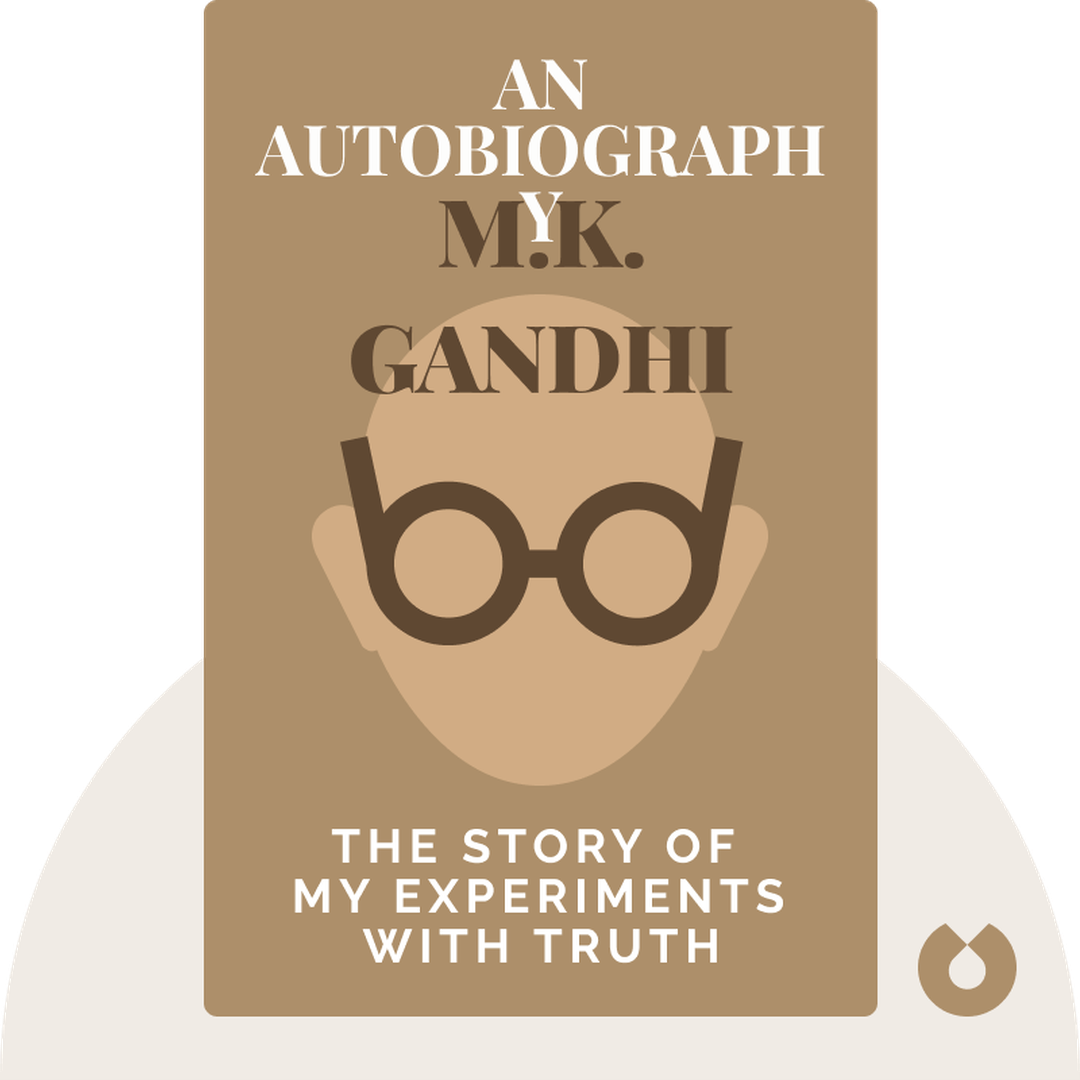
An Autobiography (First published in two volumes; Volume 1, 1927, and Volume 2, 1929) is the autobiography of one of the world’s most famous political icons – Mohandas Karamchand Gandhi. The book traverses his rebellious childhood, his early activism in South Africa and his work for the Indian Independence Movement up until 1920, and gives insight into Gandhi’s personal philosophy and his lifelong quest for Truth.
Who Should Listen to An Autobiography?
- Anyone interested in Gandhi’s life and personal philosophy
- Students of history and political science
- People cultivating leadership skills
Books Similar to An Autobiography
Readers who enjoyed this also liked these titles.