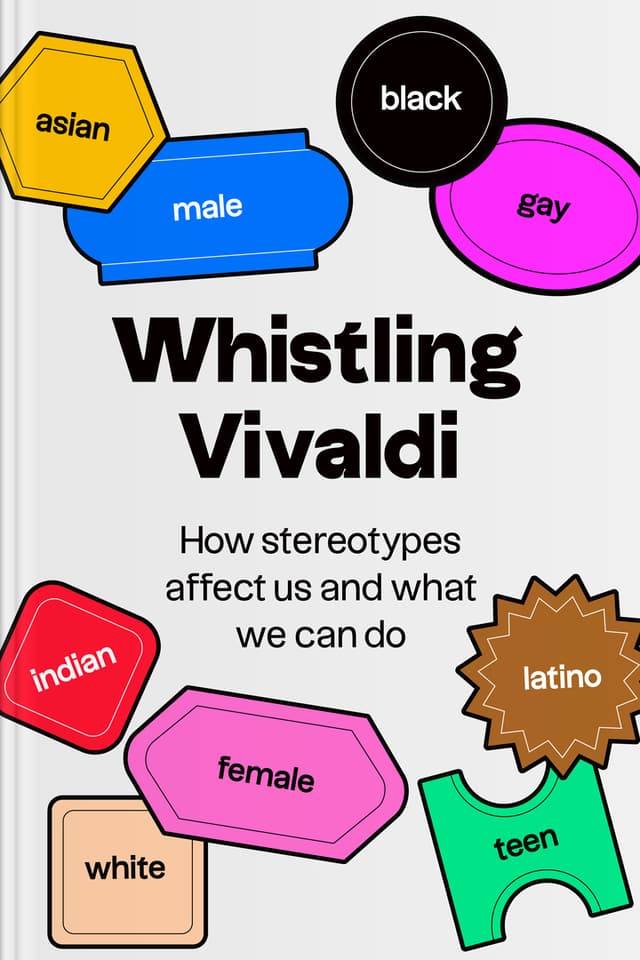
If You're Curious About These Questions...
You should listen to this audiobook
- Have you ever wondered why highly skilled people sometimes underperform in high-stakes moments, even when they’re perfectly prepared?
- Did you know that subtle "identity contingencies" in your environment could be draining your mental energy without you ever realizing it?
- What if you could transform a workplace or classroom into a space where everyone feels safe to excel, simply by understanding the hidden mechanics of stereotype threat?
Listen to Whistling Vivaldi
What You'll Learn from Whistling Vivaldi
- — Seeing Beyond Old Stories
- — The Hidden Rules of Belonging
- — Looking Past the Surface
- — What Happens When Someone Is the Only One
- — The Quiet Work of Anxiety
Whistling Vivaldi Chapter Overview
Chapter 1: AudiobookHub Recommendation
Chapter 2: — Seeing Beyond Old Stories
Chapter 3: — The Hidden Rules of Belonging
Chapter 4: — Looking Past the Surface
Chapter 5: — What Happens When Someone Is the Only One
Chapter 6: — The Quiet Work of Anxiety
Chapter 7: — When Caution Turns Into Distance
Chapter 8: — Learning, Unlearning, and Making Room for Everyone
About Whistling Vivaldi
This narration walks through how social identity—race, gender, age, and other group memberships—can create hidden pressures in everyday life. These pressures are not always loud or obvious; often they appear as worry, self-monitoring, or a sense of not belonging, and they can affect learning, relationships, and performance.
Drawing on memorable stories and observations associated with Claude M. Steele’s work on stereotype threat and identity contingencies, the script offers a compassionate lens: it doesn’t blame individuals for struggling under pressure. Instead, it helps listeners notice the situations that amplify threat, and it points toward shared responsibility—creating environments where people are seen for skill, character, and humanity first.
Who Should Listen to Whistling Vivaldi
- Listeners who want to understand how stereotypes can shape confidence and performance, even when no one intends harm
- Educators, managers, and mentors who want to reduce anxiety and increase belonging in classrooms and workplaces
- Anyone who has felt “out of place” because of identity—and wants language and tools to navigate it with more ease
More Books Like Whistling Vivaldi
Readers who enjoyed this also liked these titles.
In the cheerful suburbs of Victorian London, Charles Pooter records every scrape, social slight, and household triumph—only to discover that the smallest mishaps can feel like public catastrophes, and that respectability is a comedy best performed in earnest.

Born from the rivalries of ancient Chinese states and sharpened by hard-won experience, this concise treatise turns war into a study of mind, timing, and advantage—teaching how to prevail through discipline, deception, and superior strategy rather than brute force alone.

In sunlit Florence and buttoned-up England, young Lucy Honeychurch discovers that a “room with a view” is more than a hotel preference—it is a challenge to inherited propriety, awakening desire, and the risk of living truthfully.

The Unmentionable World of Human Waste and Why It Matters