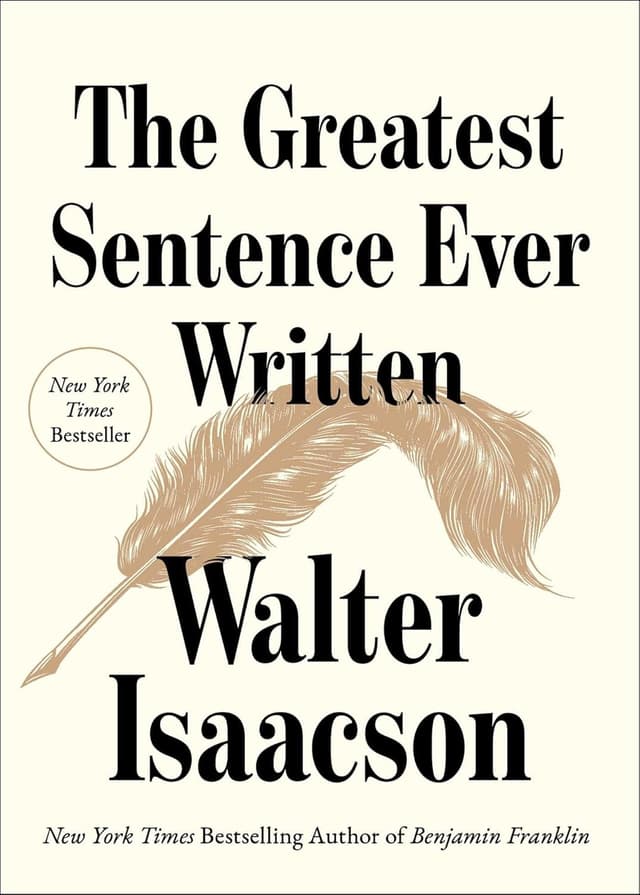
If You're Curious About These Questions...
You should listen to this audiobook
- Did you know that a single, last-minute edit by Benjamin Franklin shifted the foundation of America's most famous sentence from a religious sermon to a scientific argument?
- What if you discovered that the most revolutionary part of the Declaration of Independence is actually a tiny, two-letter word that completely redefined who holds power over your life today?
- Have you ever wondered what the Founders actually meant by 'created equal,' considering they fully knew that people aren't born with the same talents, strengths, or luck?
Listen to The Greatest Sentence Ever Written
What You'll Learn from The Greatest Sentence Ever Written
- The Ink That Changed a Nation
- “We” Before Anything Else
- The Meaning of “Self-Evident”
- The Limits Hidden in “All Men”
- Equality, and the Founding Contradiction
The Greatest Sentence Ever Written Chapter Overview
Chapter 1: AudiobookHub Recommendation
Chapter 2: The Ink That Changed a Nation
Chapter 3: “We” Before Anything Else
Chapter 4: The Meaning of “Self-Evident”
Chapter 5: The Limits Hidden in “All Men”
Chapter 6: Equality, and the Founding Contradiction
Chapter 7: Creator, Deism, and the Art of Balance
Chapter 8: “Unalienable” Rights and the Pursuit of Happiness
Chapter 9: Common Ground and the Commons
Chapter 10: The American Dream, Polarization, and Hanging Together
About The Greatest Sentence Ever Written
Walter Isaacson builds an entire, vivid guided tour around one line in the Declaration of Independence: “We hold these truths to be self-evident…” He starts inside Jefferson’s Market Street lodgings, where the draft is written, then shows how Franklin and Adams reshape it—swapping “sacred” for “self-evident,” and tightening Jefferson’s logic into unforgettable rhythm.
From there, the book unpacks each phrase as both philosophy and fuel: the Enlightenment roots of social contract theory; the meaning of “self-evident” as a claim about reason; the explosive promise—and original exclusions—inside “all men”; and the moral contradiction of slavery that haunted the Founding. Isaacson then carries the sentence forward into modern America, arguing that its core ideals—common ground and the pursuit of happiness—still offer a framework for repairing polarization, protecting opportunity, and renewing democracy.
Who Should Listen to The Greatest Sentence Ever Written
- Listeners who want a fast, story-driven understanding of the Declaration’s key sentence and why each word matters.
- Anyone interested in Enlightenment ideas—Locke, Hume, Rousseau—and how philosophy becomes political action.
- People wrestling with modern polarization who want a values-based lens for debates about equality, opportunity, and the “commons.”
More Books Like The Greatest Sentence Ever Written
Readers who enjoyed this also liked these titles.

How New Managers Become Successful Managers

Building a Better World for All

A Memoir

In the green seclusion of Hardy’s Wessex, a country girl’s beauty and pride collide with class illusion, sexual hypocrisy, and implacable chance—until Tess’s struggle for dignity tests what “purity” and justice can possibly mean in her world.