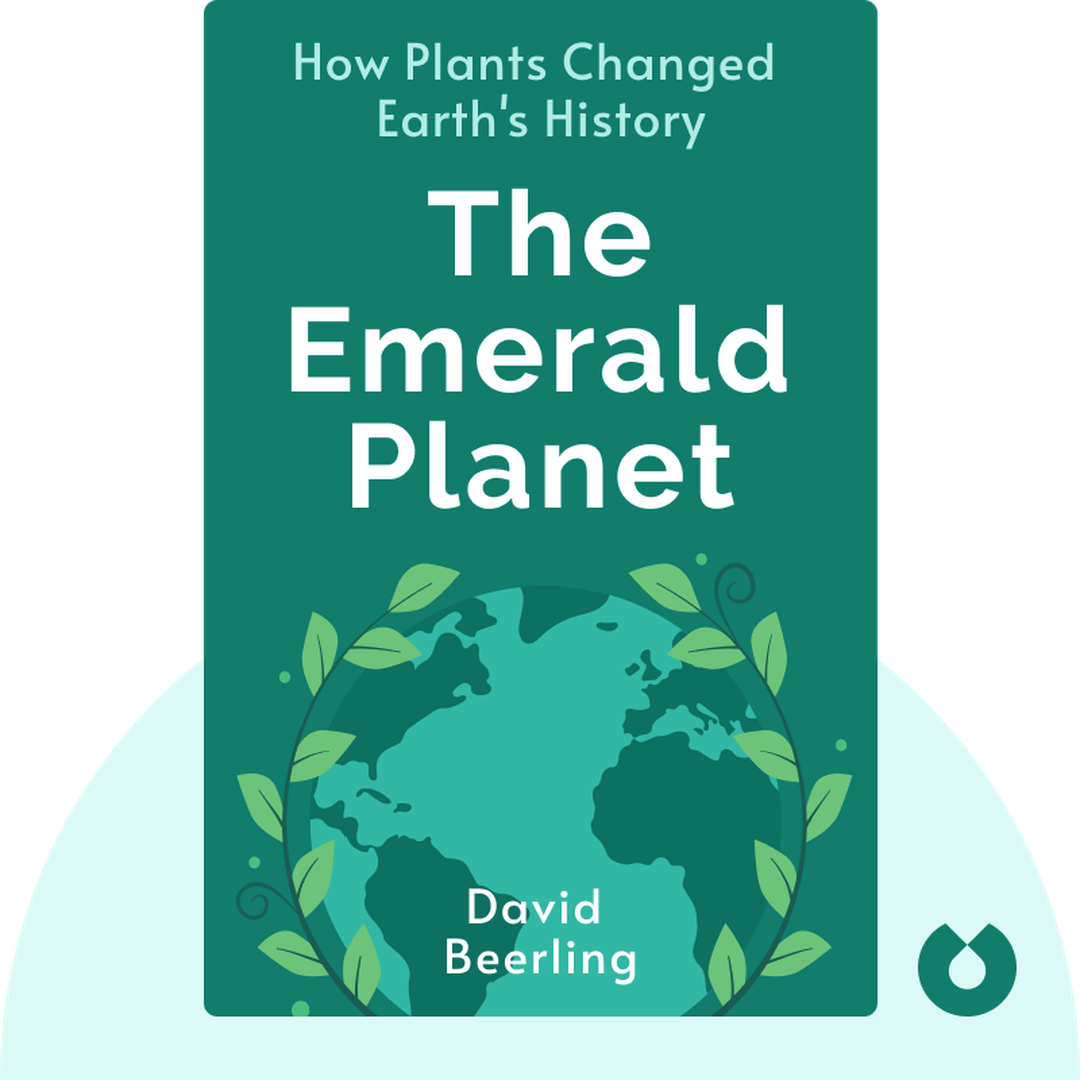
If You're Curious About These Questions...
You should listen to this audiobook
- Did you know that the evolution of simple leaves actually triggered a massive, planet-wide shift in Earth's climate?
- Have you ever wondered how fossilized plants can act as a 'time machine' to reveal the true causes behind our planet's greatest mass extinctions?
- Are you curious about how the hidden power of plants has actually dictated the course of animal evolution and the very air we breathe today?
Listen to The Emerald Planet — Free Audiobook
Loading player...
Key Takeaways from The Emerald Planet
- Discover how studying the interconnected prehistoric history of plants, animals, and the climate prepares us to tackle our current environmental crises.
- Learn how a massive drop in atmospheric carbon dioxide 375 million years ago forced plants to develop larger leaves, paving the way for an evolutionary boom in animal species.
- Understand how plants actively manipulate the planet's long-term carbon cycle by adjusting their microscopic leaf pores in response to changing atmospheric conditions.
- Find out why a massive spike in oxygen levels and atmospheric pressure 300 million years ago led to the supersized growth of ancient plants and giant insects.
- Explore how the destruction of the stratospheric ozone layer 250 million years ago caused history's largest mass extinction and triggered rapid genetic mutations in surviving plants.
Learning Tools
Reinforce what you learned from The Emerald Planet
Mind Map
The Emerald Planet
Leaves & CO2 (375M years ago)+
Oxygen & Gigantism (300M years ago)+
Ozone & Mass Extinction (250M years ago)+
Global Warming & Dinosaurs (200M years ago)+
Deciduous Polar Forests+
Greenhouse Hothouse (50M years ago)+
C4 Photosynthesis (30M years ago)+
Quiz — Test Your Understanding
Question 1 of 7
Why did plants evolve to have larger leaves approximately 375 million years ago?
Question 2 of 7
What environmental factor primarily contributed to the supersizing of insects and plants during the Carboniferous Period?
Question 3 of 7
During the Permian mass extinction, how did lycopsids manage to survive and colonize new ground while other plants died out?
Question 4 of 7
What evidence from plant fossils collected in Greenland pointed to global warming as the cause of the late-Triassic extinction?
Question 5 of 7
Why did deciduous trees outcompete evergreen trees in ancient northern polar forests?
Question 6 of 7
What do scientists now believe was the primary cause of the extremely mild polar temperatures 50 million years ago?
Question 7 of 7
What evolutionary advantage do C4 plants have over C3 plants in low carbon dioxide environments?
The Emerald Planet — Full Chapter Overview
- 1Recommendation
- 2Plants evolved leaves to cope with declining carbon dioxide levels, which in turn kick-started long-term animal and insect evolution.
- 3A surge in oxygen levels enlarged all living organisms.
- 4Destruction of the ozone layer triggered mass extinctions for some and genetic mutations for others.
- 5Rising CO2 levels drove global temperatures higher, which caused ancient life to vanish and then dinosaurs to flourish.
- 6Deciduous trees ruled northern polar forests by growing rapidly and then eventually dying young.
- 7Fifty million years ago, greenhouse gases warmed the Earth’s surface, producing a climate vastly different from today’s climate.
- 8An alternative photosynthesis method lets some plants thrive even when CO2 levels are low.
The Emerald Planet Summary & Overview
The Emerald Planet (2007) looks at the central role plants have played in shaping the planet and its environment. New research makes use of plants, both fossilized and living, to explain how the planet got where it is, and where it might go in the future. The Emerald Planet inspired a three-part BBC series called How to Grow a Planet.
Who Should Listen to The Emerald Planet?
- Anyone interested in plant biology and paleobotany
- People who want to learn more about ancient mass extinctions
- Evolutionary science enthusiasts
Books Similar to The Emerald Planet
Readers who enjoyed this also liked these titles.