If You're Curious About These Questions...
You should listen to this audiobook
- Did you know that plants have been subtly manipulating humans and animals for millennia to ensure their own survival?
- Have you ever wondered what makes a seed so incredibly resilient that it can wait centuries for the perfect moment to sprout?
- What’s the secret behind how these tiny packages of life managed to conquer the Earth and fundamentally change the course of human history?
Listen to The Triumph of Seeds — Free Audiobook
Loading player...
Key Takeaways from The Triumph of Seeds
- Discover how seed plants came to dominate the plant world and seamlessly weave their way into our everyday lives, from the cotton in our sheets to the coffee in our cups.
- Understand the universal three-part anatomy of every seed—an embryo, nutrient tissue, and a protective coat—and why water is the critical trigger required to spark germination.
- Learn how plants evolved from water-dependent spores to highly adaptable seeds by transforming sperm into wind-carried pollen and encasing eggs in hard shells to conquer dry climates.
- Find out how seeds can survive for centuries in a state of dormancy, exemplified by a 2,000-year-old date seed that successfully sprouted into a healthy tree after being unearthed by archaeologists.
- Explore the evolutionary balancing act seeds perform by developing shells just thick enough to deter immediate consumption, yet attractive enough to trick unwitting rodents into burying and dispersing them.
Learning Tools
Reinforce what you learned from The Triumph of Seeds
Mind Map
The Triumph of Seeds
Anatomy & Germination+
Evolutionary Origins+
Dormancy & Longevity+
Defense & Dispersal+
The Human Connection+
Quiz — Test Your Understanding
Question 1 of 6
According to the text, what are the three fundamental parts of every seed?
Question 2 of 6
Why did plants evolve to produce seeds instead of relying solely on spores for reproduction?
Question 3 of 6
What does the story of the "Methuselah" date tree demonstrate about the nature of seeds?
Question 4 of 6
How do plants use their seeds' protective coats to solve the "evolutionary dilemma" posed by rodents?
Question 5 of 6
According to the text, what is the primary evolutionary purpose of the sweet scents and flavors of fruits like apples and cherries?
Question 6 of 6
While genetically engineered seedless fruits offer convenience to consumers, what is a major drawback mentioned regarding their agricultural impact?
The Triumph of Seeds — Full Chapter Overview
- 1Recommendation
- 2Every seed contains three parts and, although their development differs, all seeds fundamentally rely on water to begin growth.
- 3Seeds arose from spores to solve reproductive challenges and better adjust to arid climates.
- 4All seeds perish, yet some can remain dormant for years, even for many centuries.
- 5Seeds evolved to protect and spread themselves, often with help from unsuspecting creatures.
- 6Many seeds spread and travel thanks to fruits that entice animals and humans alike.
- 7Manipulating seeds to aid companies and consumers brings some questionable consequences too.
The Triumph of Seeds Summary & Overview
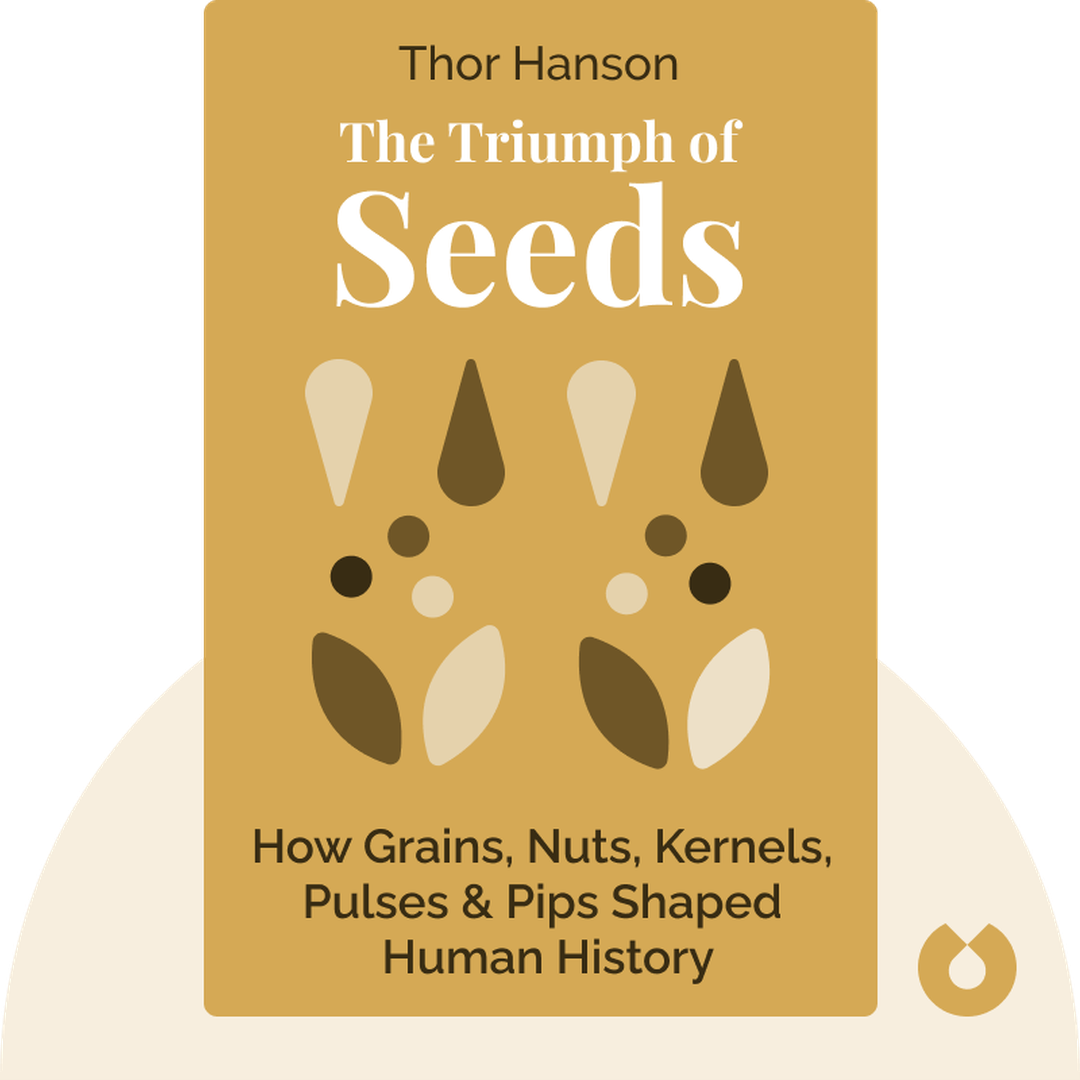
The Triumph of Seeds (2015) tells the amazing story of the influence of seeds. Find out how plants have managed to endure and evolve over the course of Earth’s long history and how they manipulated both man and animal into doing their bidding.
Who Should Listen to The Triumph of Seeds?
- Students of biology, ecology or agriculture
- Botanists
- Readers who love natural science or gardening
Books Similar to The Triumph of Seeds
Readers who enjoyed this also liked these titles.