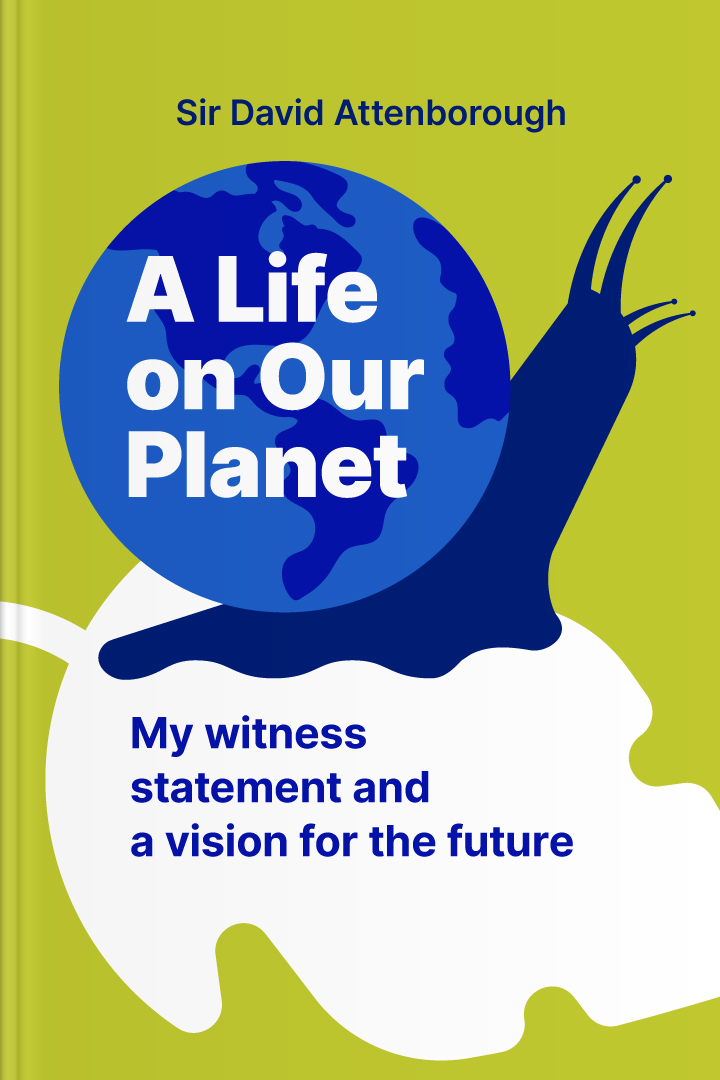
A Life on Our Planet audiobook cover - In a changing world, biodiversity is more than beauty—it is the living system that steadies climate, feeds communities, and protects the future, and this gentle journey explores how everyday choices and bold collective action can help restore balance.
Theme Song

A Life on Our Planet

In a changing world, biodiversity is more than beauty—it is the living system that steadies climate, feeds communities, and protects the future, and this gentle journey explores how everyday choices and bold collective action can help restore balance.

Sir David Attenborough

4.0 / 5(3 ratings)
Start ListeningDownloadQR code that opens AudiobookHub on the App StoreTry free on iPhoneScan to start in 5 seconds

If You're Curious About These Questions...

You should listen to this audiobook

Listen to A Life on Our Planet — Free Audiobook

Loading player...

Key Takeaways from A Life on Our Planet

Learning Tools

Reinforce what you learned from A Life on Our Planet

Mind Map

A Life on Our Planet
The Problem: Environmental Decline+
The Future: The Great Decline+
Solution 1: Population & Equality+
Solution 2: Rewilding the World+
Solution 3: Clean Energy & Lifestyle+

Quiz — Test Your Understanding

Question 1 of 10
According to the book, what was a key factor in creating the stable climate of the Holocene epoch, which allowed human societies to flourish?
  • A. A decrease in global volcanic activity.
  • B. The development of early, widespread human agriculture.
  • C. Biodiversity, with many living systems acting together to regulate the planet's climate.
  • D. The end of the last Ice Age, which made fresh water more available.
Question 2 of 10
What fundamental shift did David Attenborough want to introduce to natural history programming early in his career?
  • A. To focus exclusively on endangered species to raise awareness.
  • B. To use animation to explain complex biological processes.
  • C. To show animals in their natural habitats rather than in a contrived studio setting.
  • D. To have zookeepers, rather than producers, present the shows.
Question 3 of 10
What event was described as a 'turning point' in shifting public perception of whales from a resource to intelligent beings worth protecting?
  • A. The discovery that whales help circulate ocean nutrients.
  • B. An episode of 'Life on Earth' showing the intelligence of dolphins and whales.
  • C. The release of vinyl records containing the 'songs' of humpback whales.
  • D. The establishment of international whale sanctuaries.
Question 4 of 10
How does the book describe the concept of the nine 'planetary boundaries'?
  • A. As a prophecy predicting the exact dates of ecological collapse.
  • B. As a legal framework for prosecuting environmental crimes.
  • C. As a ranking system to compare the environmental performance of different countries.
  • D. As guardrails that show the thresholds beyond which Earth's systems may fail.
Question 5 of 10
What specific action regarding the ocean does the book suggest is vital for allowing marine ecosystems to recover?
  • A. Banning all aquaculture and fish farming globally.
  • B. Creating no-fishing zones that cover about one-third (33%) of the ocean.
  • C. Focusing conservation efforts only on coral reefs.
  • D. Introducing new, non-native fish species to depleted areas.
Question 6 of 10
The book states that over 75% of farmlands are used for a specific purpose. What is it?
  • A. Growing grains for human consumption.
  • B. Cultivating fruits and vegetables.
  • C. Meat and dairy production, including land for animal feed.
  • D. Producing biofuels like corn ethanol.
Question 7 of 10
What is the fundamental problem the book identifies with the phrase 'throw away'?
  • A. It makes recycling seem less important than it is.
  • B. It ignores the economic cost of landfill management.
  • C. It creates the illusion that waste disappears, when 'away' doesn't truly exist on a finite planet.
  • D. It discourages the creation of durable, long-lasting products.
Question 8 of 10
The book proposes a 'win-win mindset' to replace the traditional focus on Gross Domestic Product (GDP). What does this new model prioritize?
  • A. Exclusively the speed of transition to renewable energy.
  • B. A balance of three principles: people, planet, and profit.
  • C. The total number of species protected from extinction each year.
  • D. A nation's self-sufficiency in food and energy production.
Question 9 of 10
Why is the country of Morocco presented as an example of 'steady hope' in the final chapter?
  • A. It successfully reversed desertification across large areas of the Sahara.
  • B. It created the largest tiger reserve outside of India.
  • C. It transformed its capital into a 'city within a garden' with 50% green space.
  • D. It shifted from 100% imported fossil fuels to generating almost half its electricity from renewables.
Question 10 of 10
How does Sir David Attenborough's quote, 'We moved from being a part of nature to being apart from nature,' summarize a key theme of the book?
  • A. It describes the human migration from rural areas to large cities.
  • B. It captures the psychological and practical separation of modern humanity from the ecosystems it depends on.
  • C. It refers to the scientific shift from studying whole ecosystems to studying individual species.
  • D. It explains why modern humans are physically weaker than their ancestors.

A Life on Our Planet — Full Chapter Overview

A Life on Our Planet Summary & Overview

This narration follows Sir David Attenborough’s clear, compassionate message: life on Earth is a web of relationships, and when that web frays—through habitat loss, climate change, pollution, and overuse—human life is affected right alongside wild nature. By looking back at the stability that allowed civilization to flourish, we can better understand what is at stake now.

Across these chapters, the story moves from the wonder and innovation of wildlife filmmaking to the hard evidence of planetary limits—and then, importantly, toward practical hope. The focus isn’t on blame. It’s on seeing what works: protecting oceans, restoring forests, shifting energy and food systems, reducing waste, and choosing a “win-win” model where human prosperity grows alongside nature’s recovery.

Who Should Listen to A Life on Our Planet?

  • Listeners who want a calm, motivating overview of why biodiversity and climate stability are tightly linked—and what that means for daily life.
  • Anyone who feels overwhelmed by environmental news and would benefit from a steady, solutions-focused perspective rooted in real-world examples.
  • Students, educators, and curious minds looking for an approachable, story-driven introduction to planetary boundaries, oceans, food systems, and sustainable habits.

About the Author: Sir David Attenborough

Sir David Attenborough is a renowned broadcaster and natural historian whose television work has helped generations experience wildlife more intimately—often by bringing audiences into animals’ natural habitats. Over decades of filmmaking, he has combined wonder with urgency, using storytelling to encourage deeper care for the living systems that support life on Earth.

🎧
Listen in the AppOffline playback & background play
Get App
A Life on Our PlanetTheme Song
NOW PLAYING
A Life on Our Planet

A Life on Our Planet

Theme Song
0:000:00