If You're Curious About These Questions...
You should listen to this audiobook
- How did the core tenets of postmodernism, originally embraced to expose government lies during Watergate, end up being weaponized to destroy objective truth in modern politics?
- In what surprising ways does the anti-immigrant and anti-reason platform of the 1855 Know Nothing Party mirror the populist movements of today?
- How do modern partisan media silos use confirmation bias to isolate their audiences, utilizing psychological tactics that closely resemble those of extremist networks?
Listen to The Death of Truth — Free Audiobook
Loading player...
Key Takeaways from The Death of Truth
- Discover how visionary writers like George Orwell and Philip Roth predicted the dangers of our current 'post-truth' era of fake news.
- Understand how modern political extremism traces its roots back to historical anti-progress movements like the 1850s Know Nothing Party.
- Learn how the internet and partisan media networks exploit confirmation bias to trap citizens inside dangerous, highly polarized ideological tribes.
- Find out how the postmodern concept of 'subjective reality' has been weaponized by politicians to debate objective facts and dismiss scientific evidence.
- See how those in power deliberately use falsehoods and alternative narratives to stoke working-class fears and scapegoat marginalized groups.
Learning Tools
Reinforce what you learned from The Death of Truth
Mind Map
The Death of Truth
Historical Opposition to Reason+
Media Landscape & Partisan Silos+
Weaponized Postmodernism+
Fake News & Digital Propaganda+
Trolling & Nihilistic Leadership+
Distraction & The New Nihilism+
Quiz — Test Your Understanding
Question 1 of 10
What historical political entity is cited as an early example of an organized movement against reason and progress in the United States?
Question 2 of 10
According to the book, how do contemporary movements opposing reason and progress compare to the supporters of the 1855 Know Nothing Party?
Question 3 of 10
What extreme analogy does the author use to describe the intense isolation and polarization of modern ideological online tribes?
Question 4 of 10
What historical events initially caused the American public to embrace the postmodern concept that truth and reality could be subjective?
Question 5 of 10
Which influential thinker noted that the ideal foundation for totalitarian rule is a population that can no longer distinguish between fact and fiction?
Question 6 of 10
What emotional triggers were recognized as being highly effective for making content go viral, setting the stage for the spread of fake news?
Question 7 of 10
How did the Russian Internet Research Agency primarily operate to disrupt the US political landscape prior to the 2016 election?
Question 8 of 10
How have leaders in countries like Syria and Myanmar internationally leveraged President Trump's rhetoric?
Question 9 of 10
What relevant warning did Neil Postman give in his 1985 book, 'Amusing Ourselves to Death'?
Question 10 of 10
According to a study by researchers Alice Marwick and Rebecca Lewis, what is a dangerous consequence of using racial slurs 'ironically' in online spaces?
The Death of Truth — Full Chapter Overview
- 1Recommendation
- 2Opposition to reason and progress has always existed, but it went mainstream in 2017.
- 3Despite the rise in information sources, the internet has built dangerous filters, silos and tribes.
- 4Postmodern theory and subjectivity are being used to fuel division and a self-serving agenda.
- 5Fake news is now a propaganda weapon, especially for Russian agents bent on disruption.
- 6Trump’s nihilistic, troll-like behavior, together with his lies and abuse of language, has dangerous effects.
- 7A new variety of nihilism is erupting across the United States.
The Death of Truth Summary & Overview
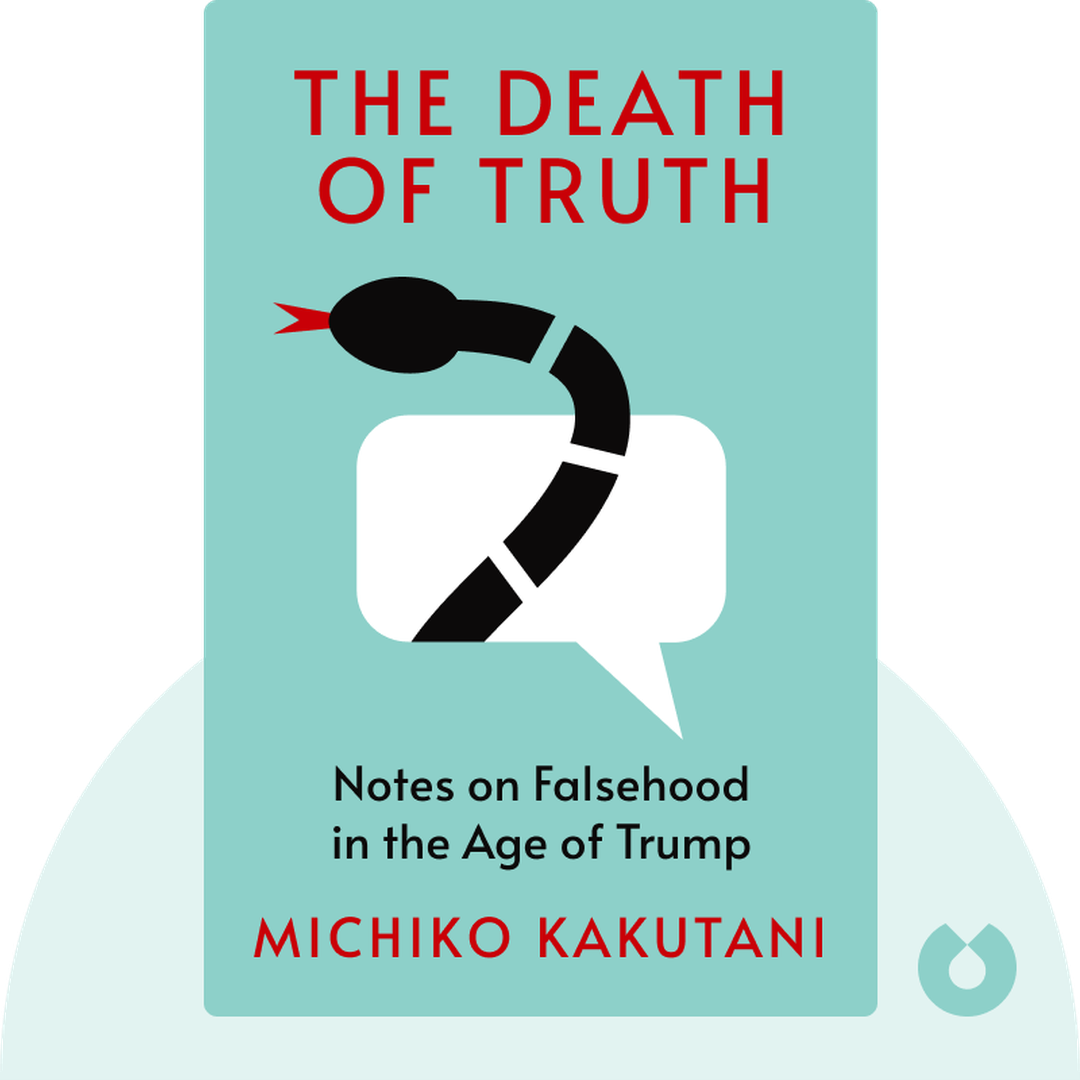
The Death of Truth (2018) offers an informative look at the current political climate in the United States, and the many developments in the past that have brought us to this divisive time. With over 30 years’ experience as a respected literary critic, Michiko Kakutani uses her expertise in modern literature to show how authors of the past worried about many of the same concerns we’re facing today.
Who Should Listen to The Death of Truth?
- Supporters of democracy
- News and political junkies
- Book lovers concerned about current affairs
Books Similar to The Death of Truth
Readers who enjoyed this also liked these titles.