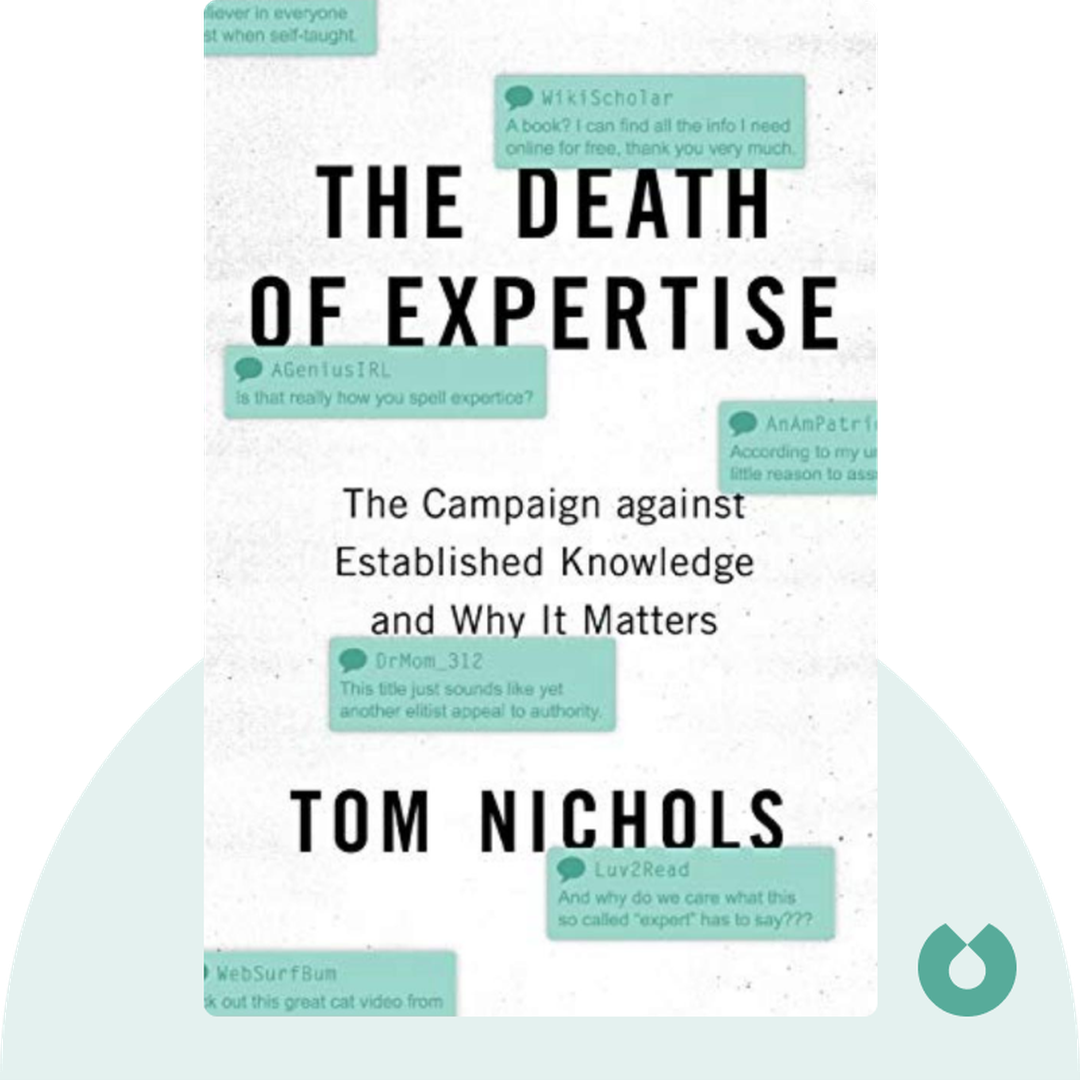
The Death of Expertise
Start ListeningDownload Try free on iPhoneScan to start in 5 seconds
Categories:
If You're Curious About These Questions...
You should listen to this audiobook
- Have you ever wondered why we’ve reached a point where a quick internet search is often valued more than decades of professional experience?
- Did you know that the democratization of information might actually be making it harder for us to tell the difference between a proven fact and a popular opinion?
- Are you curious about how political partisanship transformed objective science into a matter of personal belief?
Listen to The Death of Expertise — Cinematic Audio Edition
Loading player...
Key Takeaways from The Death of Expertise
- Discover how the rise of the internet has fueled dangerous conflicts between experts and laypeople by allowing anyone to find sources that validate their unscientific opinions.
- Understand the Dunning-Kruger effect and how a lack of self-awareness causes people with no formal training to confidently overestimate their actual knowledge.
- Learn how confirmation bias tricks everyone, from everyday internet users to highly trained medical doctors, into seeking out only the information that supports their pre-existing beliefs.
- Find out why treating higher education like a customer-focused business has led to massive grade inflation and a generation of overconfident graduates.
- Recognize the dangers of an unregulated digital landscape and why relying on the internet without rigorously double-checking facts can easily lead you astray.
Learning Tools
Reinforce what you learned from The Death of Expertise
Mind Map
The Death of Expertise
The Knowledge Crisis+
Psychological Biases+
Commodification of Education+
The Internet's Impact+
Decline of Journalism+
Fallibility of Experts+
Quiz — Test Your Understanding
Question 1 of 6
How has the internet primarily affected the relationship between experts and laypeople?
Question 2 of 6
According to the Dunning-Kruger effect, why do people with less skill at a task often fail to recognize their own incompetence?
Question 3 of 6
Which of the following best describes 'confirmation bias' as explained in the text?
Question 4 of 6
What is a major consequence of modern universities treating higher education as a 'product' and students as 'customers'?
Question 5 of 6
Why has the quality of modern journalism decreased with the rise of the internet, according to the book?
Question 6 of 6
According to the text, what is a common reason why established experts sometimes make significant and public errors?
The Death of Expertise — Full Chapter Overview
- 1Recommendation
- 2Disagreements about expertise aren’t new, but they have grown sharply in today’s connected internet age.
- 3Human tendencies can sometimes lead us to accept and believe flawed arguments.
- 4Higher education is now a product, leaving graduates no longer genuine experts.
- 5Don’t trust everything you read on the internet.
- 6Modern journalism leaves readers with a misleading sense of knowledge.
- 7Experts can be wrong, too.
The Death of Expertise Summary & Overview
The Death of Expertise (2017) examines the current attacks on science and knowledge that seem to be on the rise in our current technological and political environment. What has happened to objective truths being the truth and facts being indisputable? Why is science now a matter of political partisanship? Find out what’s really going on and why this is one of the most important issues of our day.
Who Should Listen to The Death of Expertise?
- Citizens looking for facts rather than political rhetoric
- Readers concerned about fake news and misinformation
- Students of political science and communications
Books Similar to The Death of Expertise
Readers who enjoyed this also liked these titles.