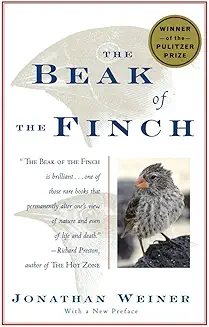
The Beak of the Finch: A Story of Evolution in Our Time audiobook cover - On a bare, cliff-walled speck of lava called Daphne Major, two scientists measure finch beaks year after year—until drought, flood, and chance collisions between species reveal that evolution isn’t just a fossil story; it’s happening fast enough to watch.

The Beak of the Finch: A Story of Evolution in Our Time

On a bare, cliff-walled speck of lava called Daphne Major, two scientists measure finch beaks year after year—until drought, flood, and chance collisions between species reveal that evolution isn’t just a fossil story; it’s happening fast enough to watch.

Jonathan Weiner

4.3 / 5(9 ratings)
Start ListeningDownloadQR code that opens AudiobookHub on the App StoreTry free on iPhoneScan to start in 5 seconds

If You're Curious About These Questions...

You should listen to this audiobook

Listen to The Beak of the Finch: A Story of Evolution in Our Time — Free Audiobook

Loading player...

Key Takeaways from The Beak of the Finch: A Story of Evolution in Our Time

Learning Tools

Reinforce what you learned from The Beak of the Finch: A Story of Evolution in Our Time

Mind Map

Oceanofpdf.Com The Beak Of The Finch Jonathan Weiner
The Grants' Quest & Darwin's Gap+
Island Ecology & Measurement+
Natural Selection & Evolution+
Oscillation & Speciation+
Modern Evolution & Human Impact+

Quiz — Test Your Understanding

Question 1 of 9
What was the primary goal of Peter and Rosemary Grant's decades-long study on Daphne Major?
  • A. To map the geographical distribution of all bird species in the Galapagos
  • B. To observe and measure natural selection and evolution happening in real time
  • C. To prove that Darwin's initial theory of evolution was fundamentally flawed
  • D. To introduce new finch species to the islands to test their adaptability
Question 2 of 9
Contrary to popular myth, what was Charles Darwin's initial experience with the Galapagos finches?
  • A. He immediately realized they were all finches and formulated the theory of evolution on the spot.
  • B. He meticulously cataloged every finch species by island to prove natural selection.
  • C. He collected them casually, mislabeled some, and didn't even realize they were all finches.
  • D. He ignored the finches entirely, focusing his evolutionary theories purely on tortoises.
Question 3 of 9
Why is the island of Daphne Major considered an ideal location for studying evolution?
  • A. It is small enough to census almost every bird, yet large enough for a meaningful sample size.
  • B. It possesses a perfectly stable climate, removing environmental variables.
  • C. It hosts the highest diversity of predators, accelerating survival of the fittest.
  • D. It is easily accessible from the mainland, allowing for daily lab equipment deliveries.
Question 4 of 9
Under what conditions do the minute, millimeter-scale differences in finch beak sizes become most critical to a bird's survival?
  • A. During wet, easy times when competition for mates is highest
  • B. When migrating to neighboring islands with different predator types
  • C. When conditions tighten, especially during dry seasons when only hard seeds are left
  • D. During volcanic eruptions that destroy nesting sites
Question 5 of 9
What measurable physical change occurred in the finch population that survived the severe 1977 drought?
  • A. The survivors developed longer wings to fly to other islands.
  • B. The survivors had, on average, bigger bodies and deeper beaks.
  • C. The survivors were mostly smaller birds with sharper, narrower beaks.
  • D. The survivors exhibited changes in plumage color to camouflage themselves.
Question 6 of 9
According to the book, what is the critical step required for natural selection to result in actual evolution?
  • A. The selected traits must be heritable so they are passed to the next generation.
  • B. The environmental pressure must last for at least a century.
  • C. Sexual selection must be entirely eliminated from the population.
  • D. The population must migrate to a completely new ecosystem.
Question 7 of 9
How does the concept of 'oscillating selection' explain why finch species can look stable over long periods of time?
  • A. Extreme environmental swings push traits in opposite directions over time, canceling out the changes on average.
  • B. Natural selection eventually stops acting on a species once it reaches its optimal form.
  • C. Gene mutations occur at a constant rate, stabilizing the physical appearance of the birds.
  • D. Predators selectively hunt the most extreme variations, keeping the population near the average.
Question 8 of 9
What surprising observation did the Grants make regarding finch hybridization?
  • A. Hybrids are completely sterile and quickly removed by natural selection.
  • B. Hybrid lineages can sometimes survive and flourish, challenging the idea of strict species boundaries.
  • C. Hybridization only occurs when different finch species are kept in captivity.
  • D. Hybrids slowly evolved into a single, uniform super-species across all the islands.
Question 9 of 9
The Grants' finch study serves as a model for understanding what modern, rapid evolutionary phenomenon?
  • A. The geological movement of tectonic plates shaping new continents
  • B. The genetic mapping of extinct species like dinosaurs
  • C. The rapid emergence of pesticide resistance in pests and antibiotic resistance in microbes
  • D. The slow decline of biodiversity in deep ocean trenches

The Beak of the Finch: A Story of Evolution in Our Time — Full Chapter Overview

The Beak of the Finch: A Story of Evolution in Our Time Summary & Overview

The Beak of the Finch is a narrative science book about evolution as an observable process, built around the long-term field research of Peter and Rosemary Grant on Darwin’s finches in the Galápagos. Jonathan Weiner follows their work on the island of Daphne Major, where every finch is banded, measured, and tracked across generations. When brutal droughts and explosive El Niño rains strike, tiny differences in beak shape become life-or-death advantages—producing measurable evolutionary shifts within years, not eons.

The book expands outward from finches to the broader machinery of natural selection: competition, sexual selection, hybridization, and the genetic “invisible characters” written in DNA. Along the way, it ties real-time evolution to modern problems—pesticide resistance, antibiotic resistance, climate variability—and shows how ecological shocks can speed up change. It’s a story about how science is done, why careful measurement matters, and what it means to live on a planet where “creation” never stops.

Who Should Listen to The Beak of the Finch: A Story of Evolution in Our Time?

  • Listeners who want a vivid, evidence-driven answer to “Where’s the proof of evolution?”
  • Students and general readers curious about Darwin’s finches, natural selection, speciation, and field biology.
  • Anyone interested in how climate swings, ecological disruption, and genetics shape evolution in real time.

About the Author: Jonathan Weiner

Jonathan Weiner is an American science writer and journalist. The Beak of the Finch won major awards including the Pulitzer Prize for General Nonfiction and helped popularize modern evolutionary biology through narrative reporting.

🎧
Listen in the AppOffline playback & background play
Get App