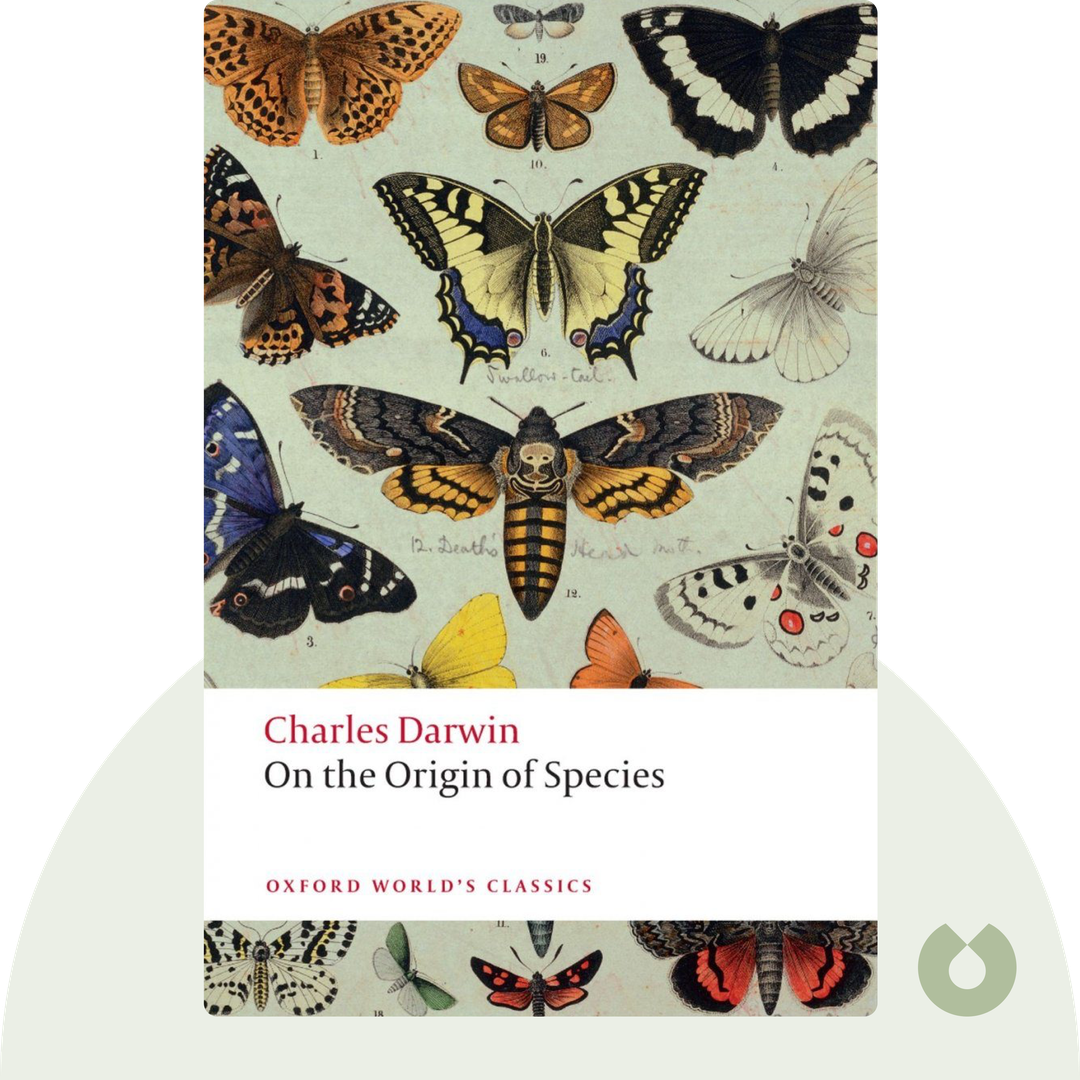
On the Origin of Species
Start ListeningDownload Try free on iPhoneScan to start in 5 seconds
Categories:
If You're Curious About These Questions...
You should listen to this audiobook
- Have you ever wondered how nature "chooses" which species flourish and which ones vanish forever?
- What if you could trace the lineage of every living creature on Earth back to a single, shared origin?
- Did you know that a tiny physical trait could be the secret to why some plants and animals thrive in the harshest environments while others fail?
Listen to On the Origin of Species — Free Audiobook
Loading player...
Key Takeaways from On the Origin of Species
- Discover how human-driven selective breeding transforms wild ancestors into diverse domestic breeds, such as creating pugs from mongrel dogs over multiple generations.
- Learn how natural selection acts as an invisible breeder by favoring organisms with advantageous traits, allowing them to survive, reproduce, and evolve into entirely new species.
- Find out why sexual selection plays a critical role in evolution by establishing variations based purely on mate attraction, such as the distinct wattle of a male turkey.
- Understand how the struggle for resources drives species to diversify into new environments, transforming single lineages into distinct, habitat-adapted animals like otters and sloths.
- Explore the complex web of coexistence that naturally balances populations, ensuring that ecosystems thrive while species that fail to adapt eventually go extinct.
Learning Tools
Reinforce what you learned from On the Origin of Species
Mind Map
On the Origin of Species
Artificial Selection+
Natural Selection+
Sexual Selection & Diversification+
Ecosystem Dynamics+
Sources of Variation+
Defending the Theory+
Instincts & Sterility+
Geography & Classification+
Quiz — Test Your Understanding
Question 1 of 10
How did humans create diverse domestic pigeon breeds like the Fantail or Brunner Pouter?
Question 2 of 10
According to the concept of natural selection, what primarily determines whether an organism survives and reproduces?
Question 3 of 10
Why is diversification crucial for a growing animal population?
Question 4 of 10
In Darwin's 'tree of life' metaphor, what do the dead branches that produce no new growth represent?
Question 5 of 10
How does the theory of descent with modification explain why armadillos have both strange skin and strange teeth?
Question 6 of 10
How does natural selection explain the existence of seemingly useless organs, like a giraffe's tail used only to swat flies?
Question 7 of 10
According to the text, why do distinct species often produce sterile offspring, such as the mule, when crossed?
Question 8 of 10
Why is the fossil record considered incomplete?
Question 9 of 10
Based on the rules of geographical distribution, why does the emu only live in Australia, despite South America having near-identical environments?
Question 10 of 10
What is the most plausible explanation for why a human hand, a mole paw, and a bat wing share the same basic bone structure?
On the Origin of Species — Full Chapter Overview
- 1Recommendation
- 2Human selection creates breeds among domesticated animals.
- 3Nature selects traits aiding survival, creating distinct species slowly over many successive generations through processes.
- 4Sexual selection and diversification also drive evolutionary natural selection.
- 5Nature maintains population balance while species compete continually for survival.
- 6Variation arises through many processes.
- 7The theory of descent with modification stands firm against its critics.
- 8Descent with modification explains instincts and the often sterile outcomes of crossbreeding as well.
- 9Although the fossil record is incomplete, it nevertheless supports the theory of descent with modification.
- 10Natural selection explains the geographic distribution of species.
- 11Descent with modification explains similarities among organisms within the same scientific class.
On the Origin of Species Summary & Overview
The Origin Of Species (1859) is Charles Darwin’s magnum opus. These blinks outline a theory of how traits are selected by nature, where the tremendous diversity of life on earth came from and how animals and plants came to be distributed across the planet.
Who Should Listen to On the Origin of Species?
- Anyone interested in science or natural history
- Nature lovers
Books Similar to On the Origin of Species
Readers who enjoyed this also liked these titles.