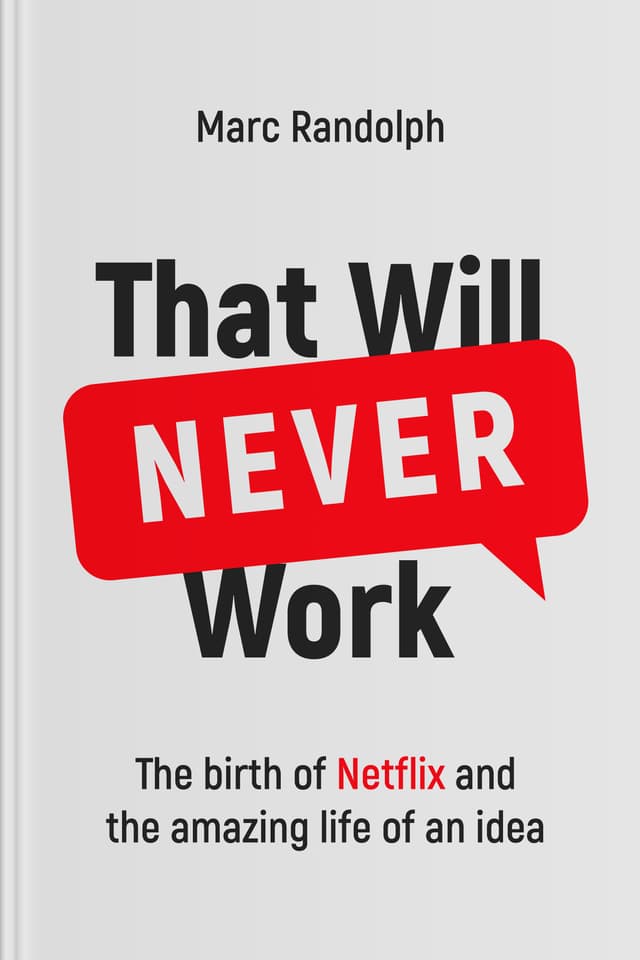
If You're Curious About These Questions...
You should listen to this audiobook
- Did you know that the initial idea for Netflix was rejected by almost everyone—including the founder’s own wife—long before it became a global powerhouse?
- What’s the secret to building a high-trust company culture that remains resilient even when your original business plan completely falls apart?
- Have you ever wondered why the most successful innovators focus less on having a 'perfect' idea and more on the speed of their feedback loops?
Listen to That Will Never Work
What You'll Learn from That Will Never Work
- — Where Ideas Really Begin
- — Turning “No” into Forward Motion
- — Freedom, Trust, and a Culture That Builds
- — Belief, Money, and the Weight of a Dream
- — The Name That Carries the Story
That Will Never Work Chapter Overview
Chapter 1: AudiobookHub Recommendation
Chapter 2: — Where Ideas Really Begin
Chapter 3: — Turning “No” into Forward Motion
Chapter 4: — Freedom, Trust, and a Culture That Builds
Chapter 5: — Belief, Money, and the Weight of a Dream
Chapter 6: — The Name That Carries the Story
Chapter 7: — Surviving the Unknown, One Pivot at a Time
Chapter 8: — When the Storm Reveals What Matters
Chapter 9: — A Gentle Closing: The Real Shape of Success
About That Will Never Work
This summary follows the early, uncertain path that led to Netflix—starting with a relatable problem, moving through rejected ideas, and arriving at a breakthrough only after countless practical experiments, honest doubts, and courageous decisions.
Along the way, it explores what innovation really looks like in daily life: the value of feedback loops, the power of a high-trust team culture, the emotional complexity of funding a dream, and the resilience required when markets shift and plans break. The tone is simple but meaningful: progress is possible, even when no one is sure it will work.
Who Should Listen to That Will Never Work
- Listeners who want a realistic, encouraging view of creativity and entrepreneurship—one that includes uncertainty, false starts, and steady iteration.
- Founders, builders, and team leaders who are shaping culture and want practical inspiration about autonomy, alignment, and trust.
- Anyone navigating change—seeking a calm reminder that perseverance and adaptability can matter as much as the original idea.
More Books Like That Will Never Work
Readers who enjoyed this also liked these titles.

Why Customers Aren't Buying What You're Selling-And What to Do About It

A timeless tale of friendship, mortality, and the search for meaning

Sent to America to recover from dangerous overwork, barrister Philip Lefrank expects rural quiet—until he enters a household poisoned by envy and suspicion, where a knife has already flashed, and one desperate man seems to carry a secret that could ruin them all.

A Memoir