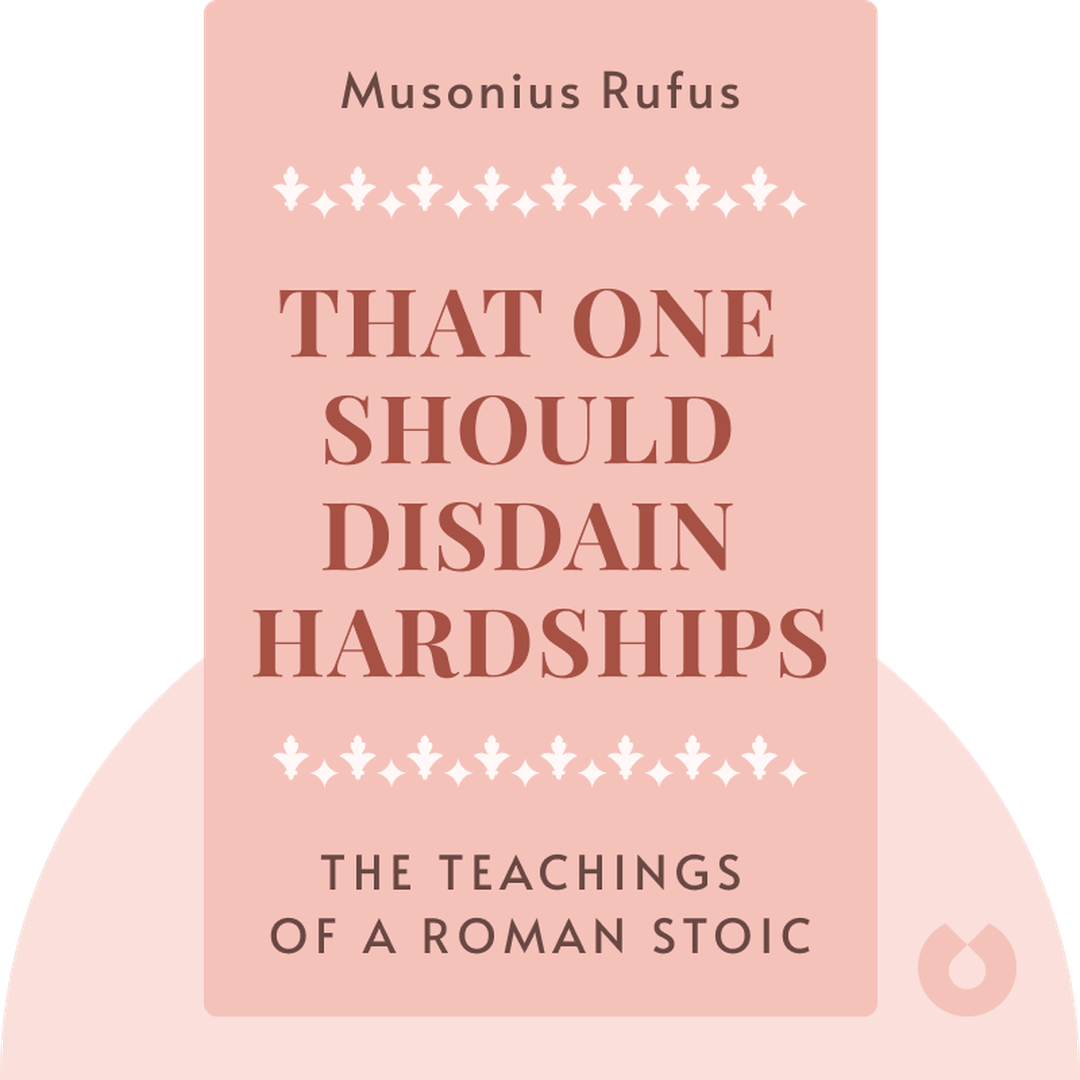
That One Should Disdain Hardships
Start ListeningDownload Try free on iPhoneScan to start in 5 seconds
Categories:
If You're Curious About These Questions...
You should listen to this audiobook
- Did you know that the man hailed as the 'Roman Socrates' believed the secret to true freedom lies not in avoiding hardships, but in actively embracing them?
- Have you ever wondered why your choice of food, clothing, and even your home might be the most important moral decisions you make every day?
- What if you could master a philosophy that isn’t just for academics, but is specifically designed to be practiced in the middle of your busiest, most difficult days?
Listen to That One Should Disdain Hardships — Cinematic Audio Edition
Loading player...
Key Takeaways from That One Should Disdain Hardships
- Understand why Stoicism is primarily a practical framework for living well, moving beyond theoretical debates to focus on actionable ethics and daily behavior.
- Discover how to navigate life's uncontrollable events, such as illness or poverty, by mastering the one thing you truly control: your reason and your response to hardships.
- Learn the four interdependent skills of Stoic virtue—love of truth, justice, courage, and self-control—and how practicing them leads to a noble, excellent life.
- Realize that the capacity for virtue is hardwired into human nature, meaning that achieving true happiness is accessible to everyone, not just a philosophical elite.
- Master the art of virtuous living by prioritizing real-world practice over theoretical knowledge, actively choosing to confront fears and act justly in your everyday life.
Learning Tools
Reinforce what you learned from That One Should Disdain Hardships
Mind Map
That One Should Disdain Hardships
Practical Philosophy+
The Nature of Virtue (Aretê)+
Practice Over Theory+
Gender Equality in Stoicism+
Rewards of a Virtuous Life+
The Role of Diet+
Fulfilling Human Potential+
Quiz — Test Your Understanding
Question 1 of 7
What did Musonius Rufus and the Roman Stoics believe was the primary purpose of philosophy?
Question 2 of 7
According to Musonius, how do humans acquire virtue (aretê)?
Question 3 of 7
What point does Musonius make using the analogy of the two doctors?
Question 4 of 7
How did Musonius's views on women studying philosophy differ from many of his contemporaries?
Question 5 of 7
How does Musonius respond to the idea that cultivating virtue is too difficult or strenuous?
Question 6 of 7
Why does Musonius advocate for a simple, unelaborate diet?
Question 7 of 7
What does it mean to 'live in accord with nature' according to Musonius?
That One Should Disdain Hardships — Full Chapter Overview
- 1Recommendation
- 2Stoicism offers a practical guide to living well.
- 3The striving to be virtuous is intrinsic to human nature itself.
- 4For virtue, in practice, effort truly does indeed make perfection.
- 5If philosophy fosters virtue, both men and women should indeed study it.
- 6The benefits of living virtuously outweigh the costs.
- 7A modest diet is not only healthier; it cultivates the good life.
- 8Stoicism allows us to achieve our full potential as humans.
That One Should Disdain Hardships Summary & Overview
That One Should Disdain Hardships (2020) is a collection of lectures delivered in imperial Rome in the first century CE by the Stoic Gaius Musonius Rufus. Heralded as the “Roman Socrates,” Musonius’s philosophy is anything but academic. Designed to help listeners lead the best possible lives, his lectures hone in on practical, everyday questions. The result? A doctrine that you really can live by.
Who Should Listen to That One Should Disdain Hardships?
- Philosophers and thinkers
- History buffs
- Practical-minded ethicists
Books Similar to That One Should Disdain Hardships
Readers who enjoyed this also liked these titles.