If You're Curious About These Questions...
You should listen to this audiobook
- Have you ever wondered what would happen if a radical scientific experiment could literally grant a woman a second chance at life, free from the prejudices of Victorian society?
- Are you curious about how a gothic, Frankenstein-esque tale can completely flip the script on how women have been traditionally portrayed in literature?
- What if the boundaries between history, memoir, and dark fantasy were so blurred that you couldn't tell where the experiment ended and reality began?
Listen to Poor Things — Free Audiobook
Loading player...
Key Takeaways from Poor Things
- Discover how the novel uses a Frankenstein-inspired premise to explore the ways men metaphorically and literally construct women to fit their desires.
- Learn how protagonist Bella Baxter defies the rigid societal scripts and narrative conventions of Victorian literature to forge her own independent path.
- Understand the postmodern philosophy that 'reality' and history are not objective truths waiting to be found, but rather stories and fictions we actively construct.
- Examine how the author uses conflicting historical documents and unreliable narrators to force readers to decide for themselves what is fact and what is fiction.
- Explore the bizarre, gothic medical experiments of Godwin Baxter to see how Victorian scientific ambition blurs the lines between life, death, and morality.
Learning Tools
Reinforce what you learned from Poor Things
Mind Map
Poor Things
Postmodern Narrative+
Archibald's Gothic Myth+
Bella's Bildungsroman+
Victoria's True Account+
Thematic Analysis+
Quiz — Test Your Understanding
Question 1 of 8
Why is 'Poor Things' considered a postmodern novel by critics?
Question 2 of 8
In Archibald McCandless's account, how does Godwin Baxter explain Bella's mental immaturity?
Question 3 of 8
What does McCandless believe is the true, underlying motivation behind Baxter's creation of Bella?
Question 4 of 8
What worldview do Mr. Astley and Dr. Hooker attempt to teach Bella during her travels?
Question 5 of 8
According to the analysis, Bella's journey away from Baxter and McCandless shifts the story's genre from a Victorian fantasy to which of the following?
Question 6 of 8
In Victoria's own account of her life, what was her real reason for initially seeking out Godwin Baxter?
Question 7 of 8
According to Victoria, why did Godwin Baxter encourage her to marry Archibald McCandless?
Question 8 of 8
How does Alasdair Gray 'correct' the traditional Frankenstein narrative in his portrayal of Godwin and Bella Baxter?
Poor Things — Full Chapter Overview
- 1Recommendation
- 2The unusual memoir of Archibald McCandless
- 3The creation of Bella Baxter
- 4Bella’s schooling
- 5Victoria McCandless puts the record straight
Poor Things Summary & Overview
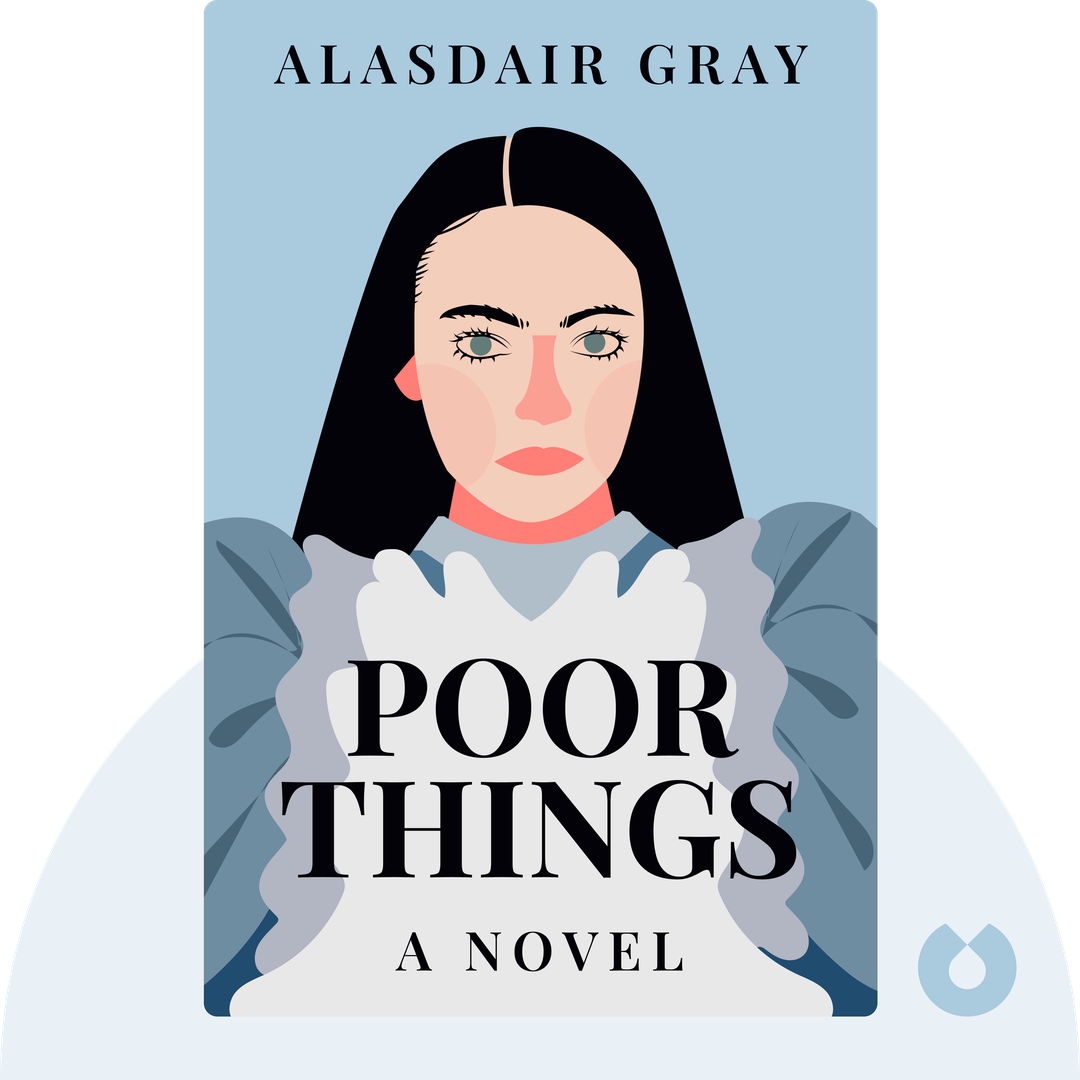
Poor Things (1992) is an award-winning postmodern novel that takes readers on a whirlwind tour through the monstrous and gothic world of late-Victorian Glasgow. A Frankenstein-esque tale of a dubious scientific experiment, it playfully subverts genre conventions to provide a fresh perspective on the representation of women in literature.
Who Should Listen to Poor Things?
- Fans of satirical postmodern literature
- History buffs who love all things Victorian
- Sci-fi enthusiasts interested in a modern take on Frankenstein
Books Similar to Poor Things
Readers who enjoyed this also liked these titles.