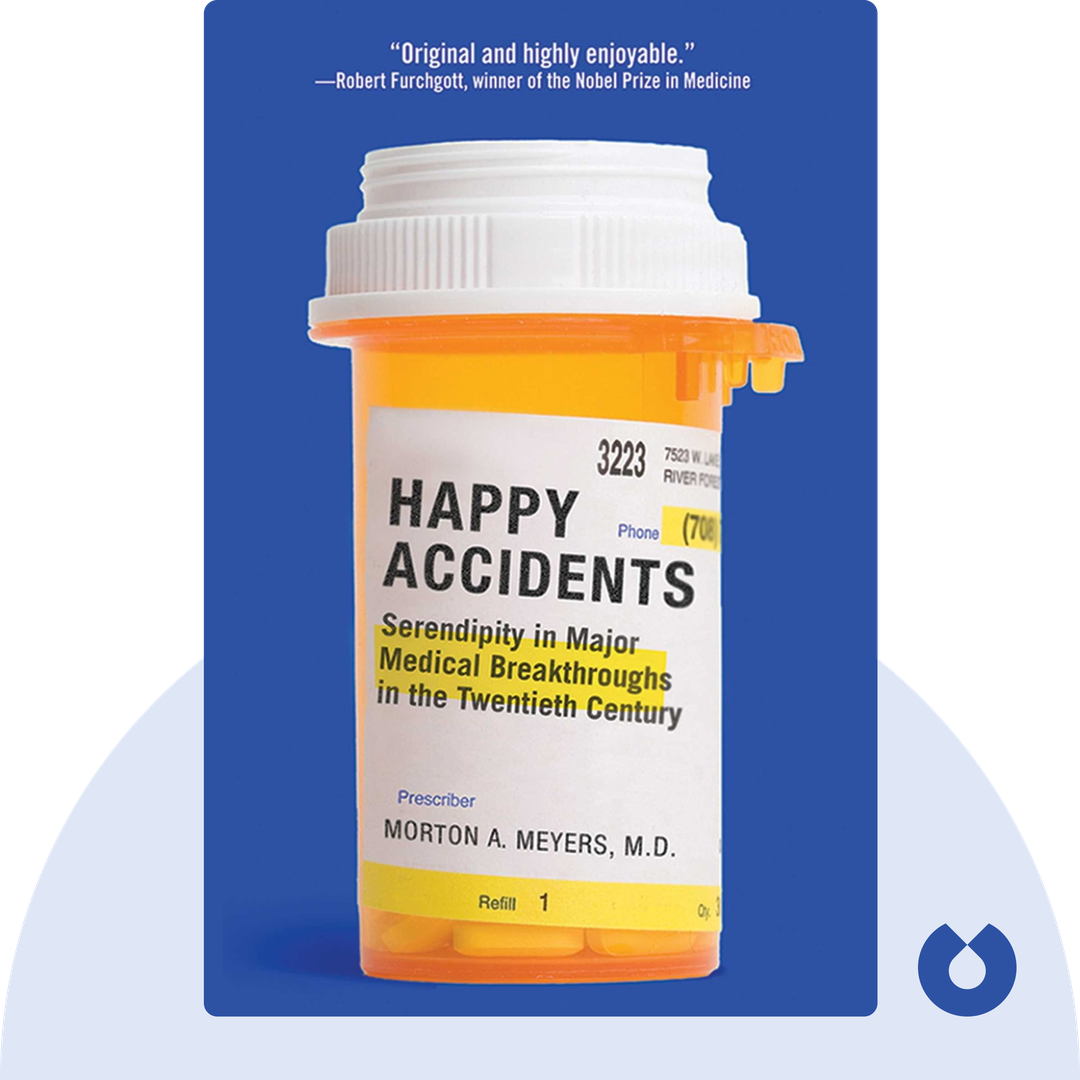
If You're Curious About These Questions...
You should listen to this audiobook
- Did you know that some of the world’s most life-saving drugs, from antibiotics to antidepressants, were actually discovered by complete accident?
- Have you ever wondered how a failed experiment or a sheer stroke of luck could lead to a revolutionary breakthrough in heart surgery?
- What if the secret to the greatest medical discoveries wasn’t meticulous planning, but the ability to turn a "dumb mistake" into a scientific miracle?
Listen to Happy Accidents — Free Audiobook
Loading player...
Key Takeaways from Happy Accidents
- Discover why the most groundbreaking medical advancements are often the result of messy serendipity rather than the idealized, systematic research promoted by scientists and the media.
- Understand why chance alone isn't enough, and learn how a creative, intuitive mind is essential to transform unexpected laboratory accidents into life-saving medical insights.
- Find out how paying attention to unintended side effects transformed simple allergy medications and curious observations into household medical staples like Dramamine and X-rays.
- Learn how the modern pharmaceutical industry and the very first targeted chemical treatments unexpectedly evolved from the nineteenth-century European coal-tar dye business.
- Explore the highly improbable sequence of chance events—including a messy desk, a stray mold spore, and freak weather—that led Alexander Fleming to accidentally discover the first antibiotic.
Learning Tools
Reinforce what you learned from Happy Accidents
Mind Map
Happy Accidents
The Nature of Discovery+
Early Chemical Drugs+
Antibiotics+
Cancer Chemotherapy+
Heart Surgery Breakthroughs+
Psychopharmacology+
Stomach Ulcers+
The Crisis in Modern Research+
Quiz — Test Your Understanding
Question 1 of 8
According to the book, why do scientists often understate the role of serendipity in their medical breakthroughs?
Question 2 of 8
What unexpected origin did the first pharmaceutical giants, such as Hoechst and Bayer, share?
Question 3 of 8
Despite discovering penicillin, what prevented Alexander Fleming from realizing its full medical potential?
Question 4 of 8
How did a tragic WWII shipping accident in Bari, Italy, inadvertently launch the medical war on cancer?
Question 5 of 8
What long-held medical belief was shattered by Mason Sones's medical mishap in 1958?
Question 6 of 8
How was the first antidepressant medication originally discovered?
Question 7 of 8
Why was Barry Marshall instrumental in proving that stomach ulcers are caused by bacteria, when other doctors dismissed the idea?
Question 8 of 8
According to the book, how does the National Institute of Health's (NIH) 'peer review' system inadvertently stifle medical innovation?
Happy Accidents — Full Chapter Overview
- 1Recommendation
- 2Many major medical discoveries came about through serendipity.
- 3The first chemical drugs were accidentally produced by Europe’s dye industry.
- 4The first antibiotic emerged from an unlikely chain of chance events.
- 5A tragic WWII shipping accident helped launch the war on cancer.
- 6A string of medical mishaps opened the door to modern heart surgery.
- 7Most mood-altering psychiatric drugs started out as other medicines with surprising side effects.
- 8Discovering the bacterial cause of stomach ulcers required the fresh perspective of a medical newcomer.
- 9To encourage serendipitous discoveries, we must rethink today’s medical research system.
- 10Final summary
Happy Accidents Summary & Overview
Happy Accidents (2011) explores the invaluable role that false assumptions, unlikely circumstances, and sheer dumb luck have played in some of medicine’s biggest discoveries. From antibiotics to antidepressants, heart surgery to chemotherapy, some of today’s most important drugs and treatments are the result of serendipity — stumbling across one thing while looking for another. Radiologist Morton A. Meyers reveals some of the incredible true stories of medicine’s luckiest findings.
Who Should Listen to Happy Accidents?
- Science nerds interested in medicine and pharmacology
- History buffs interested in how great minds make big discoveries
- Readers who enjoy stories with a good plot twist
Books Similar to Happy Accidents
Readers who enjoyed this also liked these titles.