If You're Curious About These Questions...
You should listen to this audiobook
- What if you could turn every unexpected setback into a "happy accident" that actually propels you toward your goals?
- Did you know that a simple two-word rule used by professional improv comedians can unlock a more creative and positive mindset in your daily life?
- Are you curious about how the secrets of stage performance can help you master the art of communication and handle life's obstacles with ease?
Listen to Happy Accidents — Free Audiobook
Loading player...
Key Takeaways from Happy Accidents
- Master the foundational improv principle of 'Yes, and' to foster a positive, judgment-free environment that can dramatically improve workplace communication and teamwork.
- Learn to recapture the natural, creative mindset of children by transforming creativity-killing words like 'No' and 'But' into collaborative opportunities.
- Understand why true success relies on collaboration by learning to identify 'hotspots' and jumping in to support your colleagues when they need it most.
- Overcome the 'prevent defense'—the fear of putting yourself out there and looking stupid—by stepping outside your comfort zone to seize new opportunities.
- Discover why the habitual use of the word 'no' to maintain control actually limits a leader's ability to adapt, think freely, and solve problems creatively.
Learning Tools
Reinforce what you learned from Happy Accidents
Mind Map
Happy Accidents
The 'Yes, and' Philosophy+
Teamwork and Collaboration+
Risk and Adaptability+
Belief and Perseverance+
Return on Improvisation (ROI)+
Continuous Growth and Legacy+
Actionable Advice+
Quiz — Test Your Understanding
Question 1 of 8
What do the two words in the improv principle 'Yes, and' represent?
Question 2 of 8
In the context of Four Day Weekend's improv philosophy, what is a 'hotspot'?
Question 3 of 8
Why do CEOs and powerful people often struggle more with improv exercises compared to lower-level employees?
Question 4 of 8
According to the book, what is the difference between a 'considerate no' and a 'reactive no'?
Question 5 of 8
What technique does Four Day Weekend recommend to help individuals discover what truly drives them and reconnect with their passions?
Question 6 of 8
How does Four Day Weekend define 'Return on Improvisation'?
Question 7 of 8
How did Four Day Weekend's inability to get their full fee from Southwest Airlines turn into a 'happy accident'?
Question 8 of 8
What is the primary reason Four Day Weekend expanded their training center and offered free shows to service members later in their career?
Happy Accidents — Full Chapter Overview
- 1Recommendation
- 2Improvisational comedy can teach valuable lessons in positivity.
- 3True success is about the team, not the individual.
- 4To move forward in life, you need to take risks and know when to let go of “no.”
- 5To achieve anything, you have to believe in what you’re doing.
- 6Always aim to maximize your Return on Improvisation.
- 7Adaptability can transform a crisis into a happy accident.
- 8Keep striving for greatness, even when it feels like you’ve made it.
- 9Final summary
Happy Accidents Summary & Overview
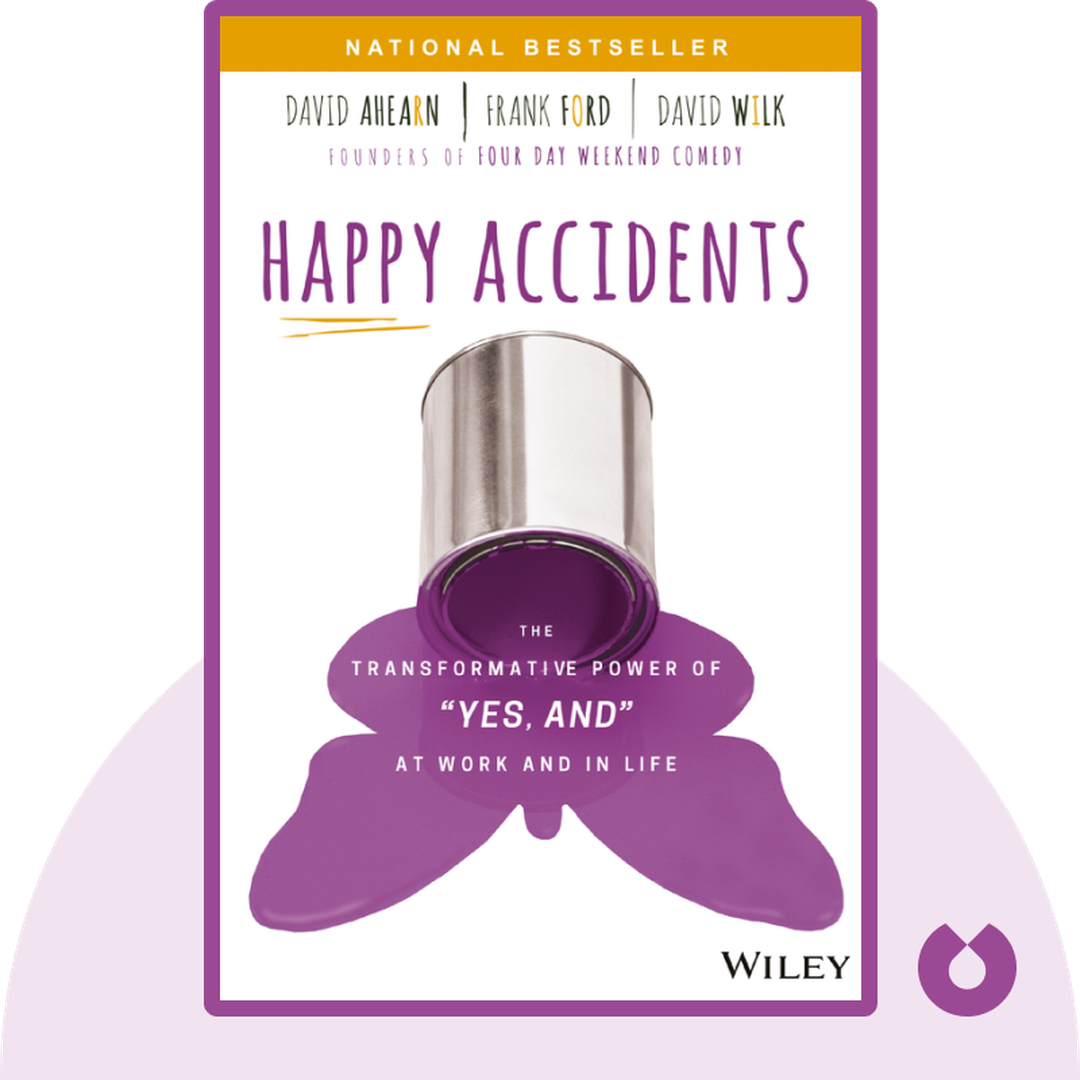
Happy Accidents (2017) is about the authors’ experiences in Four Day Weekend – an improv comedy troupe from Fort Worth, Texas. It chronicles the success Four Day Weekend achieved over the course of 20 years and reveals how anyone can use the principles of improv comedy to become more positive, creative, and better at dealing with obstacles in life.
Who Should Listen to Happy Accidents?
- Thoughtful individuals who want to approach life more positively
- Fans of comedy
- Outgoing people who’d like to improve their communication skills
Books Similar to Happy Accidents
Readers who enjoyed this also liked these titles.