If You're Curious About These Questions...
You should listen to this audiobook
- Did you know that the battle for free speech didn’t start with the First Amendment, but actually has its roots in ancient civilizations that faced the same dilemmas we do today?
- Have you ever wondered why history’s most revolutionary communication tools—from the printing press to the internet—have almost always been met with immediate and intense attempts at censorship?
- Are you curious about how history's greatest proponents of free speech navigated the 'free speech paradox' and defended the right to speak even when it was most dangerous?
Listen to Free Speech — Free Audiobook
Loading player...
Key Takeaways from Free Speech
- Understand why censorship is never the savior of democracy, but rather marks the end of a free society, even when facing modern challenges like disinformation.
- Discover how ancient Athens revolutionized society by prioritizing free speech, proving that the open exchange of ideas is the foundation for cultural and scientific advancement.
- Learn a crucial lesson from the execution of Socrates: in the rush to protect democratic values from perceived threats, free speech is tragically often the first right to be sacrificed.
- Find out how rigid religious orthodoxy during the Middle Ages led to the loss of up to 90 percent of ancient literary works, demonstrating the devastating cultural cost of censorship.
- Explore how the Catholic Church instituted the Inquisition's militant tribunals to suppress the intellectual revival sparked by early universities, revealing the historical struggle between reason and enforced dogma.
Learning Tools
Reinforce what you learned from Free Speech
Mind Map
Free Speech
The State of Free Speech+
Ancient Origins+
The Inquisition+
Technological Disruption+
Tolerance & Enlightenment+
The Censorship Trap+
The Digital Age+
Quiz — Test Your Understanding
Question 1 of 10
What historical misconception about censorship does the book challenge?
Question 2 of 10
Why was Socrates likely executed by the Athenians despite their long-standing culture of free speech?
Question 3 of 10
According to the text, why did the Islamic world NOT experience an equivalent to the Catholic Inquisition during the medieval period?
Question 4 of 10
What psychological or historical tendency does Martin Luther’s relationship with free speech illustrate?
Question 5 of 10
Why did the Dutch Republic become a safe haven for free thought and the printing press in the 17th century?
Question 6 of 10
What key distinction did the philosopher Baruch Spinoza make regarding state regulation?
Question 7 of 10
How did the Weimar Republic’s attempts to censor Adolf Hitler and his supporters ultimately affect the Nazi movement?
Question 8 of 10
What was the fatal flaw in the Weimar constitution that legally allowed the Nazis to crush all dissent once in power?
Question 9 of 10
Based on the text, what is a major concern regarding social media companies using algorithms to delete disinformation and hate speech?
Question 10 of 10
How does the author suggest we might best resolve the current issues surrounding internet censorship and centralized tech control?
Free Speech — Full Chapter Overview
- 1Recommendation
- 2Origins in Ancient Times
- 3The Age of the Inquisition
- 4The Major Disruption
- 5Seeds of the Enlightenment
- 6The Weimar Republic
- 7Today's Controversies
Free Speech Summary & Overview
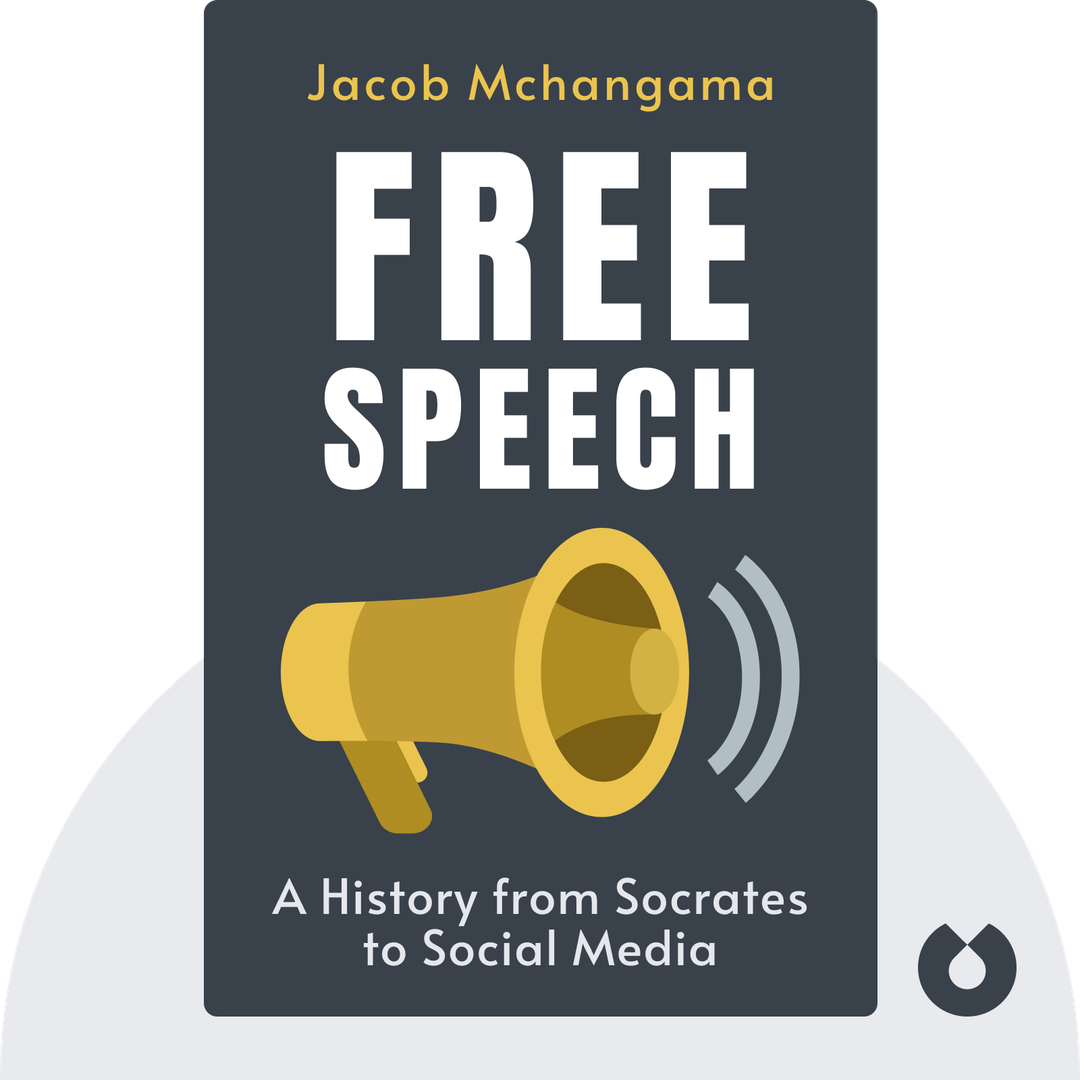
Free Speech (2022) traces the history of this world-defining idea. It provides a soapbox for some of free speech’s greatest proponents and highlights key events that pushed the idea forward from ancient times to the present. Offering an evenhanded treatment of the costs and benefits of free speech throughout history, it’s a powerful retort to all those forces that threaten to erode free speech today.
Who Should Listen to Free Speech?
- Passionate defenders of free speech who could use more argumentative ammunition
- Students preparing for campus debates on whether free speech should be limited
- Anyone on the left or right seeking insight into modern-day debates on free speech
Books Similar to Free Speech
Readers who enjoyed this also liked these titles.