If You're Curious About These Questions...
You should listen to this audiobook
- Have you ever wondered why simply being "left alone" isn't enough to make you truly free?
- Did you know that the secret to lasting liberty lies in the specific social structures we often take for granted?
- What if the way we've been taught to think about freedom is actually making it easier for modern forms of tyranny to take root?
Listen to On Freedom — Free Audiobook
Loading player...
Key Takeaways from On Freedom
- Discover why true freedom is more than just the absence of oppression, and understand the necessity of 'positive freedom' to genuinely thrive and realize your potential.
- Learn how exercising true freedom often requires active commitment and presence, demonstrated by choices to stay and fight for what is right rather than simply escaping hardship.
- Understand how personal sovereignty depends on empathy, and why recognizing the shared humanity in others is essential to breaking free from a limited, isolated existence.
- Recognize the historical dangers of an 'us versus them' approach to freedom, and see how dehumanizing others ultimately leads to manipulation and shared oppression.
- Find out why unpredictability is a cornerstone of a free life, and how modern social media algorithms threaten your personal agency by making your behavior predictable and controllable.
Learning Tools
Reinforce what you learned from On Freedom
Mind Map
On Freedom
Core Concepts of Freedom+
The Five Forms of Freedom+
Role of Government+
Quiz — Test Your Understanding
Question 1 of 8
According to the text, how does Timothy Snyder define 'positive freedom'?
Question 2 of 8
Which of the following events does the author cite as a prime example of 'positive freedom' in action?
Question 3 of 8
How does philosopher Edith Stein's distinction between 'Leib' and 'Körper' relate to Snyder's concept of sovereignty?
Question 4 of 8
Why did Václav Havel, and later Snyder, view 'predictability' as a threat to freedom?
Question 5 of 8
According to the text, what characterizes the 'politics of eternity' utilized by authoritarian figures like Vladimir Putin and Donald Trump?
Question 6 of 8
What is the primary danger of the 'big lie' political tactic, as highlighted in the discussion on factuality?
Question 7 of 8
How does the text critique modern American libertarianism in relation to the concept of solidarity?
Question 8 of 8
How did philosopher Leszek Kołakowski suggest we should approach political philosophy to build a better government?
On Freedom — Full Chapter Overview
- 1Recommendation
- 2What does freedom really mean?
- 3Freedom in the human experience
- 4Freedom of the unknown
- 5Freedom to move
- 6Freedom of understanding
- 7Freedom in togetherness
- 8Reflections on better government
On Freedom Summary & Overview
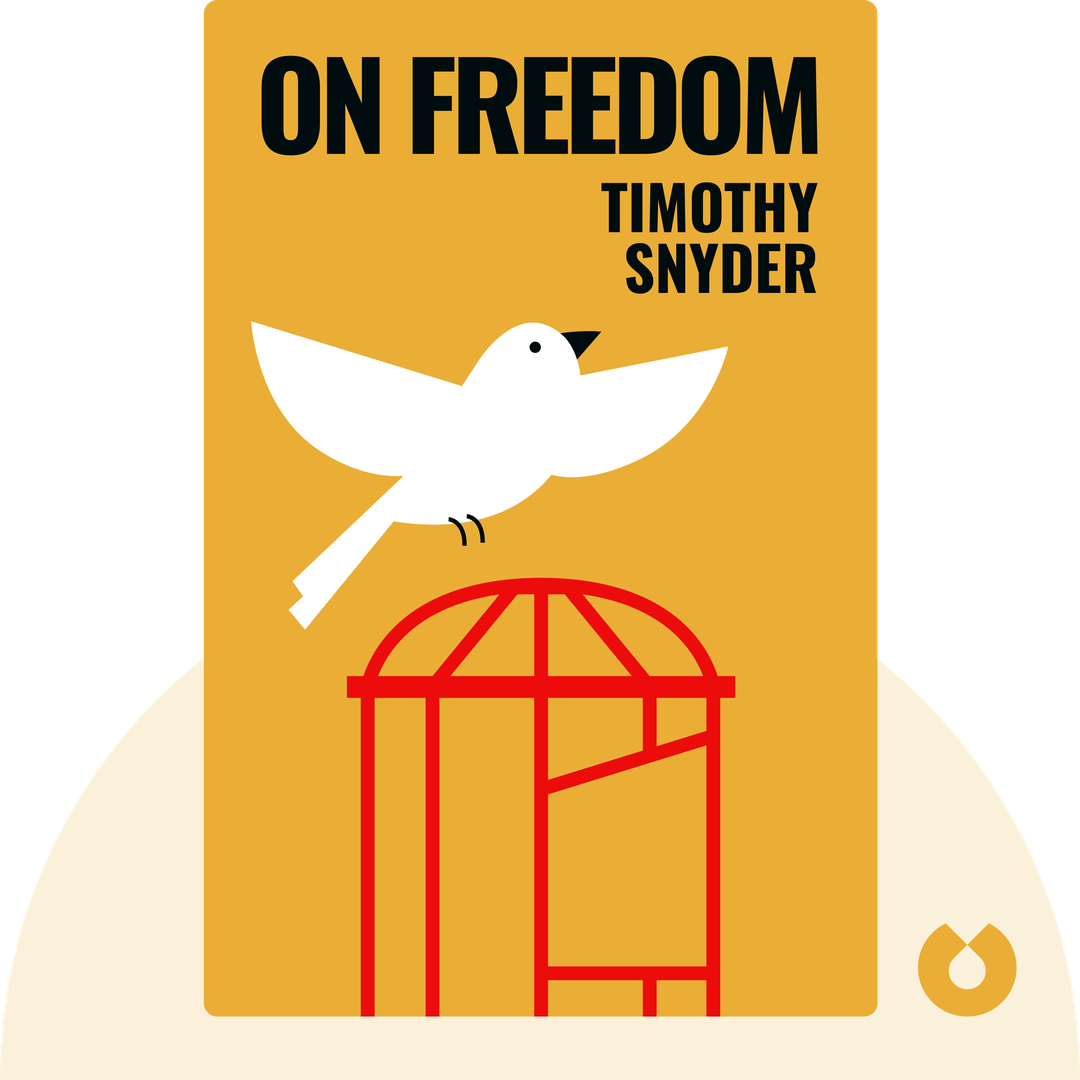
On Freedom (2024) challenges us to rethink what it means to be truly free in a world increasingly dominated by political and economic tyranny. It weaves together history, philosophy, and urgent contemporary issues, illustrating how our pursuit of freedom is intertwined with the structures that support it. It inspires people to reflect on their role in safeguarding democracy and creating a more equitable future.
Who Should Listen to On Freedom?
- History and political buffs
- Fans of democracy
- Students of sociology and economics
Books Similar to On Freedom
Readers who enjoyed this also liked these titles.