If You're Curious About These Questions...
You should listen to this audiobook
- Did you know that the 'human game' we’ve been playing for millennia is currently facing a triple threat that could bring our story to an abrupt end?
- Have you ever wondered if the recent wave of 'optimism' about the future is actually blinding us to a much more sobering environmental and technological reality?
- Are you curious about why our attempts to 'improve' the human race through AI and genetic engineering might actually be our undoing?
Listen to Falter — Free Audiobook
Loading player...
Key Takeaways from Falter
- Understand the paradox of the Anthropocene, a defining era where human civilization achieves remarkable technological progress while simultaneously driving toward existential ecological collapse.
- Discover how transforming climate anxiety into active engagement and ethical innovation can prevent systemic paralysis and spark real, collective solutions.
- Recognize the immediate reality of global warming, evidenced not just by extreme temperatures, but by the devastating 'silencing' of half the world's wild animals since 1970.
- Learn how environmental crises directly destabilize human societies by acting as the root cause for severe weather shocks, mass migration, and geopolitical conflicts like the Syrian Civil War.
- Grasp the urgent threat to Earth's fundamental life-support systems, including how warming oceans could destroy the phytoplankton responsible for producing two-thirds of our oxygen by the year 2100.
Learning Tools
Reinforce what you learned from Falter
Mind Map
Falter
The Human Game+
Threat 1: Global Warming+
Threat 2: Genetic Engineering+
Threat 3: Artificial Intelligence+
The Space Escape Myth+
Practical Solutions+
The Ultimate Obstacle+
Quiz — Test Your Understanding
Question 1 of 8
According to the book, what three looming threats pose the greatest danger to the continuation of the 'human game'?
Question 2 of 8
How does the book illustrate the interconnected societal dangers of climate change using the Syrian Civil War?
Question 3 of 8
What is identified as a potential 'worst-case scenario' consequence if the Earth's oceans become too hot by the year 2100?
Question 4 of 8
What is the primary ethical and societal danger posed by CRISPR and genetic engineering, according to the author?
Question 5 of 8
Why does the author argue that Artificial General Intelligence (AGI) poses an existential threat to humanity?
Question 6 of 8
Why does the author dismiss space colonization as a viable backup plan for humanity?
Question 7 of 8
What practical solution does the author suggest to mitigate the specific threat of artificial intelligence?
Question 8 of 8
How did the fossil fuel industry, specifically Exxon, react to early knowledge about global warming in the 1980s?
Falter — Full Chapter Overview
- 1Recommendation
- 2Global warming and environmental destruction are already a real threat.
- 3In the worst case, global warming could threaten humanity and most life on Earth.
- 4Even in better-case scenarios, global warming remains a serious danger to humanity.
- 5On our current path, climate change will bring deeply disruptive and dangerous social consequences.
- 6Genetic engineering presents a second threat to the human game.
- 7Artificial intelligence presents a third threat to the human game.
- 8If you want to save humanity from annihilation, don’t rely on space travel.
- 9There are practical, relatively simple steps we can take to confront the threats to the human game.
- 10Powerful individuals and corporations block action on global warming, genetic engineering, and AI.
- 11Final summary
Falter Summary & Overview
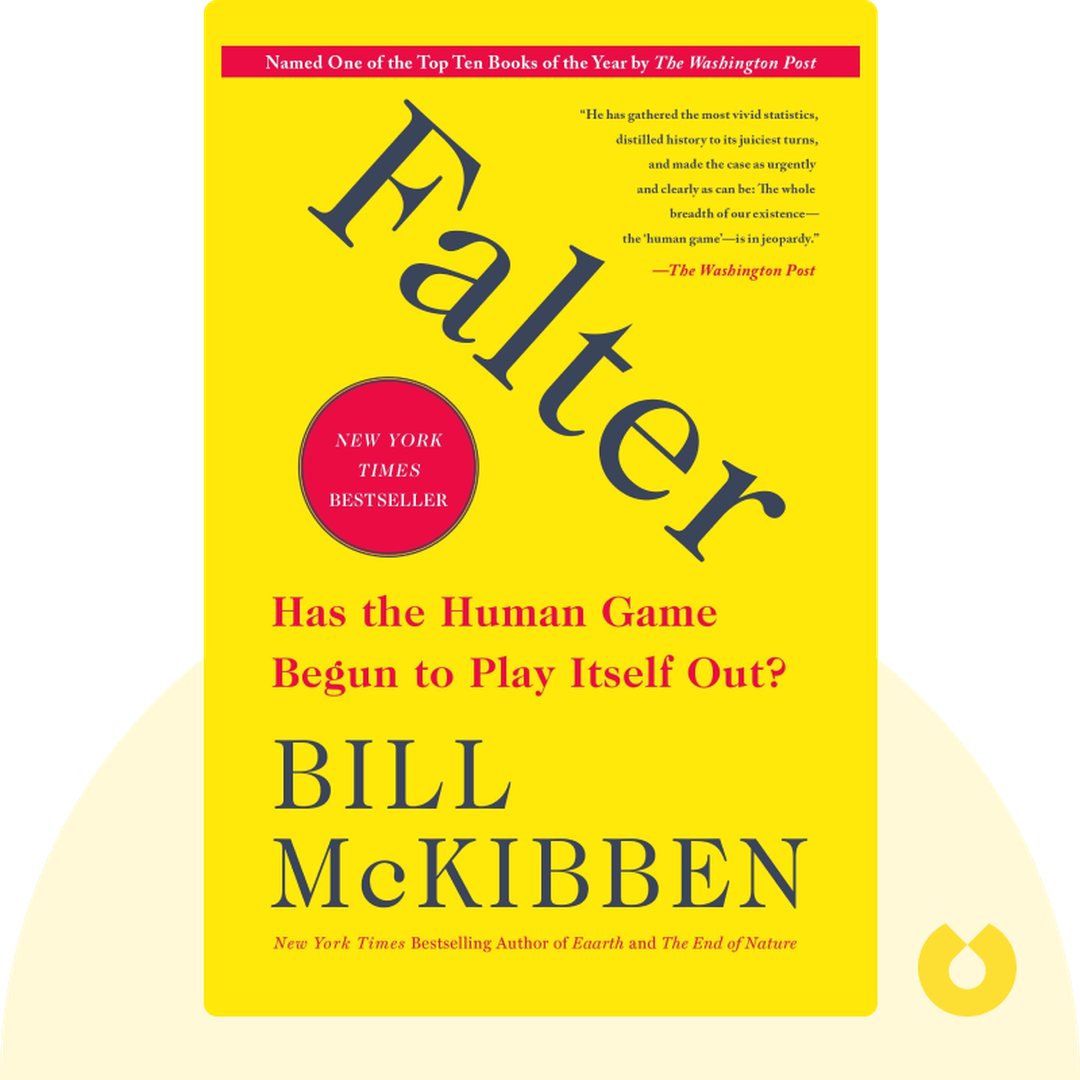
Falter (2019) provides a rather sobering counterargument to the rash of optimistic books about the present and future that have been appearing on the market lately. Instead of everything being pretty good and set to get even better, author Bill McKibben argues that things are already pretty bad and are on a course to get even worse, due to the threats posed to humanity by climate change, genetic engineering and artificial intelligence. He then goes on to provide some suggestions for how we can deal with these threats before it’s too late.
Who Should Listen to Falter?
- Those skeptical of authors preaching optimism about the future of humanity
- Science fiction buffs wondering about the likelihood of a dystopian 21st century
- Any human being concerned about the survival of our species
Books Similar to Falter
Readers who enjoyed this also liked these titles.