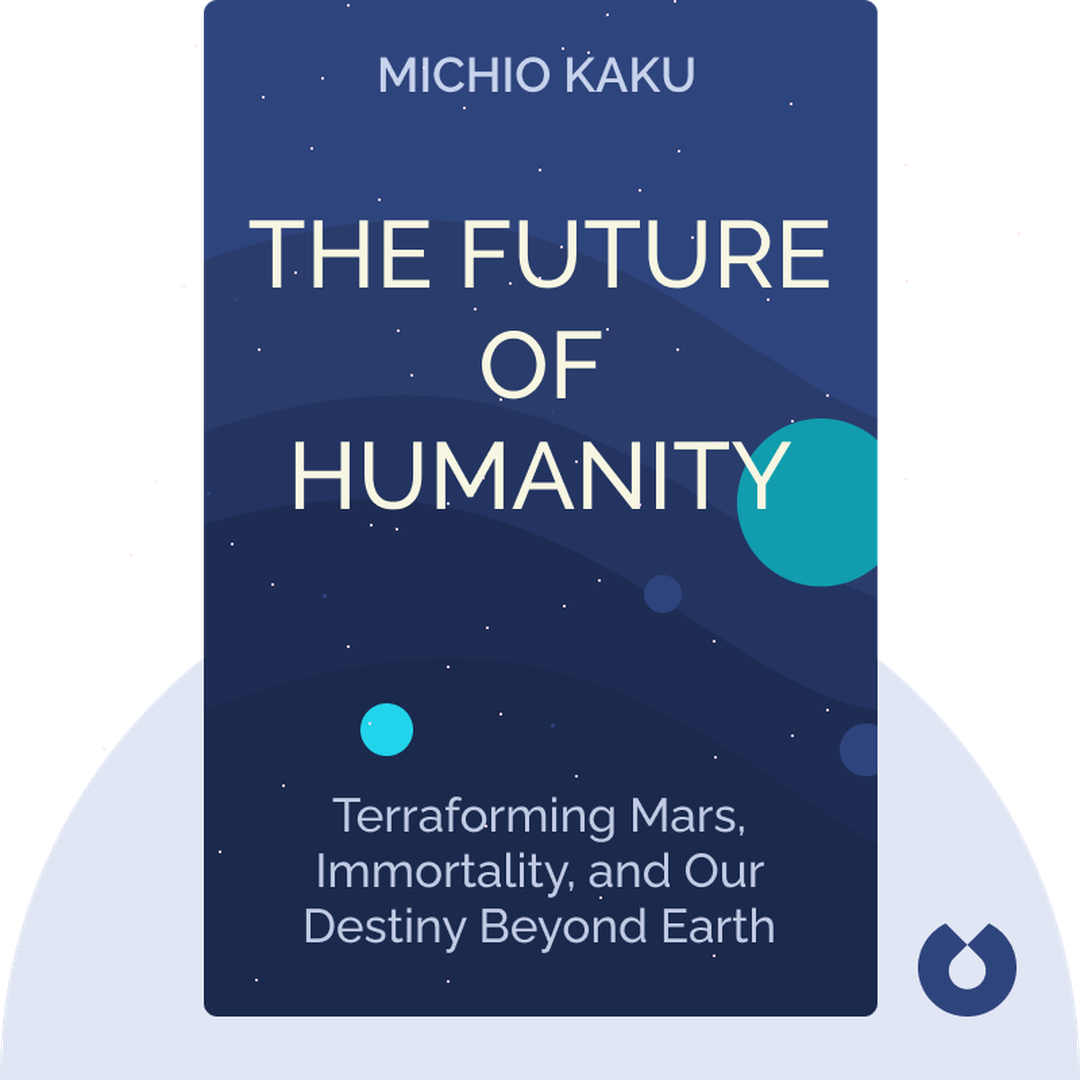
The Future of Humanity
Start ListeningDownload Try free on iPhoneScan to start in 5 seconds
Categories:
If You're Curious About These Questions...
You should listen to this audiobook
- Have you ever wondered what it would actually take to transform a frozen, hostile planet like Mars into a lush, habitable second home for humanity?
- What if you could travel to the stars using revolutionary propulsion technology that’s already moving from the realm of science fiction into reality?
- Are you curious about how we might have to genetically re-engineer the human body just to survive the extreme environments of other worlds?
Listen to The Future of Humanity — Free Audiobook
Loading player...
Key Takeaways from The Future of Humanity
- Discover how early space pioneers used breakthrough mathematics and liquid fuel innovations to prove that escaping Earth's atmosphere was truly possible.
- Learn how modern entrepreneurs are revitalizing space exploration by developing reusable booster rockets and planning off-world supply chains.
- Understand the resourcefulness required for lunar colonization, such as extracting breathable oxygen and drinking water from the vast amounts of ice hidden in lunar craters.
- Find out why deadly solar radiation poses a massive threat to living on the moon and how ancient volcanic lava tubes could serve as vital underground shelters.
- Explore the ambitious goal of making humanity a multiplanetary species by leveraging innovations like SpaceX's reusable booster rockets to drastically reduce space travel costs.
Learning Tools
Reinforce what you learned from The Future of Humanity
Mind Map
The Future of Humanity
History of Rocketry+
Lunar Colonization+
Mars Colonization+
Off-World Construction+
Interstellar Travel+
Surviving Deep Space+
Intelligent Alien Life+
Quiz — Test Your Understanding
Question 1 of 9
What was Konstantin Tsiolkovsky's major contribution to early space travel?
Question 2 of 9
According to the text, what is proposed as a viable solution to protect humans from dangerous solar radiation on the moon?
Question 3 of 9
How has SpaceX significantly reduced the cost of sending payloads into space?
Question 4 of 9
Which of the following is a major atmospheric complication that humans would face on Mars?
Question 5 of 9
Why is graphene considered crucial for building future cities in outer space?
Question 6 of 9
Why are AI-driven automatons deemed essential for constructing off-world cities?
Question 7 of 9
What is the primary propulsion method for a 'nanoship' designed to explore distant star systems like Alpha Centauri?
Question 8 of 9
To survive a centuries-long journey to a distant habitable planet, the text suggests relying on defeating aging or using which alternative method?
Question 9 of 9
Based on evolutionary principles discussed in the text, what is one educated assumption we can make about intelligent alien life?
The Future of Humanity — Full Chapter Overview
- 1Recommendation
- 2Scientists have been obsessed with rockets for over a century.
- 3Humans first reached the moon in the 1960s, but now interest in going back is growing again.
- 4There are numerous obstacles to solve before humans can live on the moon.
- 5SpaceX is moving us nearer to Martian cities, but significant challenges remain.
- 6Building space cities will require nanotechnology and advanced robots.
- 7Emerging technology may let us see beyond our galaxy, but it brings new challenges.
- 8Surviving centuries-long journeys would demand generation ships and extended lifespans.
- 9If intelligent alien life is real, it will share traits with us as well as key differences.
The Future of Humanity Summary & Overview
The Future of Humanity (2018) explores the challenges we face finding new homes on other, potentially hostile, planets. As physicist Michio Kaku shows us, this scenario is no longer science fiction, but rather a very pressing concern for scientists and future-minded entrepreneurs. Kaku presents the options currently being explored as well as the many problems that are on the verge of being solved.
Who Should Listen to The Future of Humanity?
- Fans of speculative science
- Students of physics and planetary science
- Astronomy enthusiasts
Books Similar to The Future of Humanity
Readers who enjoyed this also liked these titles.