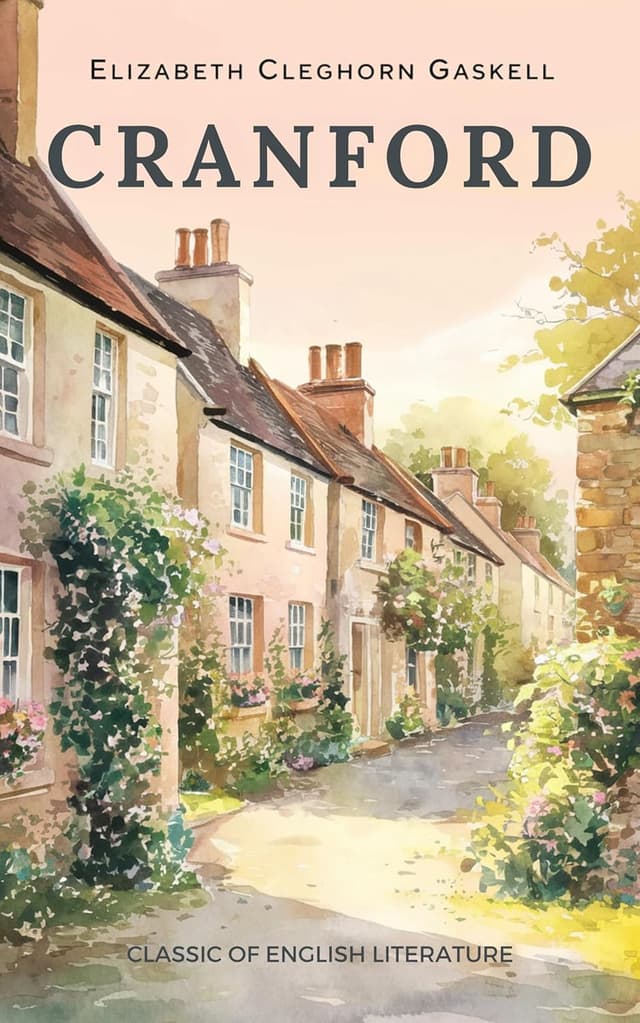
Cranford (Full Version) audiobook cover - In the quiet English town of Cranford—where ladies rule, poverty is politely unspoken, and visiting hours are law—a newcomer’s plainspoken kindness upends delicate proprieties, revealing a community sustained by humor, pride, and unexpectedly fierce compassion.

Cranford (Full Version)

In the quiet English town of Cranford—where ladies rule, poverty is politely unspoken, and visiting hours are law—a newcomer’s plainspoken kindness upends delicate proprieties, revealing a community sustained by humor, pride, and unexpectedly fierce compassion.

Elizabeth Cleghorn Gaskell

4.8 / 5(4655 ratings)
Categories:

Listen to Cranford (Full Version)

Loading player...

Historical Background

Written in the bustling industrial hub of Manchester, England, Elizabeth Gaskell’s *Cranford* was initially published in serialized installments between 1851 and 1853 in Charles Dickens’s magazine, *Household Words*. The mid-nineteenth century was a period defined by the rapid transformations of the Industrial Revolution. As railways expanded and urban centers swelled with factories, traditional English village life began to fade. Set against this backdrop of relentless modernization, *Cranford* captured the twilight of a bygone agrarian era, reflecting the anxieties and nostalgia of a society caught in the throes of unprecedented economic and social change.

Upon its publication, the novel stood out as a significant, albeit quietly subversive, departure from traditional Victorian literature. While Gaskell’s earlier work, *Mary Barton*, confronted the gritty realities of industrial poverty, *Cranford* offered a gentle, episodic exploration of a provincial town populated almost entirely by unmarried women and widows. This focus was subtly controversial; in a deeply patriarchal society that defined women strictly by their relationships to men, Gaskell centered her narrative on independent "spinsters" who functioned as the self-appointed guardians of local morality and tradition. By depicting a functional, deeply affectionate female-centric community where men were largely absent or peripheral, Gaskell gently mocked yet ultimately validated the lives of women whom Victorian society often marginalized or dismissed.

The lasting impact of *Cranford* lies in its pioneering contribution to the genre of provincial realism. It paved the way for future literary explorations of rural English life, heavily influencing later literary giants like George Eliot. Furthermore, its enduring charm and nuanced portrayal of female friendship continue to resonate with modern readers, cementing Gaskell’s legacy not merely as a chronicler of industrial strife, but as a masterful observer of human nature and women's agency in a rapidly modernizing world.


Study Questions

  1. In the opening chapter, the narrator describes Cranford as being in the possession of the 'Amazons.' How does Gaskell use this female-dominated society to subvert traditional Victorian gender roles, and what does the overarching principle of 'elegant economy' reveal about the intersection of class, gender, and financial independence in the novel?

  2. Consider the role of Mary Smith as the narrator. As someone who constantly travels between the industrial, capitalist hub of Drumble and the quaint, nostalgic town of Cranford, how does Mary's dual perspective shape our understanding of the changing Victorian landscape? In what ways does her evolving attitude toward the Cranford ladies mirror the novel's broader themes of modernization versus tradition?

  3. Although Cranford is famously a town of women, male characters like Captain Brown, Mr. Holbrook, and Aga Jenkyns (Peter) play pivotal roles. How do these male figures function within the narrative structure? Do they represent an invasive force of modernity and patriarchy threatening Cranford's delicate social ecosystem, or are they essential catalysts for the community's emotional and practical survival?

What Critics and Readers Say

Cranford is celebrated as a delightfully gentle and character-rich classic of Victorian literature, first published between 1851–1853 in Household Words and then as a novel in 1853. The story centres on the everyday lives of a small English village’s inhabitants, especially a circle of mature women led by Miss Matty and Miss Deborah Jenkyns. Gaskell’s portrayal of their friendship, humour, and social rituals has long been praised as a vivid snapshot of rural society in a time of shifting cultural norms. 

Critics and literary scholars often highlight Cranford for its subtle humour, warmth, and affectionate tone, transforming what could be mundane social vignettes into a compelling portrait of community life. Its episodic structure and gentle commentary on class, tradition, and the resilience of its characters underpin its enduring appeal, even if the novel lacks a conventional dramatic arc. 

Some readers and commentators have noted that while Cranford is less overtly serious or revolutionary than other Victorian novels — such as North and South or Mary Barton — its charm lies in the empathy and humour with which it depicts everyday social interactions, especially among women whose lives were once underrepresented in mainstream literature. 

Modern readers on platforms like Goodreads frequently celebrate the novel for its vivid characterisation, nostalgic atmosphere, and gentle insights into friendship, dignity, and humour in later life, finding it both comforting and perceptive in its social observations. 

Sources:

• Wikipedia – overview of Cranford, publication context, and social portrayal: https://en.wikipedia.org/wiki/Cranford_%28novel%29

• Literary analysis – recounting social depiction, tone and character sketches: Analysis of Elizabeth Gaskell’s Cranford (Literariness) 

• Goodreads – reader impressions and contemporary reception: https://www.goodreads.com/book/show/182381.Cranford

• Bookish Wayfarer review – commentary on friendship and humour in Cranford’s narrative: Review: Cranford by Elizabeth Gaskell 

Cranford (Full Version) Chapter Overview

About Cranford (Full Version)

First published in 1853, Cranford is Elizabeth Gaskell’s gently comic, deeply humane portrait of a small Cheshire town governed almost entirely by women. Through the observant narration of a visitor with ties to the community, Gaskell traces the rituals of “elegant economy,” the strict etiquette of calls and card parties, and the quiet heroism required to preserve dignity when money is scarce and change is near.

Behind the town’s amusing rules and fashionable stubbornness lies a moving study of friendship, class, and resilience. As the railway and the wider commercial world press closer, Cranford’s inhabitants respond not with grand declarations but with small acts of loyalty, stubborn tenderness, and moral imagination. By turns witty and poignant, the novel remains a classic for its affectionate realism, its satiric sparkle, and its lasting insight into the ways communities care for—and sometimes gently correct—one another.

Who Should Listen to Cranford (Full Version)

  • Listeners who enjoy character-driven Victorian fiction with humor, warmth, and social observation rather than melodrama.
  • Fans of intimate, community-centered stories about friendship, aging, and the quiet negotiations of class and money.
  • Readers drawn to English village life, sharp dialogue, and a compassionate look at the everyday courage of ordinary people.

About Elizabeth Cleghorn Gaskell

Elizabeth Cleghorn Gaskell (1810–1865) was a major Victorian novelist and biographer, admired for her sympathy, realism, and moral intelligence. Living in industrial Manchester as the wife of a Unitarian minister, she wrote about both factory life and domestic worlds with equal acuity. Her best-known works include Mary Barton, North and South, Wives and Daughters, and Cranford, as well as her influential Life of Charlotte Brontë. Gaskell’s fiction is celebrated for its lively communities, nuanced class portraits, and enduring humanity.