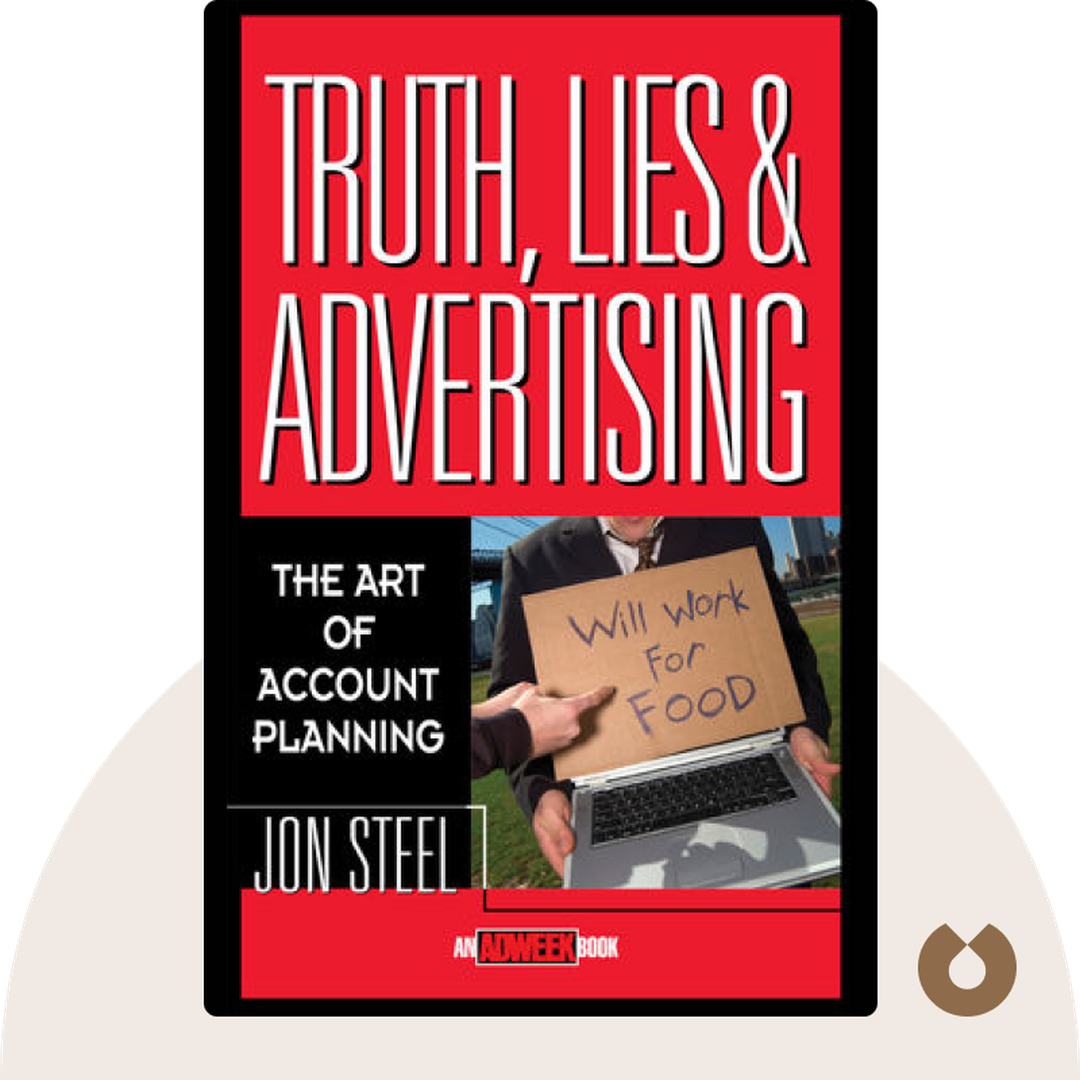
Truth, Lies and Advertising
Start ListeningDownload Try free on iPhoneScan to start in 5 seconds
Categories:
If You're Curious About These Questions...
You should listen to this audiobook
- What if the most important person in an advertising meeting isn’t actually in the room?
- Have you ever wondered why traditional market research often fails to capture what consumers really think?
- What’s the secret to bridging the gap between a client’s business goals and a creative team’s wildest ideas?
Listen to Truth, Lies and Advertising — Free Audiobook
Loading player...
Key Takeaways from Truth, Lies and Advertising
- Discover how an account planner acts as the vital bridge connecting a client's business goals, the creative team's vision, and the consumer's actual needs.
- Learn why asking the obvious questions and avoiding restrictive surveys can save a campaign from disaster, as demonstrated by the New Coke failure.
- Understand the importance of observing consumers in natural, comfortable environments—rather than intimidating research labs—to capture their genuine thoughts and habits.
- Master the art of the creative brief by distilling complex consumer research into a single, powerful proposition sentence that guides the creative team.
- Find out how to translate deep consumer research into unforgettable campaigns by collaborating with creatives to polish and elevate your initial insights.
Learning Tools
Reinforce what you learned from Truth, Lies and Advertising
Mind Map
Truth, Lies and Advertising
The Account Planner's Role+
Effective Consumer Research+
The Creative Brief+
Collaboration & Client Management+
Case Study: got milk?+
Cultivating Inspiration+
Quiz — Test Your Understanding
Question 1 of 6
What is the primary role of an account planner in an advertising agency?
Question 2 of 6
Why does the author suggest that an account planner should work with a maximum of three clients at a time?
Question 3 of 6
According to the author, what is a best practice for conducting consumer research and focus groups?
Question 4 of 6
What is considered the most important part of a creative brief?
Question 5 of 6
How did the account planner handle the Foster Farms client's disapproval of the chicken puppets drinking beer and smoking?
Question 6 of 6
What key insight from consumer research drove the strategy behind the famous "got milk?" campaign?
Truth, Lies and Advertising — Full Chapter Overview
- 1Recommendation
- 2Account planners connect clients’ business goals, the agency’s creative teams, and consumers’ essential needs today.
- 3The account planner steers creatives by conducting consumer research and analyzing the findings in depth.
- 4The account planner employs the creative brief to deliver a simple, powerful idea to the creative team.
- 5The account planner partners with creatives to weave client expectations into the overall campaign concept effectively.
- 6The author created the iconic “got milk?” campaign by following the account-planning process closely.
Truth, Lies and Advertising Summary & Overview
In Truth, Lies and Advertising (1998), leading account planner Jon Steel shares an insider’s insight into the world of advertising. For Steel, the creation of great ads is all about understanding the consumer, and his compelling behind-the-scenes anecdotes illustrate the role account planners play in developing a successful campaign.
Who Should Listen to Truth, Lies and Advertising?
- Anyone who’s starting out in advertising or planning
- Mad Men fans who want to understand how a real advertising agency works
- Business owners want to hire an advertising agency to develop a campaign
Books Similar to Truth, Lies and Advertising
Readers who enjoyed this also liked these titles.