If You're Curious About These Questions...
You should listen to this audiobook
- Did you know that you are constantly using your imagination every time you recall a memory or plan your future, even if you don’t consider yourself a "creative" person?
- Have you ever wondered why some people can visualize vivid mental images while others see only darkness—and what this reveals about the biological machinery of your mind?
- What if the way you "see" the world isn't just about your eyes, but a complex hidden process that dictates how you interact, learn, and even dream?
Listen to The Shape of Things Unseen — Free Audiobook
Loading player...
Key Takeaways from The Shape of Things Unseen
- Discover the three key types of imagination—everyday mind-wandering, creative meaning-making, and social empathy—that allow you to envision experiences beyond your own.
- Understand why your mind involuntarily wanders during nearly half of your waking hours, giving you the profound ability to untether from reality and travel through time.
- Learn how mental visualization triggers actual physical responses in your body, such as your pupils constricting when imagining a bright light, revealing shared neural pathways.
- Find out why imagination cannot be pinned to a single brain region, but instead relies on a complex, multimodal network that activates your visual, sensory, and kinaesthetic dimensions simultaneously.
- Master the concept of 'bisociation' to drive productive imagination by unexpectedly combining incompatible ideas to spark original thinking and innovative breakthroughs.
The Shape of Things Unseen — Full Chapter Overview
Chapter 1: Recommendation
Chapter 2: Three kinds of imagination
Chapter 3: Our visual imagination
Chapter 4: Creative breakthroughs
Chapter 5: Shaping imagination
Chapter 6: Imagination gone awry
Chapter 7: Imagination's potential
The Shape of Things Unseen Summary & Overview
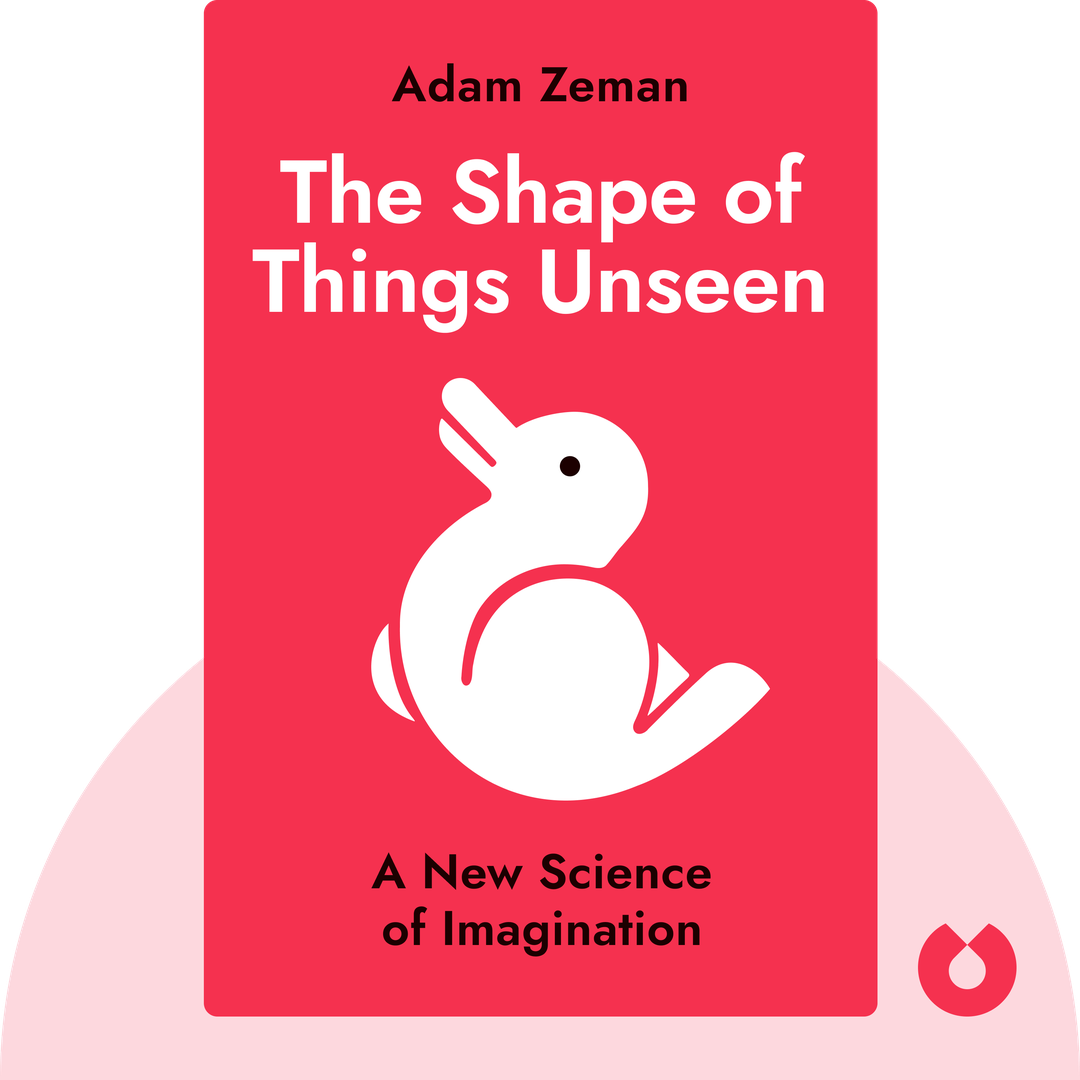
The Shape of Things Unseen (2025) challenges the myth that imagination is used only in creative endeavours, illustrating how we use our imaginative capacities constantly, whether anticipating, reminiscing, hypothesizing or daydreaming. It draws on the latest cognitive science to show how imaginative thought is embedded in our development, our interactions, and our biological and perceptual processes.
Who Should Listen to The Shape of Things Unseen?
- Psychologists interested in the neuroscience of mental imaging
- Artists interested in uncovering the scientific foundation of their creativity
- Parents hoping to understand their child’s developing imagination
Books Similar to The Shape of Things Unseen
Readers who enjoyed this also liked these titles.