If You're Curious About These Questions...
You should listen to this audiobook
- Did you know that your brain doesn’t actually see the world as it is, but creates a version of reality based on shortcuts and past experiences?
- Have you ever wondered why our minds are hardwired to avoid uncertainty, and how that instinct might be blocking your creative potential?
- What if you could master the neuroscience of perception to see past your brain's hidden biases and discover entirely new ways to solve problems?
Listen to Deviate — Free Audiobook
Loading player...
Key Takeaways from Deviate
- Discover why your brain constantly lies to you and how these evolutionary perceptual distortions actually help you survive.
- Understand why raw information is entirely meaningless until your brain interprets and filters it to create your unique view of reality.
- Learn how actively engaging with dynamic, novel environments physically alters your brain structure by building denser neural connections.
- Explore the incredible flexibility of the human mind through real-world examples, like how a blind boy taught himself to navigate using bat-like echolocation.
- Recognize that what you consider objective reality is merely a mental interpretation, and use this counterintuitive truth to unlock new avenues of creativity.
Learning Tools
Reinforce what you learned from Deviate
Mind Map
Deviate
The Nature of Perception+
The Power of Context+
Brain Plasticity+
Overcoming Assumptions+
Embracing Uncertainty+
Ecology of Innovation+
Quiz — Test Your Understanding
Question 1 of 10
Why did the human brain evolve to interpret reality inaccurately in certain situations?
Question 2 of 10
According to the book, what is required for raw sensory input (like photons or vibrations) to have any value to humans?
Question 3 of 10
What did the study involving rats in dynamic versus dull cages demonstrate about the brain?
Question 4 of 10
Why did the colorful yarns in Louis XVIII's royal tapestry factory appear dull when customers took them home?
Question 5 of 10
Why do native Japanese speakers initially have difficulty distinguishing between English 'R' and 'L' sounds?
Question 6 of 10
How does the brain's reliance on past experiences and assumptions affect our daily thinking?
Question 7 of 10
What is the primary lesson demonstrated by the 'Dunker’s Candle' brainteaser?
Question 8 of 10
According to the text, why do humans have a natural, instinctual aversion to uncertainty?
Question 9 of 10
What is a common misunderstanding people have about how innovation works, according to the book?
Question 10 of 10
What practical technique does the author suggest for embracing uncertainty in daily life?
Deviate — Full Chapter Overview
- 1Recommendation
- 2There is an objective reality, but our brains don’t perceive it directly.
- 3Information has no meaning without interpretation.
- 4Our brains learn through interaction with the world.
- 5Our perception of reality depends on context.
- 6We can use our minds to reshape how we perceive the world.
- 7Our assumptions about the world can both help and hinder our thinking.
- 8To think creatively, let go of your established assumptions.
- 9Find new ways of seeing the world by embracing uncertainty.
- 10An ecology of innovation balances play with efficiency.
- 11Final summary
Deviate Summary & Overview
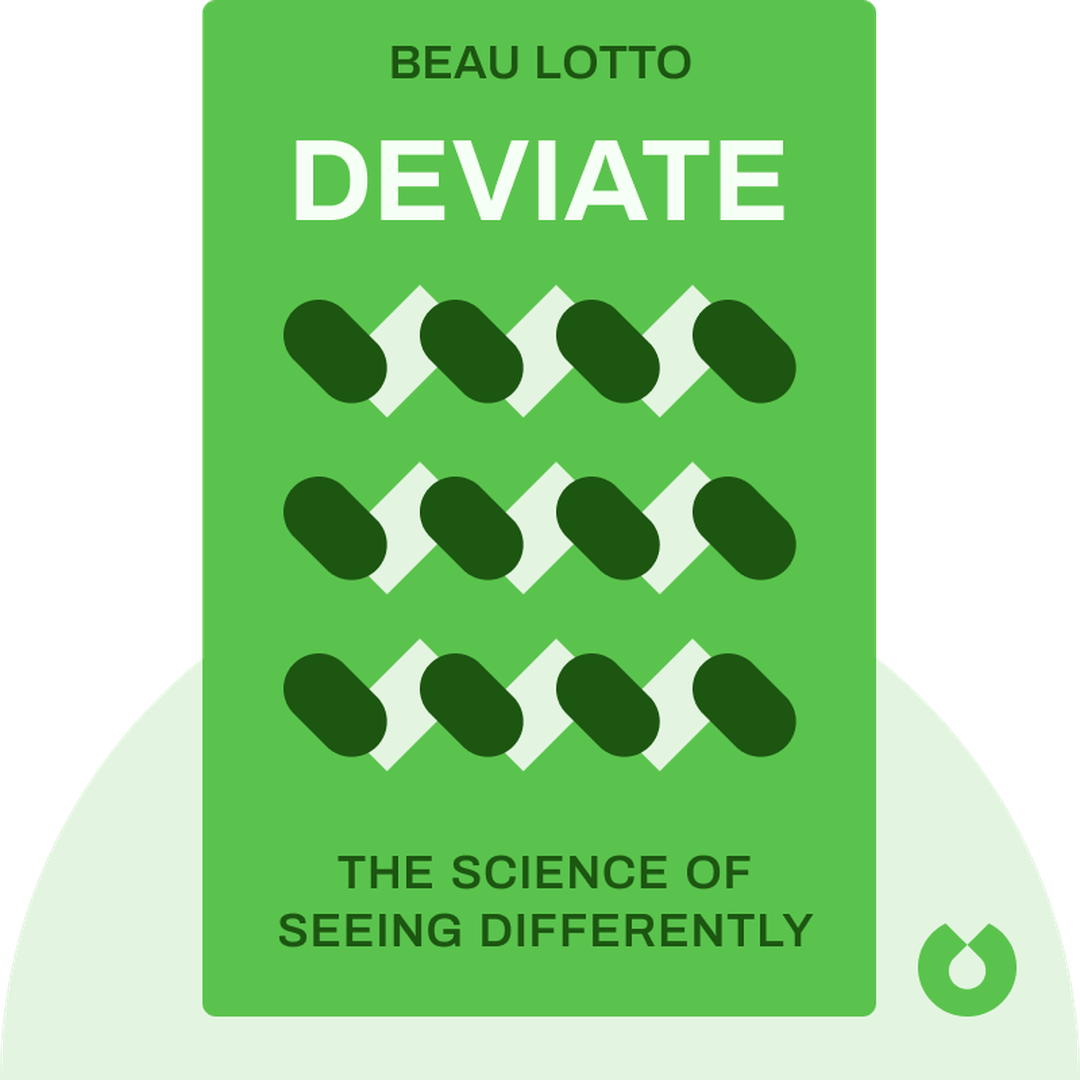
Deviate (2017) is a primer on the sometimes-tricky neuroscience behind human perception. It details all the illusions, distortions, and shortcuts our brains take when making sense of the world around us.
Who Should Listen to Deviate?
- Curious minds interested in the science of human perception
- Designers seeking novel approaches to problems
- Anyone who wants to see the world from a new perspective
Books Similar to Deviate
Readers who enjoyed this also liked these titles.