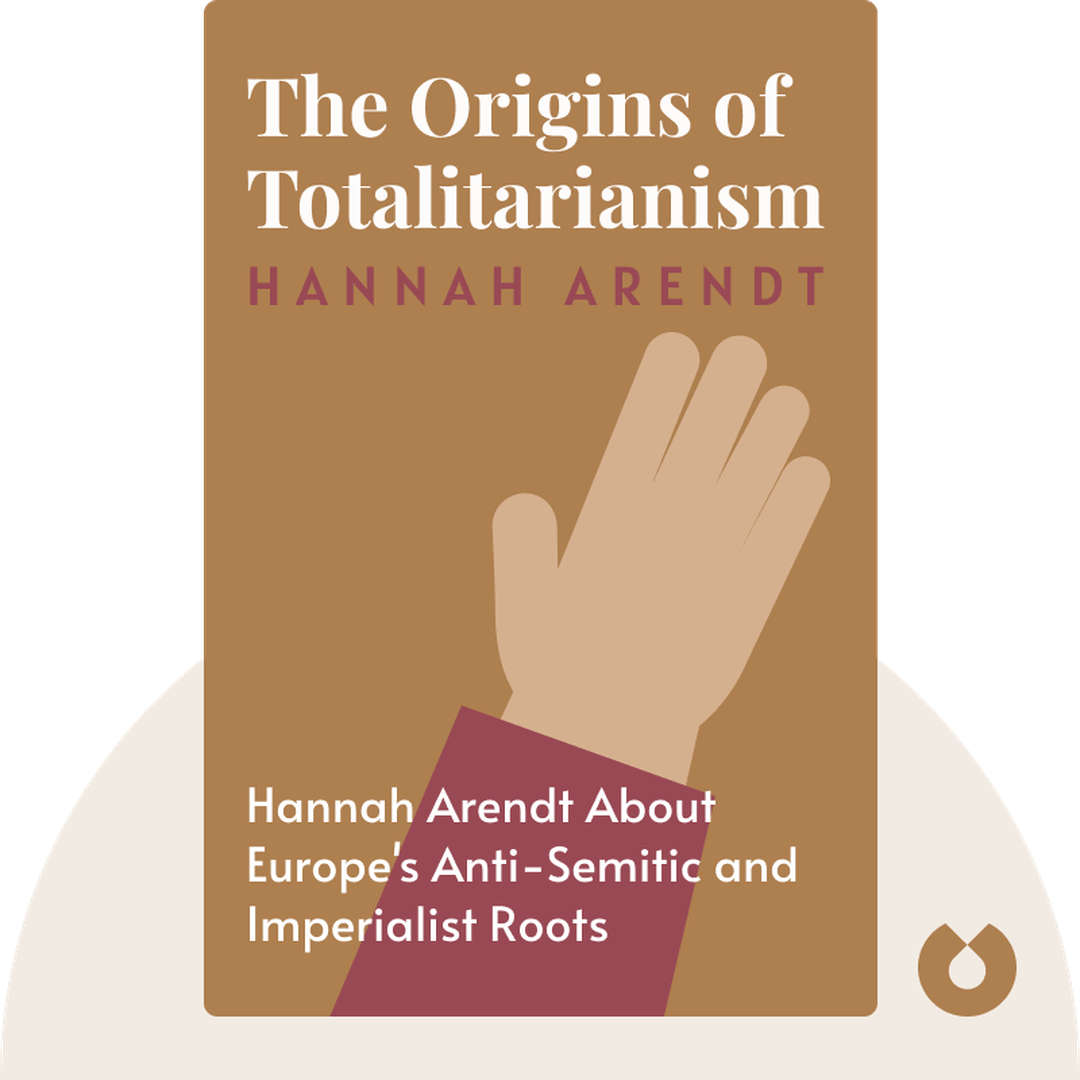
The Origins of Totalitarianism
Start ListeningDownload Try free on iPhoneScan to start in 5 seconds
Categories:
If You're Curious About These Questions...
You should listen to this audiobook
- What's the secret to recognizing the warning signs of totalitarianism before it's too late?
- Are you curious about how the seeds of Nazi Germany and Stalinist Russia were sown centuries before their rise to power?
- Have you ever wondered why some societies are more susceptible to the erosion of free-thinking democracy, and how to prevent it in your own community?
Listen to The Origins of Totalitarianism — Free Audiobook
Loading player...
Key Takeaways from The Origins of Totalitarianism
- Understand how quickly democratic societies can fall into totalitarianism when free discourse is abandoned and vulnerable, lonely people fall through the cracks.
- Discover how the historical shift from feudalism to nation-states isolated European Jews in government financial roles, inadvertently sparking dangerous conspiracy theories.
- Learn how early capitalist ambitions fueled imperialism, leading colonizers to weaponize racism as a tool to bypass human rights and maximize their profits.
- Find out how pan-nationalist movements manipulated history to create false narratives of racial superiority, indoctrinating the masses to override local laws.
- Recognize why Jewish people became the ultimate scapegoats for the failures of the crumbling nation-state, despite having little actual political influence at the time.
Learning Tools
Reinforce what you learned from The Origins of Totalitarianism
Mind Map
The Origins of Totalitarianism
Historical Roots of Anti-Semitism+
Imperialism and Racism+
The Classless Masses+
Propaganda and Ideology+
Dehumanization and Terror+
Prevention and Defense+
Quiz — Test Your Understanding
Question 1 of 8
How did the transition from feudalism to nation-states affect the social standing of Jewish people in Europe?
Question 2 of 8
According to the text, what was the primary function of racism in the era of European imperialism?
Question 3 of 8
What did the Dreyfus affair demonstrate about European society at the turn of the twentieth century?
Question 4 of 8
How does Arendt characterize the 'classless masses' that emerged around the time of World War I?
Question 5 of 8
What is the true underlying goal of totalitarian ideologies, despite the myths perpetuated by their propaganda?
Question 6 of 8
What essential human characteristic does totalitarianism actively seek to extinguish in order to turn individuals into 'cogs in a machine'?
Question 7 of 8
How are concentration camps viewed in the context of totalitarian dehumanization?
Question 8 of 8
Which psychological and social state makes individuals most vulnerable to the appeal of totalitarian movements?
The Origins of Totalitarianism — Full Chapter Overview
- 1Recommendation
- 2European Jews long stood apart from society yet remained near the centers of political power.
- 3Racist imperialism and pan-nationalism then arose within the new, fragile nation-state.
- 4As nation-states faltered, Jews were then scapegoated for society’s many ills.
- 5Before and after WWI, increasing numbers of people joined the “classless masses,” becoming ideal subjects for totalitarianism.
- 6The masses were now prepared to be indoctrinated by totalitarian propaganda.
- 7At the helm of totalitarianism sits an ideology that distorts history to match its preferred version of reality.
- 8Totalitarianism is genuinely all-encompassing.
- 9Whenever people are lonely, when humans are “atomised,” then totalitarianism always has a chance to succeed.
The Origins of Totalitarianism Summary & Overview
The Origins of Totalitarianism (1951) is a landmark work by Hannah Arendt, in which she traces the anti-Semitic and imperialist roots of modern-day totalitarianism in Europe. Starting with the rise of the nation-state in the seventeenth century, Arendt reveals the prejudices and myths that empowered the Nazism and Stalinism of the early twentieth century, and that can lead to the erosion of free-thinking democracy. She also gives clear warning on how to avoid predatory totalitarian movements in the future.
Who Should Listen to The Origins of Totalitarianism?
- Students of philosophy and political science
- Anyone interested in how history can teach us about the present
- People concerned about human rights
Books Similar to The Origins of Totalitarianism
Readers who enjoyed this also liked these titles.