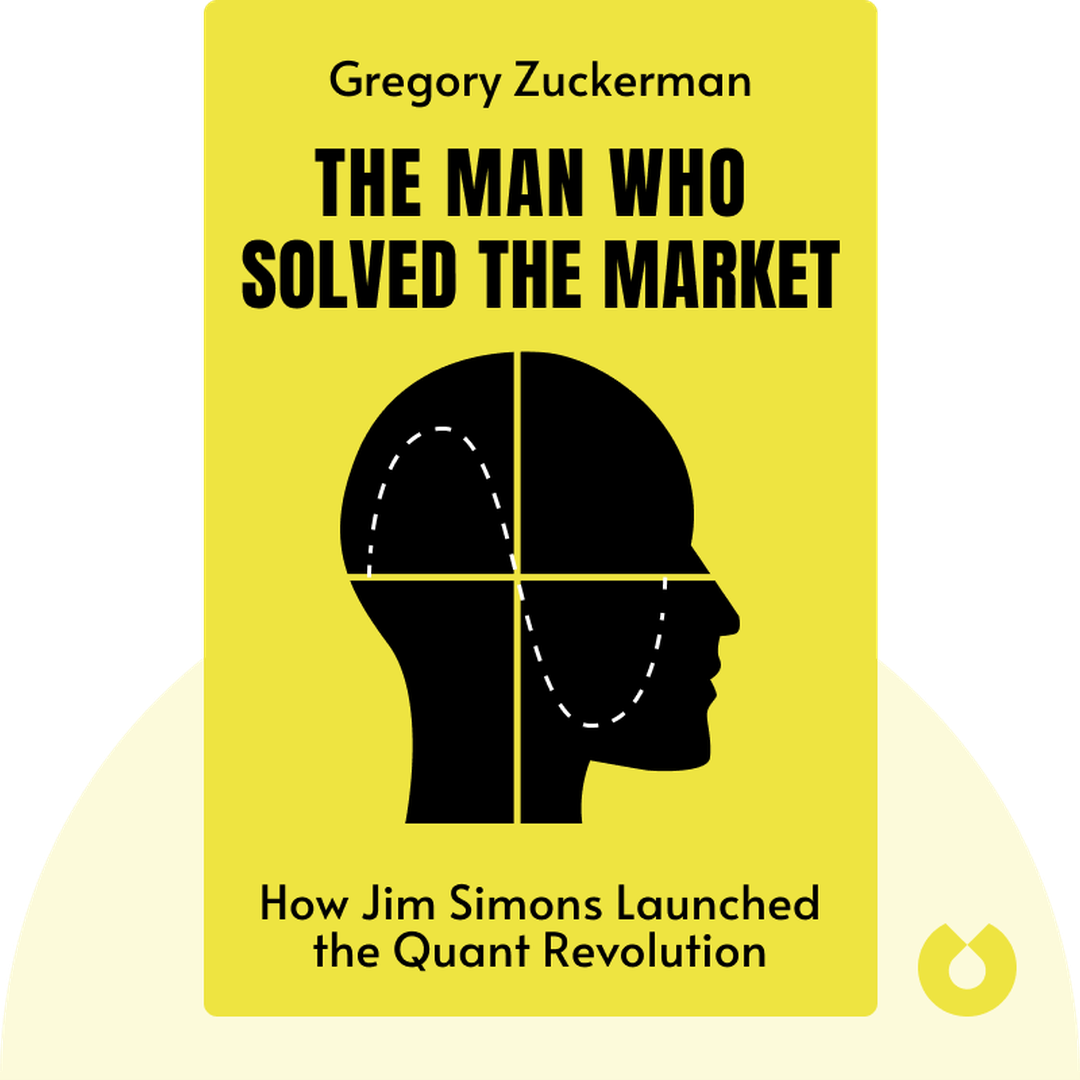
The Man Who Solved the Market
Start ListeningDownload Try free on iPhoneScan to start in 5 seconds
Categories:
If You're Curious About These Questions...
You should listen to this audiobook
- What’s the secret behind a team of mathematicians and code-breakers outperforming the world’s most elite investors for decades?
- Did you know that the most successful investor in modern history wasn't a finance expert, but a geometer who spent years breaking Soviet codes?
- Have you ever wondered how a purely mathematical approach could finally “solve” the chaos of the financial markets to generate the greatest returns in history?
Listen to The Man Who Solved the Market — Cinematic Audio Edition
Loading player...
Key Takeaways from The Man Who Solved the Market
- Discover how viewing financial markets as predictable mathematical patterns, rather than relying on traditional business metrics, can revolutionize the way you approach investing.
- Learn how an early fascination with abstract mathematical concepts can lay the foundation for decoding complex, real-world problems.
- Find out how stepping outside a comfortable career path to tackle unconventional challenges can teach you to identify valuable patterns in seemingly meaningless data.
- Understand the power of the 'bad ideas is good' philosophy, and how encouraging pure brainstorming over perfection can lead to breakthrough innovations.
- Master the concept of modeling the stock market as an abstract system that completely ignores corporate news in favor of tracking underlying market states and price moves.
Learning Tools
Reinforce what you learned from The Man Who Solved the Market
Mind Map
The Man Who Solved the Market
Early Life & Mathematical Genius+
Code-Breaking & Geometry+
Transition to Finance+
Renaissance Technologies+
Key Figures & Controversies+
Legacy & Philanthropy+
Quiz — Test Your Understanding
Question 1 of 8
How did four-year-old Jim Simons unknowingly demonstrate his grasp of Zeno's paradox?
Question 2 of 8
Why did Jim Simons leave his position as a popular mathematics professor at Harvard University?
Question 3 of 8
How did Simons's initial approach to the stock market differ from traditional investment methods of his time?
Question 4 of 8
What was the primary advantage of the Baum-Welch algorithm used by Simons and Leonard Baum at Monemetrics?
Question 5 of 8
Why did Simons closely associate himself with the protagonist of Joseph Conrad's novel, Lord Jim?
Question 6 of 8
When historical data proved insufficient for predicting the highly volatile markets of the 1980s, what crucial pivot did Renaissance Technologies make?
Question 7 of 8
What ultimately led to Robert Mercer stepping down from his position as co-CEO of Renaissance Technologies?
Question 8 of 8
According to the text, how does the financial success of Jim Simons's Medallion fund compare to other legendary investors like Warren Buffett and George Soros?
The Man Who Solved the Market — Full Chapter Overview
- 1Recommendation
- 2Jim Simons was fixated on mathematics from an exceptionally early age.
- 3Soon after finishing school, Simons joined academia, then abruptly left to break Soviet codes for an intelligence agency.
- 4Simons achieved great success in geometry and devised a novel trading system.
- 5Following a second spell in academia, Simons launched the hedge fund management firm Monemetrics.
- 6Simons named his Monemetrics fund for a character in a Joseph Conrad novel, which proved quite revealing.
- 7Simons brought computers into the investing world with remarkable, lasting success.
- 8Simons’s career led him into the orbit of a brilliant man who would go on to court major controversy.
- 9When all is said and done, Jim Simons’s résumé is an astonishing document.
The Man Who Solved the Market Summary & Overview
The Man Who Solved the Market (2019) traces the life of enigmatic hedge fund manager and mathematician Jim Simons. It chronicles his early life as a brilliant geometer who won awards for his math, to his work breaking Soviet codes, all the way through to his success with his hedge fund management firm Renaissance Technologies. Far more than just another investor, Simons changed the world with his math and methods.
Who Should Listen to The Man Who Solved the Market?
- Anyone working in the world of finance
- Business journalists
- Mathematicians and geometers
Books Similar to The Man Who Solved the Market
Readers who enjoyed this also liked these titles.