Theme Song
If You're Curious About These Questions...
You should listen to this audiobook
- Did you know that a single mathematics professor figured out how to legally beat the game of blackjack, forcing casinos worldwide to change their rules?
- What if you could take the same statistical strategies used to win at the gambling table and apply them to consistently outperform the stock market?
- Are you curious about the secret logic that allows a person to master risk and turn high-stakes uncertainty into a predictable science of success?
Listen to A Man for All Markets — Cinematic Audio Edition
Loading player...
Key Takeaways from A Man for All Markets
- Discover how cultivating an investigative mindset and independently testing assumptions can help you uncover hidden patterns and systems in the world.
- Learn how to use mathematical simulations and probability to identify shifting odds and gain a measurable edge in seemingly unbeatable systems.
- Understand the importance of rigorously testing theoretical ideas against real-world outcomes and carefully managing risk to turn a statistical advantage into consistent success.
- Find out how to apply statistical reasoning to financial markets to spot mispriced assets, using careful hedging to profit regardless of overall market direction.
- Master the strategy of relying on methodical, math-driven logic rather than flashy predictions to isolate pricing errors and consistently outperform the market.
Learning Tools
Reinforce what you learned from A Man for All Markets
Mind Map
A Man for All Markets
The Mathematician's Mindset+
Conquering the Casino+
Revolutionizing Wall Street+
Mastering Risk+
Personal Wealth Strategy+
Life Philosophy+
Quiz — Test Your Understanding
Question 1 of 8
What childhood experiment best demonstrated Edward O. Thorp's innate desire to deeply understand numbers and systems?
Question 2 of 8
Why did Thorp believe blackjack could be mathematically beaten, unlike games such as roulette or craps?
Question 3 of 8
How did Thorp initially apply his statistical strategies to the financial markets?
Question 4 of 8
What was the primary investment approach of Thorp’s hedge fund, Princeton/Newport Partners?
Question 5 of 8
According to Thorp's observations, what is the main reason many investors fail?
Question 6 of 8
What mathematical concept did Thorp use to determine exactly how much to invest or bet when he had a quantifiable edge?
Question 7 of 8
What investment strategy did Thorp highly recommend for the average person?
Question 8 of 8
Why did Thorp ultimately choose to stop managing outside money?
A Man for All Markets — Full Chapter Overview
- 1Recommendation
- 2The Early Curiosity That Formed a Mathematician
- 3Cracking Blackjack with Statistical Precision
- 4Uncovering Hidden Patterns in Financial Markets
- 5Creating a Math-Driven Hedge Fund from the Ground Up
- 6Learning to Manage Risk in the Real World
- 7A Mathematician’s Guide to Building Wealth Safely
- 8Choosing Independence Over Fame and Fortune
- 9Final summary
A Man for All Markets Summary & Overview
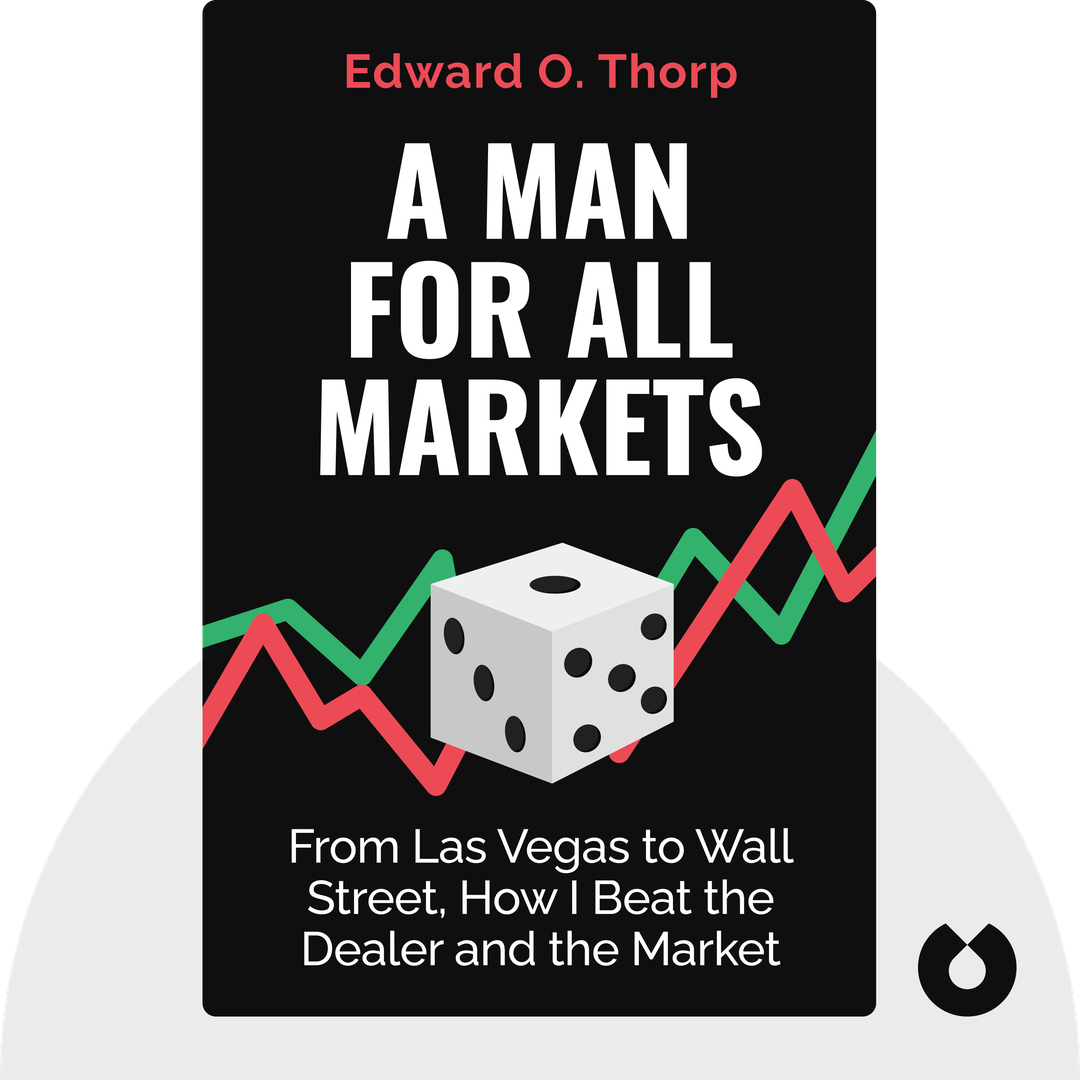
A Man for All Markets (2017) recounts how Edward O. Thorp, a mathematics prodigy, used statistical thinking to beat casinos and revolutionize Wall Street investing. It explores how Thorp applied deep analytical reasoning and disciplined risk management to consistently turn the odds in his favor in both gambling and finance.
Who Should Listen to A Man for All Markets?
- Curious mathematicians interested in real-world applications
- Ambitious investors seeking insights into quantitative strategy
- Anyone fascinated by risk and logic
Books Similar to A Man for All Markets
Readers who enjoyed this also liked these titles.