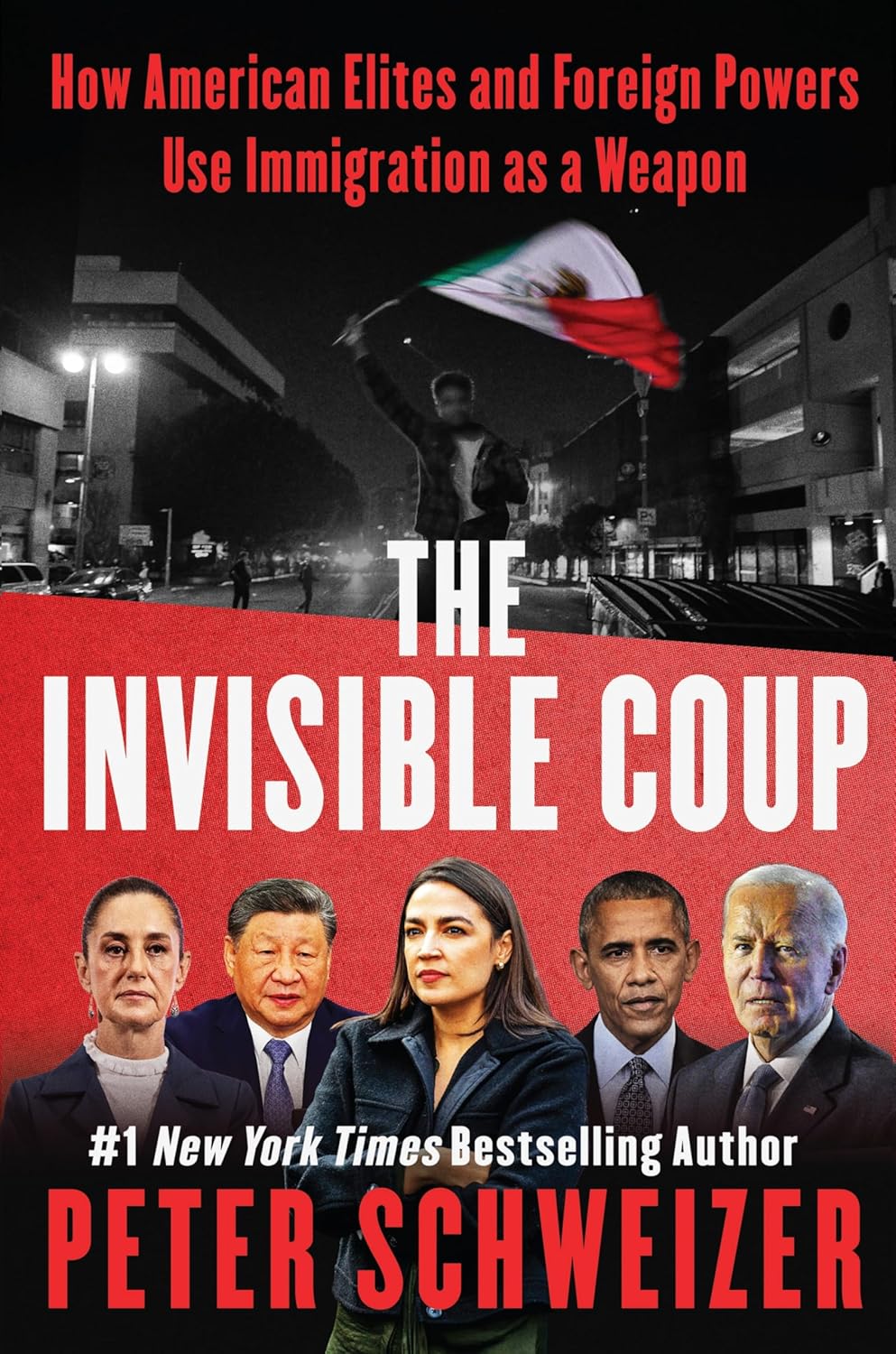
The Invisible Coup audiobook cover - This book argues that mass migration is being used as a strategic weapon—by foreign governments, ideological movements, and U.S. political actors—creating long-term leverage inside American institutions long after border crossings slow down.

The Invisible Coup

This book argues that mass migration is being used as a strategic weapon—by foreign governments, ideological movements, and U.S. political actors—creating long-term leverage inside American institutions long after border crossings slow down.

Peter Schweizer

4.0 / 5(3 ratings)
Start ListeningDownloadQR code that opens AudiobookHub on the App StoreTry free on iPhoneScan to start in 5 seconds

If You're Curious About These Questions...

You should listen to this audiobook

Listen to The Invisible Coup — Free Audiobook

Loading player...

Key Takeaways from The Invisible Coup

Learning Tools

Reinforce what you learned from The Invisible Coup

Mind Map

The Invisible Coup
Core Thesis & Historical Precedent+
Mexico's Reconquista & Consular Activism+
China's Influence & Financial Exploitation+
Domestic Enablers & Radical Alliances+
Institutional Support & Coordinated Surges+
Fighting Back: Policy Prescriptions+

Quiz — Test Your Understanding

Question 1 of 10
What is the core thesis of 'The Invisible Coup' regarding mass migration?
  • A. It is primarily an economic issue that strains social services and lowers wages for native-born workers.
  • B. It is a humanitarian crisis that the U.S. has a moral obligation to address through more open policies.
  • C. It can be a weaponized tool of subversion used by foreign powers and domestic allies to change a country from within.
  • D. It is an unstoppable global phenomenon that all developed nations must adapt to by dissolving national borders.
Question 2 of 10
How does the book characterize the 1980 Mariel Boatlift?
  • A. As a successful humanitarian rescue mission that showcased American generosity.
  • B. As a spontaneous mass exodus of Cubans fleeing economic hardship.
  • C. As a failed U.S. policy that was too restrictive and turned away deserving refugees.
  • D. As a 'prototype' of migration warfare where Castro exported criminals and intelligence agents to the U.S.
Question 3 of 10
According to the book, what is the primary goal of Mexico's alleged 'Reconquista' strategy?
  • A. To achieve cultural and political 'detachment' by preventing assimilation and fostering loyalty to Mexico.
  • B. To formally redraw the U.S.-Mexico border and reclaim territories lost in 1848 through military action.
  • C. To secure better trade deals with the U.S. by using migration as a negotiation tactic.
  • D. To encourage skilled Mexican workers to immigrate to the U.S. and send remittances back home.
Question 4 of 10
What does Schweizer accuse some U.S. presidents of doing with the naturalization process, creating 'Voter Mills'?
  • A. Making the civics and English tests so difficult that very few immigrants could ever become citizens.
  • B. Selling citizenship to the highest foreign bidders in exchange for direct payments.
  • C. Accelerating the process and loosening standards to create new voters for partisan electoral advantage.
  • D. Outsourcing the entire naturalization process to private companies with no oversight.
Question 5 of 10
What is the long-term strategic threat of Chinese 'birth tourism' and surrogacy, as described in the book?
  • A. It overwhelms maternity wards in U.S. hospitals, creating a public health crisis.
  • B. It creates a future generation of U.S. citizens raised in China who may lack cultural or civic loyalty to the U.S.
  • C. It is a method for wealthy Chinese families to avoid China's one-child policy.
  • D. It allows Chinese citizens to immediately claim U.S. social security and welfare benefits.
Question 6 of 10
What is the book's primary concern with the EB-5 investor visa program?
  • A. That it fails to create the number of jobs promised in its official guidelines.
  • B. That the investment amount required is too low to be meaningful for the U.S. economy.
  • C. That it primarily benefits European investors over those from other regions.
  • D. That it serves as a channel for foreign political influence through campaign donations from new residents.
Question 7 of 10
Why, according to the book, do progressive groups sometimes form alliances with Islamist movements?
  • A. Because they share the same views on social issues like LGBTQ+ rights and feminism.
  • B. Because Islamist groups provide significant funding for progressive political campaigns.
  • C. Because both groups share a common opposition to 'Western' or 'American' civilizational values.
  • D. Because both groups are committed to promoting free-market capitalism globally.
Question 8 of 10
How does the book characterize the role of Pope Francis and the Catholic Church in the migration debate?
  • A. As a neutral party focused purely on humanitarian aid without a political agenda.
  • B. As an institution promoting migration as a tool to reshape Western societies away from individualism.
  • C. As a conservative force advocating for stronger border enforcement and assimilation.
  • D. As an institution that has remained silent and uninvolved in the politics of migration.
Question 9 of 10
Which country does the book identify as a key 'staging hub' for the Biden-era surge, enabling migrants from around the world to fly in and travel north?
  • A. Mexico
  • B. Cuba
  • C. Nicaragua
  • D. Panama
Question 10 of 10
Which of these is a major policy reform Schweizer proposes to 'fight back' against migration as subversion?
  • A. Increasing the number of guest-worker visas to meet economic demand.
  • B. Expanding dual citizenship to encourage global integration.
  • C. Banning political donations by noncitizens and ending birthright citizenship for children of tourists.
  • D. Providing more government funding to NGOs to help them manage migrant flows.

The Invisible Coup — Full Chapter Overview

The Invisible Coup Summary & Overview

The Invisible Coup presents a provocative national-security thesis: that mass migration into the United States is not merely a humanitarian, economic, or law-enforcement issue, but an instrument of political subversion. Peter Schweizer frames recent migration waves as engineered by foreign governments and movements—and amplified by domestic allies—whose goal is to weaken U.S. sovereignty, reshape culture, and influence elections.

Moving from historical precedent (the 1980 Mariel Boatlift) to contemporary case studies, Schweizer alleges Mexico pursues a “Reconquista” strategy through consular activism and anti-assimilation efforts; China exploits birthright citizenship, surrogacy, and investor visas to create future political leverage; and transnational networks—from revolutionary left groups to Islamist movements—use migrant flows to build domestic power.

The book concludes with policy prescriptions aimed at reversing these trends through stricter vetting, limits on dual citizenship and birth tourism, constraints on foreign political funding, and enforcement actions against foreign diplomatic interference.

Who Should Listen to The Invisible Coup?

  • Readers interested in immigration policy framed through national security and foreign influence
  • Listeners who follow U.S. political strategy, election mechanics, and demographic change debates
  • Those who want a case-study-driven argument linking transnational actors to U.S. domestic institutions

About the Author: Peter Schweizer

Peter Schweizer is president of the Government Accountability Institute and the author of multiple #1 New York Times bestsellers. His investigative work has appeared in major outlets including The New York Times, The Wall Street Journal, and 60 Minutes.

🎧
Listen in the AppOffline playback & background play
Get App