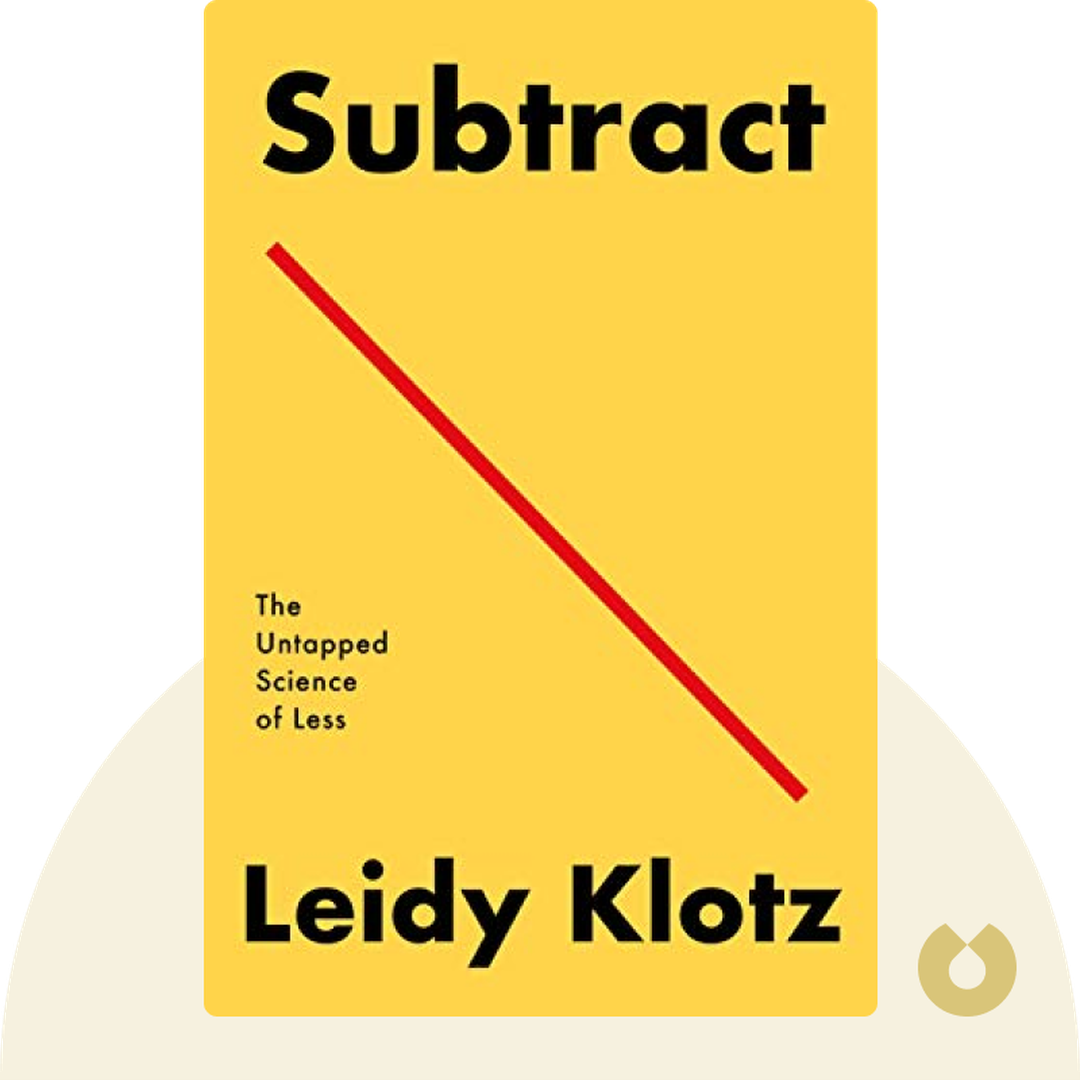
If You're Curious About These Questions...
You should listen to this audiobook
- Have you ever wondered why our brains instinctively choose to add more tasks and objects to our lives, even when we know we're already overwhelmed?
- What if the secret to solving your most complex problems isn't about what you can add, but what you can take away?
- Are you curious about how our evolutionary history has programmed us to overlook the power of subtraction in favor of 'more'?
Listen to Subtract — Free Audiobook
Loading player...
Key Takeaways from Subtract
- Discover why human beings are biologically and psychologically wired to add rather than subtract when trying to improve a situation.
- Understand why subtraction is a powerful, yet overlooked force for positive change that can transform everything from daily habits to urban landscapes.
- Learn what a simple Lego building block experiment reveals about mental accessibility, and why taking things away rarely occurs to us as a solution.
- Find out how simply reminding yourself that subtraction is an option can drastically improve your decision-making and problem-solving skills.
- Explore how our evolutionary drive to acquire resources and display competence makes it difficult to eliminate physical clutter and unnecessary work.
Subtract — Full Chapter Overview
Chapter 1: Recommendation
Chapter 2: Subtraction is a neglected driver of change.
Chapter 3: Subtracting is harder to call to mind than adding.
Chapter 4: Adding helps us feel capable and content.
Chapter 5: Addition came first; civilization followed.
Chapter 6: Keynesian theory suggests we grow wealthy by adding.
Chapter 7: Structural oppression can be reduced through subtraction.
Chapter 8: Subtraction repays the extra work it demands.
Subtract Summary & Overview
Subtract (2021) explores subtraction as a way to make positive change. It examines the human love affair with adding and having “more” – and it explains how our brains and environments work against subtraction.
Who Should Listen to Subtract?
- Design professionals looking for a fresh perspective
- Psychology buffs wanting new insights
- Anthropology enthusiasts
Books Similar to Subtract
Readers who enjoyed this also liked these titles.
The More of Less
★ 4.5 / 5 • 508 ratingsFinding the Life You Want Under Everything You Own
Deviate
★ 4.4 / 5 • 206 ratingsThe Science of Seeing Differently
Scaling Down
★ 4.2 / 5 • 66 ratingsLiving Large in a Smaller Place
Scarcity Brain
★ 4.1 / 5 • 319 ratingsFix Your Craving Mindset and Rewire Your Habits to Thrive with Enough