If You're Curious About These Questions...
You should listen to this audiobook
- Have you ever wondered why the very movements meant to unite South Asia against colonial rule actually sowed the seeds of its most violent division?
- Did you know that the trauma of partition didn't just change maps, but fundamentally reshaped the art, films, and daily habits of an entire subcontinent?
- Are you curious about how the 'shadows' of a 75-year-old border continue to dictate the modern politics and identities of three different nations today?
Listen to Shadows at Noon — Free Audiobook
Loading player...
Key Takeaways from Shadows at Noon
- Discover why the 1947 partition of the Indian subcontinent remains a permanent wound that still dictates modern trade routes, cultural identities, and daily life.
- Understand how early resistance to British colonialism birthed a muscular Hindu nationalism that weaponized religious festivals and ancient texts to justify violent rebellion.
- Learn how Gandhi’s tactic of using religious sentiment for mass political mobilization inadvertently alienated minority groups and deepened the exact divisions he wanted to heal.
- Uncover the tragic irony of how the Muslim League mirrored Gandhi’s religious appeals during the political vacuum of World War II to successfully demand the creation of Pakistan.
- Explore the divergent post-partition paths of India, Pakistan, and Bangladesh, and see how India's bold experiment with secular democracy was built on entrenched political patronage.
Learning Tools
Reinforce what you learned from Shadows at Noon
Mind Map
Shadows at Noon
Roots of Division+
The 1947 Partition+
Three Divergent Nations+
Cultural Fracturing+
Lingering Shadows+
Quiz — Test Your Understanding
Question 1 of 7
How did Bal Gangadhar Tilak and other militant activists in the 1890s change the approach to resisting British colonialism?
Question 2 of 7
What was the tragic irony of Mahatma Gandhi's methods for achieving Indian independence, according to the text?
Question 3 of 7
What pattern emerged in Pakistan's political landscape shortly after its creation?
Question 4 of 7
What primary factor led to the bloody emergence of Bangladesh in 1971?
Question 5 of 7
How did language policy reflect the new national identities of India and Pakistan after partition?
Question 6 of 7
In Saadat Hasan Manto's story 'Toba Tek Singh,' how is the trauma of partition primarily depicted?
Question 7 of 7
Which of the following is cited as a modern-day economic consequence of the 'lingering shadows' of partition?
Shadows at Noon — Full Chapter Overview
- 1Recommendation
- 2Colonial shadows and cultural defiance
- 3The enduring shadow of partition
- 4Three roads diverge
- 5The cultural battleground
- 6Enduring shadows
Shadows at Noon Summary & Overview
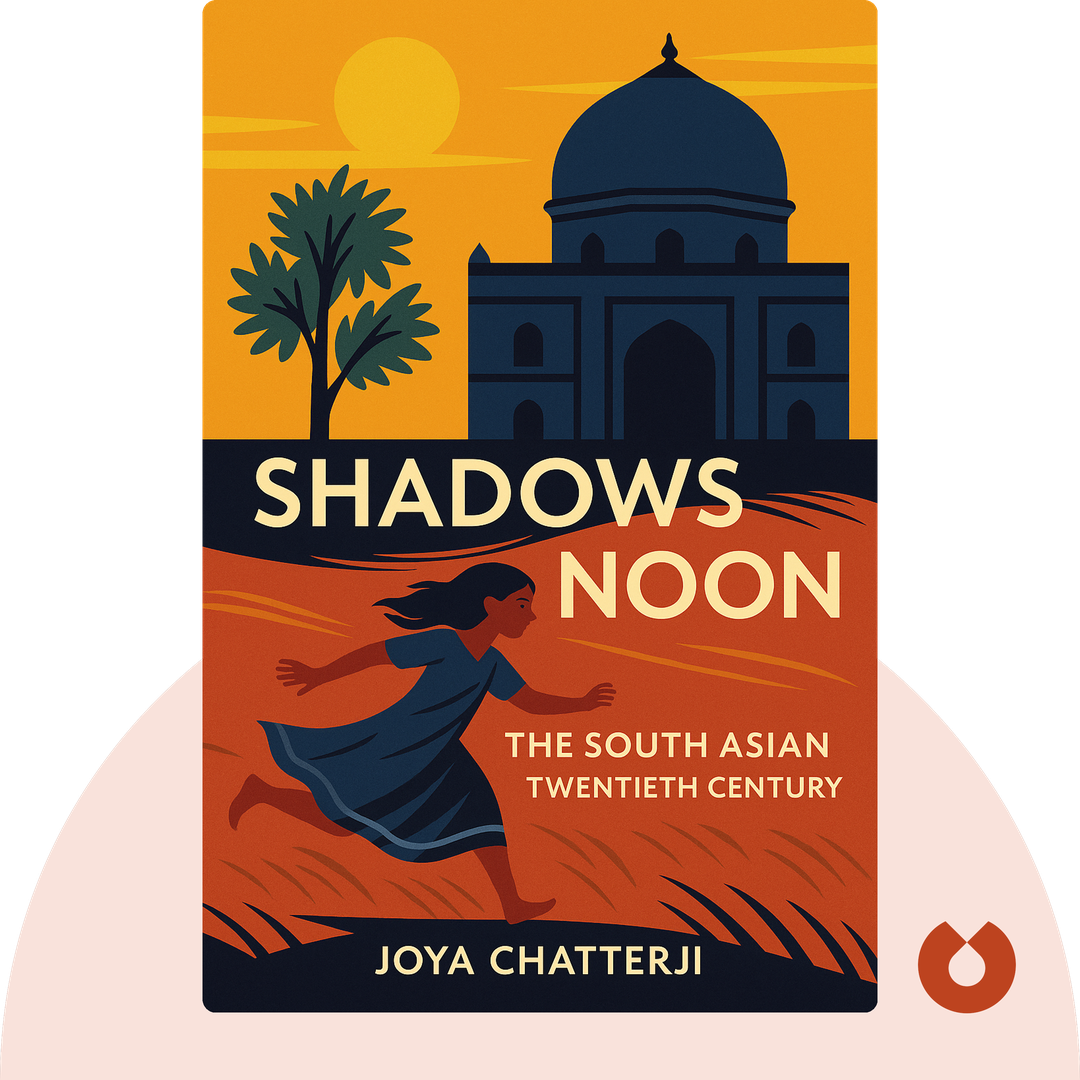
Shadows at Noon (2023) examines how the promise of independence in South Asia was undermined by the enduring trauma of partition and the contradictions within anti-colonial movements. It traces how religious mobilization against British rule inadvertently deepened communal divisions, creating wounds that continue to shape the subcontinent’s politics, culture, and daily life across three nations.
Who Should Listen to Shadows at Noon?
- History lovers looking to understand how colonial legacies continue to shape the modern world
- Culture fans curious about how literature, film, and art process collective trauma across generations
- Anyone interested in how historical events create lasting divisions in society – and what it means for post-conflict regions
Books Similar to Shadows at Noon
Readers who enjoyed this also liked these titles.