If You're Curious About These Questions...
You should listen to this audiobook
- Have you ever wondered how a group of middle-aged family men with no previous military experience could transform into cold-blooded executioners in just a few months?
- Did you know that many of the men responsible for the Holocaust’s most brutal acts were actually given the choice to opt out—and yet, most of them chose to stay?
- Are you curious about the chilling psychological process that allows a person to go from being revolted by cruelty to eventually finding delight in it?
Listen to Ordinary Men — Free Audiobook
Loading player...
Key Takeaways from Ordinary Men
- Discover how a group of middle-aged, working-class men from Hamburg with no prior military experience transformed into brutal mass murderers.
- Understand the historical context that led Nazi leadership to rely on ordinary reserve police units to carry out the atrocities of the Final Solution.
- Learn the chilling reality of human compliance through the Józefów massacre, where 80 percent of the men chose to kill despite being explicitly offered the chance to opt out.
- Find out how a small minority of men managed to resist their horrific orders, using methods ranging from outright refusal to intentionally shooting past their victims.
- Examine the severe psychological distress the battalion experienced after their first massacre, highlighting how ordinary people grapple with their own monstrous actions.
Learning Tools
Reinforce what you learned from Ordinary Men
Mind Map
Ordinary Men
The 'Ordinary' Demographics+
The First Massacre (Józefów)+
Mechanisms of Desensitization+
Evolution into Hardened Killers+
Why Ordinary Men Killed+
Ultimate Impact and Warning+
Quiz — Test Your Understanding
Question 1 of 6
Why was the demographic makeup of Reserve Police Battalion 101 considered surprising for a group that became mass murderers?
Question 2 of 6
How did Major Wilhelm Trapp handle the orders for the battalion's first major massacre at Józefów?
Question 3 of 6
Why did the Nazi leadership originally decide to use the Order Police to round up and deport Jewish populations?
Question 4 of 6
After the initial massacre at Józefów, how did the battalion's leadership alleviate the psychological burden of killing on the policemen?
Question 5 of 6
What did the subsequent 'Jew hunts' reveal about the psychological evolution of the men in Battalion 101?
Question 6 of 6
According to the text, which sociological factor, famously demonstrated by the Milgram experiments, strongly influenced the men's participation in the atrocities?
Ordinary Men — Full Chapter Overview
- 1Recommendation
- 2A Dreadfully Unpleasant Task
- 3The Final Solution
- 4The Massacre at Józefów
- 5Time and Again
- 6The Downfall of Lieutenant Gnade
- 7The 'Jew Hunts'
- 8Ordinary Men?
Ordinary Men Summary & Overview
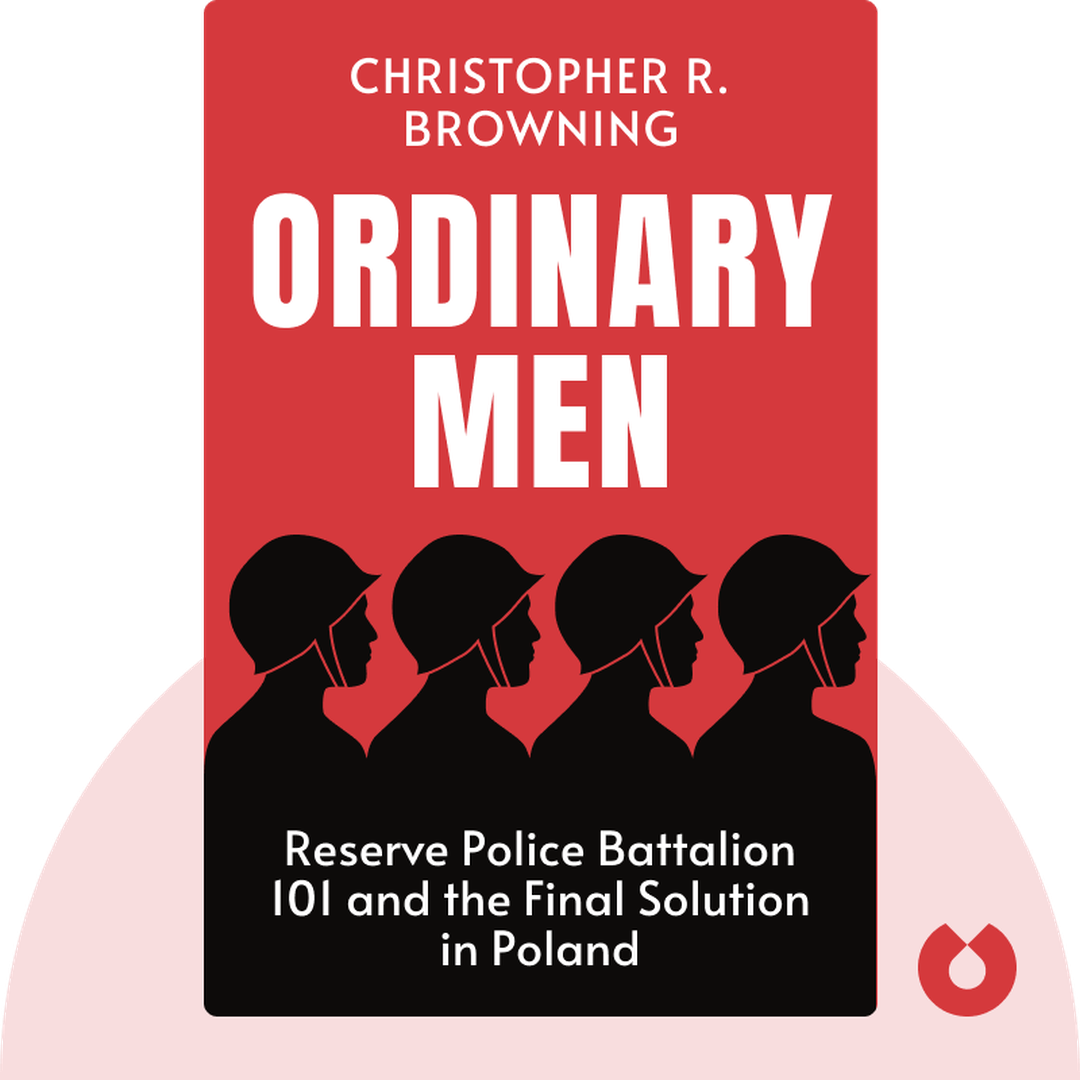
Ordinary Men (1992) tells the disturbing tale of how a group of men went from “ordinary” to brutal, hardened killers executing the Nazi mission during the Holocaust. It examines in detail the evolution of these men’s attitudes, from the beginning when most experienced disgust at the gruesome tasks they were asked to carry out, through to the end when almost all had become accustomed to the cruelty and some even came to delight in it. Above all, it is a warning and a reminder of what humanity is capable of in its darkest moments.
Who Should Listen to Ordinary Men?
- World War II and Holocaust historians
- Survivors of the Holocaust and their relatives and ancestors
- Anyone who thinks themselves incapable of acts of cruelty
Books Similar to Ordinary Men
Readers who enjoyed this also liked these titles.