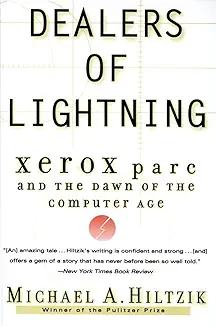
Dealers of Lightning: Xerox PARC and the Dawn of the Computer Age audiobook cover - In the early 1970s, Xerox quietly built a research lab in Palo Alto that invented the personal computer, Ethernet, the laser printer, and the modern graphical interface—then watched outsiders turn those ideas into fortunes while the parent company struggled to understand what it had paid for.

Dealers of Lightning: Xerox PARC and the Dawn of the Computer Age

In the early 1970s, Xerox quietly built a research lab in Palo Alto that invented the personal computer, Ethernet, the laser printer, and the modern graphical interface—then watched outsiders turn those ideas into fortunes while the parent company struggled to understand what it had paid for.

Michael Hiltzik

4.0 / 5(3 ratings)
Start ListeningDownloadQR code that opens AudiobookHub on the App StoreTry free on iPhoneScan to start in 5 seconds

If You're Curious About These Questions...

You should listen to this audiobook

Listen to Dealers of Lightning: Xerox PARC and the Dawn of the Computer Age — Free Audiobook

Loading player...

Key Takeaways from Dealers of Lightning: Xerox PARC and the Dawn of the Computer Age

Learning Tools

Reinforce what you learned from Dealers of Lightning: Xerox PARC and the Dawn of the Computer Age

Mind Map

Oceanofpdf.Com Dealers Of Lightning Michael Hiltzik
Origins & Xerox's Strategy+
Lab Culture & The Rebellion+
Core Innovations+
Demos & Expanding Horizons+
Commercialization & Legacy+

Quiz — Test Your Understanding

Question 1 of 9
What event primarily served as the catalyst for the creation of Xerox PARC?
  • A. The sudden bankruptcy of IBM and the resulting power vacuum.
  • B. Xerox's realization that their acquisition of Scientific Data Systems was a mismatch for beating IBM in business computing.
  • C. Steve Jobs approaching Xerox with a proposal to fund a personal computer prototype.
  • D. The invention of the laser printer by Gary Starkweather.
Question 2 of 9
What was Bob Taylor's defining belief regarding the fundamental purpose of computers?
  • A. They were primarily advanced calculators meant for complex physics simulations.
  • B. They were communication devices, and the visual display was the primary point of interaction.
  • C. They should be designed exclusively to manage and optimize corporate supply chains.
  • D. They were stepping stones meant strictly to achieve artificial general intelligence.
Question 3 of 9
Why did PARC engineers build the MAXC computer instead of simply purchasing a standard research machine?
  • A. DEC refused to sell their PDP-10 to a direct competitor like Xerox.
  • B. They wanted a machine exclusively dedicated to generating 3-D graphics.
  • C. They were rebelling against corporate pressure to use a machine from Xerox's recently acquired SDS subsidiary.
  • D. They needed a portable machine that could be easily transported to trade shows.
Question 4 of 9
What trio of inventions at PARC formed a complete workflow for modern digital document creation?
  • A. The Geometry Engine, VisiCalc, and the Star workstation.
  • B. The Alto, Ethernet, and the laser printer.
  • C. Smalltalk, the PDP-10, and ALOHAnet.
  • D. The MAXC, the cookie monster animation, and bitmapped memory.
Question 5 of 9
How did the Gypsy word processor significantly improve the usability of early computer interfaces?
  • A. By introducing a voice-activated command system.
  • B. By restricting text editing to a highly efficient, keyboard-only terminal command line.
  • C. By eliminating overlapping windows to reduce screen clutter.
  • D. By attacking the usability trap of 'modes' and introducing point-and-click selection with 'cut' and 'paste'.
Question 6 of 9
What primary disconnect was revealed during 'Futures Day' at the 1977 Boca Raton conference?
  • A. The PARC equipment repeatedly crashed during the live demonstrations.
  • B. Xerox sales executives could not comprehend how software ecosystems and distributed computing fit their traditional copier-lease sales model.
  • C. The executives felt that eliminating paper would ruin Xerox's public image as an eco-friendly company.
  • D. John Ellenby failed to create a compelling narrative to explain what the Alto was.
Question 7 of 9
What phenomenon proved both the power and the fragility of self-propagating code within PARC's growing networked environment?
  • A. A distributed program called 'the worm' that accidentally spread and crashed machines.
  • B. Malicious software intentionally embedded in the Smalltalk programming environment by a rival firm.
  • C. The introduction of VisiCalc, which overwhelmed the network's processing power.
  • D. The first documented ransomware attack launched by hobbyists from outside the facility.
Question 8 of 9
How did Xerox's official attempt at commercializing PARC's technology, the Star workstation, fare in the market?
  • A. It became an instant massive success, permanently crushing IBM's market share.
  • B. It was historically important and elegant, but proved too expensive and slow, and was blindsided by the simpler IBM PC.
  • C. It was completely rejected because it lacked a graphical user interface.
  • D. It was canceled before release because Steve Jobs stole the exclusive patents during his 1979 visit.
Question 9 of 9
Which of the following best summarizes the book's conclusion regarding the myth that 'Xerox Blew It'?
  • A. Xerox completely ignored PARC's inventions and actively suppressed their release to protect their copier monopoly.
  • B. Xerox missed obvious opportunities, but dominating the volatile personal computing market as a distracted copier-centric company was never a guaranteed prize.
  • C. Xerox successfully commercialized all of PARC's inventions, but lost the profits strictly due to premature patent expiration.
  • D. PARC's inventions were overhyped and ultimately had little actual impact on the broader tech industry.

Dealers of Lightning: Xerox PARC and the Dawn of the Computer Age — Full Chapter Overview

Dealers of Lightning: Xerox PARC and the Dawn of the Computer Age Summary & Overview

Dealers of Lightning is an inside chronicle of Xerox PARC’s first decade and a half—how a cash-rich copier giant assembled an unmatched cast of engineers and scientists, gave them unusual freedom, and accidentally helped ignite the personal computing revolution. The book tracks the lab’s core breakthroughs: the Alto personal computer, the Ethernet local network, WYSIWYG word processing, laser printing, and the software systems that made graphical computing feel natural.

It’s also a story of friction: research culture versus corporate incentives, the politics of budgets and product strategy, and how hard it is for large organizations to commercialize disruptive technologies while defending existing cash cows. Built from extensive interviews and detailed timelines, the narrative shows both the myth and the nuance behind the famous question: did Xerox “blow it,” or was the outcome nearly inevitable?

Who Should Listen to Dealers of Lightning: Xerox PARC and the Dawn of the Computer Age?

  • Listeners who want the real origin story behind the GUI, Ethernet, laser printing, and modern office computing
  • Product leaders and founders studying why great R&D doesn’t automatically translate into market wins
  • Anyone fascinated by Silicon Valley’s pre-Apple, pre-Microsoft “time machine” era

About the Author: Michael Hiltzik

Michael Hiltzik is a Pulitzer Prize–winning journalist and longtime reporter and editor at the Los Angeles Times. He has covered finance, politics, foreign affairs, and technology, and draws heavily on interviews and archival sources to reconstruct PARC’s formative years.

🎧
Listen in the AppOffline playback & background play
Get App