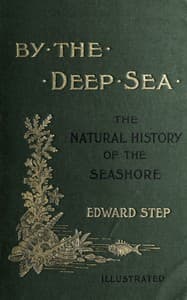
By the Deep Sea (Full Version) audiobook cover - Step invites you to trade the promenade for the rock-pool: timed by moon and tide, armed with jars and a keen eye, you’ll enter a teeming littoral world where beauty, science, and seaside wonder meet at every turn.

By the Deep Sea (Full Version)

Step invites you to trade the promenade for the rock-pool: timed by moon and tide, armed with jars and a keen eye, you’ll enter a teeming littoral world where beauty, science, and seaside wonder meet at every turn.

Edward Step

4.8 / 5(2349 ratings)
Categories:

Listen to By the Deep Sea (Full Version)

Loading player...

Historical Background

Written in the United Kingdom and first published in 1896, Edward Step’s *By the Deep Sea* emerged during the twilight of the Victorian era, a period characterized by a profound public fascination with natural history. This era witnessed the rise of the amateur naturalist, a cultural shift fueled by the rapid expansion of the British railway system, which suddenly made coastal holidays accessible to the growing middle class. Socially and scientifically, the public was still absorbing the paradigm-shifting aftershocks of Charles Darwin’s evolutionary theories. Consequently, the British seaside transformed from a mere recreational destination into a vibrant, living laboratory where ordinary citizens were eager to observe the wonders of biology firsthand.

Upon its publication, the book was highly significant for its pivotal role in democratizing science. Prior to works like Step's, marine biology was largely the exclusive, gatekept domain of elite academics and wealthy aristocratic collectors. Step wrote with engaging, accessible prose that translated complex marine ecology for the layperson. While not politically scandalous, the book gently challenged the rigid class boundaries of Victorian academia by asserting that the scientific observation of nature belonged to everyone. It empowered the general public to engage directly with coastal ecosystems, shifting the societal paradigm from passive reading to active, outdoor investigation.

The lasting impact of *By the Deep Sea* on literature and society is most evident in the evolution of modern nature writing and the modern field guide. Step’s pioneering approach successfully bridged the gap between rigorous scientific observation and literary accessibility, laying the structural groundwork for twentieth-century environmental literature. By inspiring generations of readers to value the intricate ecosystems of the shoreline, the book helped cultivate an early public ethos of marine conservation, forever altering how society interacts with and protects the natural world.


Study Questions

  1. How does Edward Step's writing in 'By the Deep Sea' reflect the late Victorian era's fascination with natural history and the seaside, and how does he balance scientific accuracy with accessible, literary prose to engage the everyday reader?

  2. Throughout the book, Step often employs anthropomorphism to describe the behaviors of marine creatures. How does attributing human-like qualities to sea life affect our understanding of the coastal ecosystem, and does it enhance or detract from the scientific value of his observations?

  3. Consider the physical setting of the tidal zone as a liminal space between the familiar land and the mysterious ocean. How does Step use the shoreline as a symbol for human curiosity, and what does the text ultimately suggest about our broader relationship with the unknown natural world?

What Critics and Readers Say

By the Deep Sea is a classic natural history work first published in 1896 that offers a detailed and accessible look at the diverse marine life found along the British coastline. Written by naturalist Edward Step, the book is remembered for making the wild, fascinating world of shoreline fauna understandable and enjoyable for general readers, bridging the gap between scientific zoology and popular nature observation. 

Critics and historical reviewers have noted that Step wrote with a clear and engaging style that invited non-specialists to explore the seaside’s rich ecosystems, from sponges and jelly-fishes to crustaceans and shore birds. His approach was seen as a “friendly go-between,” introducing readers for whom formal scientific texts might be intimidating to the “wonderful and interesting creatures of the rocks, sands, and shingle beach.” 

Although written over a century ago, By the Deep Sea remains valued by collectors and enthusiasts of natural history literature for its rich descriptions and abundant illustrations. The book’s emphasis on observation and appreciation of marine life reflects the Victorian era’s growing public interest in natural science and exploration. 

Readers and nature enthusiasts continue to seek out editions of By the Deep Sea, appreciating its blend of scientific detail and accessible narrative, making it both informative for learners and evocative for those who love coastal wildlife. 

Sources:

• Project Gutenberg – bibliographic overview of By the Deep Sea: https://www.gutenberg.org/ebooks/77774

• ThriftBooks – description of the book’s accessible style and appeal: https://www.thriftbooks.com/w/by-the-deep-se–a-popular-introduction-to-the-wild-life-of-the-british-shores-1896/13005095/

• The Zoologist (1897 review) – contemporary commentary on the book’s intent to introduce natural fauna to general readers: https://en.wikisource.org/wiki/Page:The_Zoologist,_4th_series,vol_1(1897).djvu/68

• Amazon – bibliographic and reader interest overview: https://www.amazon.com/deep-sea-popular-introduction-British/dp/B006DI2HN6

By the Deep Sea (Full Version) Chapter Overview

About By the Deep Sea (Full Version)

By the Deep Sea is Edward Step’s classic, field-born introduction to the living shore—written within sight and sound of breaking waves, and meant for the holiday visitor as much as for the serious amateur naturalist. Beginning with the sea as Earth’s “heart” and reservoir of life, Step guides listeners into the littoral zone with practical counsel on tides, collecting, and observation, then opens the microscope’s door onto an unseen universe of minute forms.

Moving from rocky pools to sands and shingle, the book celebrates the extraordinary diversity of marine life and the intricate systems that sustain it, from seaweeds and anemones to the “low life” of Foraminifera and other microscopic builders whose labors shape whole landscapes. Step’s prose blends Victorian wonder with lucid explanation, making this work both a charming seaside companion and a testament to the era’s passion for natural history—where careful looking becomes a moral and intellectual adventure.

Who Should Listen to By the Deep Sea (Full Version)

  • Seaside walkers and curious travelers who want to understand what tides, rock-pools, and shoreline “treasures” really contain.
  • Fans of classic natural-history writing who enjoy vivid observation, practical field guidance, and the romance of late-Victorian science.
  • Listeners interested in marine ecology and microscopy—especially the hidden, foundational life that supports ocean systems.

About Edward Step

Edward Step (1855–1931) was a British naturalist and prolific popularizer of science, widely read for his clear, companionable guides to plants, fungi, and wildlife. A Fellow of the Linnean Society (F.L.S.), he wrote for a broad audience of amateur observers at a time when natural history was a common passion. Among his best-known works are Wayside and Woodland volumes and other field guides that combine careful description with encouragement to look closely. Step’s writing helped make everyday encounters with nature—on footpaths, in woods, or beside the sea—both accessible and intellectually rewarding.