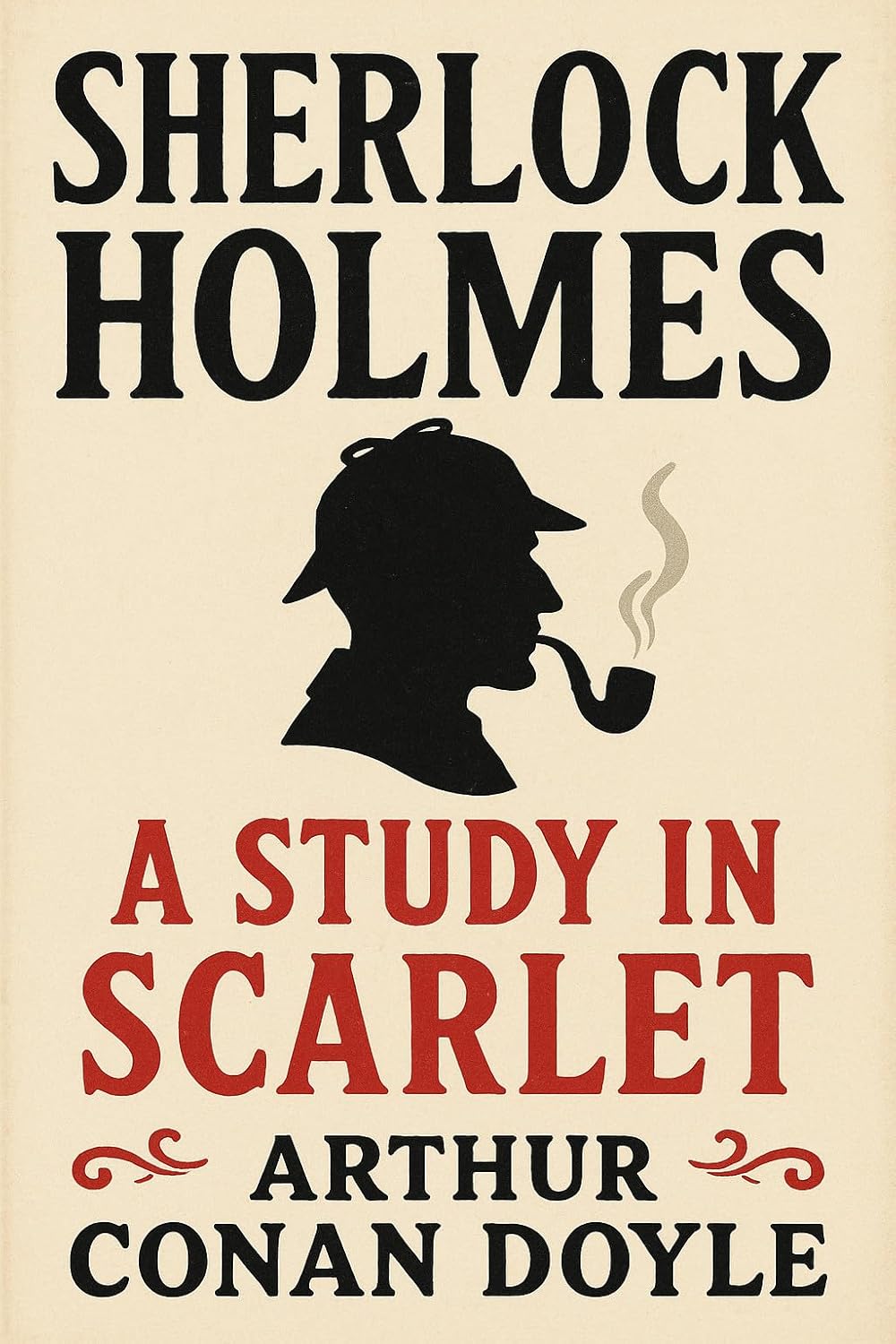
A Study in Scarlet (Full Version) audiobook cover - Fresh from war and illness, Dr. John Watson meets a brilliant, unnerving stranger in a London laboratory—and by the time they share rooms at 221B Baker Street, a trail of blood and logic is about to introduce the world to Sherlock Holmes.

A Study in Scarlet (Full Version)

Fresh from war and illness, Dr. John Watson meets a brilliant, unnerving stranger in a London laboratory—and by the time they share rooms at 221B Baker Street, a trail of blood and logic is about to introduce the world to Sherlock Holmes.

Arthur Conan Doyle

4.9 / 5(2410 ratings)
Categories:

Listen to A Study in Scarlet (Full Version)

Loading audio... Please wait for the audio to load before using controls.
0:00300:48
100%

Historical Background

Arthur Conan Doyle wrote *A Study in Scarlet* in 1886, completing the manuscript in just three weeks while working as a struggling physician in Southsea, England. The novel was first published in November 1887 in Beeton's Christmas Annual, a British magazine, where it received little initial fanfare despite introducing one of literature's most enduring characters.

The late Victorian era provided fertile ground for detective fiction. London in the 1880s was a city of stark contrasts—imperial grandeur alongside grinding poverty, scientific optimism shadowed by Jack the Ripper's imminent reign of terror. The public was fascinated by forensic science and rational inquiry, making Holmes's "science of deduction" remarkably timely. Doyle drew inspiration from his medical school professor, Dr. Joseph Bell, whose diagnostic brilliance and observation skills became the template for Holmes's methods.

The novel's unconventional structure—shifting midway from London to the American frontier—reflected Victorian readers' appetite for exotic adventure narratives. However, its depiction of Mormon settlers in Utah drew controversy even then and remains problematic today, representing common nineteenth-century prejudices rather than historical accuracy.

Despite its modest debut, *A Study in Scarlet* proved revolutionary. It established the template for modern detective fiction: the brilliant amateur investigator, the loyal companion-narrator, and the methodical unraveling of clues. Holmes would eventually appear in four novels and fifty-six short stories, becoming a cultural phenomenon that transformed mystery writing forever.
Study Questions

  1. How does Watson's role as narrator shape our understanding of Holmes, and why might Doyle have chosen this indirect method of characterization rather than letting Holmes tell his own story?

  2. The novel's structure divides sharply between the London mystery and the Utah backstory. How does this narrative choice affect the pacing and themes, and what does it reveal about Victorian attitudes toward America and religious communities?

  3. Holmes famously dismisses knowledge he considers irrelevant (like the solar system) while mastering obscure details useful for detection. What does this selective expertise suggest about intelligence, specialization, and the limits of rationality?

What Critics and Readers Say

A Study in Scarlet is celebrated as the first appearance of Sherlock Holmes and Dr. John H. Watson, launching one of the most iconic detective duos in literary history. Published in 1887, the novel's title comes from Holmes's metaphor about a "scarlet thread of murder" running through the "colourless skein of life," highlighting his belief in rationality, logic, and deduction as tools to unravel crime.

Critics and historians recognise that the work's initial public interest was modest, but its influence on the detective fiction genre has been profound. The story's structure — combining a London murder mystery with a later flashback to the American West — has been both praised for innovation and critiqued for feeling uneven. Some commentators note that while A Study in Scarlet may appear structurally flawed by modern standards, it remains revolutionary in its introduction of Holmes's deductive methods and its role in shaping detective narratives thereafter.

Reader responses often highlight the attraction of Holmes and Watson's characters; many enjoy the dynamic between Holmes's eccentric brilliance and Watson's grounded narration. At the same time, some readers find parts of the narrative — particularly the abrupt shift to the antagonist's backstory — to disrupt the pacing and tone of the mystery.

Modern evaluations also address historical context: while the novel remains a cornerstone of classic mystery literature, aspects of its portrayal (such as the depiction of certain groups) reflect Victorian-era attitudes and may feel dated to contemporary audiences.

Sources:

• Wikipedia – general overview of A Study in Scarlet and its place in the Sherlock Holmes canon: https://en.wikipedia.org/wiki/A_Study_in_Scarlet

• Chris Routledge – critical discussion of narrative structure and influence on detective fiction: https://chrisroutledge.co.uk/writing/a-study-in-scarlet/

• Literary Omnivore – reader-review insights on strengths and weaknesses: https://theliteraryomnivore.wordpress.com/2010/10/11/review-a-study-in-scarlet/

• Reddit/r/books – community reader impressions and character reactions: https://www.reddit.com/r/books/comments/q45tyq/today_i_started_to_read_my_first_sherlock_holmes/

A Study in Scarlet (Full Version) Chapter Overview

About A Study in Scarlet (Full Version)

A Study in Scarlet (1887) is the electrifying debut of Sherlock Holmes and Dr. John Watson, framed through Watson’s clear-eyed narration as he returns from Afghanistan and stumbles into an unlikely partnership with a razor-minded amateur detective. In Victorian London—foggy, bustling, and anxious—Holmes applies chemistry, forensic insight, and fierce observation to a baffling murder whose clues seem at once obvious and impossible.

Part mystery, part character study, the novel establishes the defining pleasures of the Holmes canon: the “science of deduction,” the intimate rhythm of two mismatched companions, and the exhilaration of reasoning made dramatic. Yet it also widens into a tale of motive and consequence, tracing how love, faith, vengeance, and displacement can travel across continents and years. Both a cornerstone of detective fiction and a sharply observed portrait of its era, this is where the legend begins.

Who Should Listen to A Study in Scarlet (Full Version)

  • Listeners who want to start Sherlock Holmes at the source, meeting Holmes and Watson as their partnership forms.
  • Fans of classic mysteries who enjoy forensic detail, logical puzzles, and the atmosphere of Victorian London.
  • Readers interested in the origins of modern detective fiction and the enduring appeal of the “brilliant outsider” investigator.

About Arthur Conan Doyle

Arthur Conan Doyle (1859–1930) was a Scottish physician and writer whose experience in medicine shaped his fascination with observation, evidence, and deduction. He introduced Sherlock Holmes in A Study in Scarlet, launching a series that defined detective fiction through novels and short stories including The Sign of the Four and The Adventures of Sherlock Holmes. Though Doyle also wrote historical novels, science fiction, and adventure tales, Holmes became his most influential creation—an enduring figure who helped popularize forensic reasoning and the modern mystery plot worldwide.