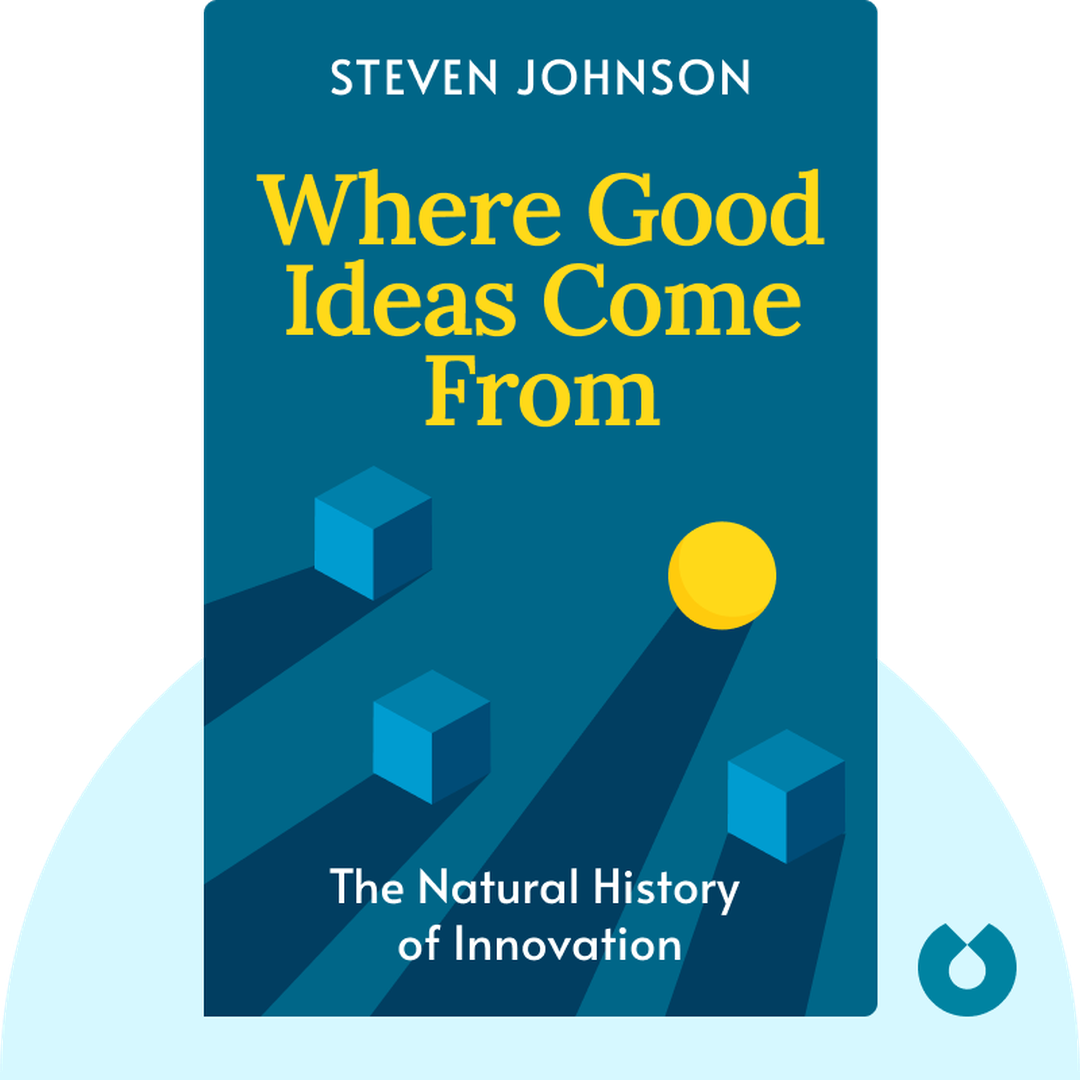
Where Good Ideas Come From
Start ListeningDownload Try free on iPhoneScan to start in 5 seconds
Categories:
If You're Curious About These Questions...
You should listen to this audiobook
- Did you know that the most innovative environments on Earth—from vibrant coral reefs to the busiest modern cities—all share the same secret structural pattern for generating great ideas?
- Have you ever wondered why the legendary "Eureka!" moment is actually a myth, and what the real, slow-burning process behind history's biggest breakthroughs looks like?
- What if you could use the same evolutionary principles that created life on Earth to systematically unlock your own creative potential and foster innovation?
Listen to Where Good Ideas Come From — Free Audiobook
Loading player...
Key Takeaways from Where Good Ideas Come From
- Understand the concept of the 'adjacent possible' and discover why successful innovations build upon immediately available technologies rather than attempting premature leaps.
- Discover why world-changing breakthroughs are rarely sudden 'eureka' moments, but rather 'slow hunches' that require time, patience, and cultivation to fully develop.
- Learn how shared platforms act as springboards for new creations, allowing innovators to stack ideas on existing foundations to rapidly expand what is possible.
- Find out why large, diverse networks—from bustling cities to the World Wide Web—are essential for breeding creativity and connecting ideas in novel ways.
- Recognize the power of open collaboration over competition, and see why the unrestricted circulation of ideas drives more historical progress than market rewards and patents.
Learning Tools
Reinforce what you learned from Where Good Ideas Come From
Mind Map
Where Good Ideas Come From
The Adjacent Possible+
Slow Hunches+
Platforms+
Networks and Collaboration+
Serendipity and Liquid Networks+
Error and Exaptation+
Quiz — Test Your Understanding
Question 1 of 9
What does the concept of the 'adjacent possible' explain about innovation?
Question 2 of 9
According to the text, how do world-changing ideas typically develop?
Question 3 of 9
In the context of innovation, what role do 'platforms' like the World Wide Web or GPS play?
Question 4 of 9
What did psychologists studying molecular biology laboratories in the 1990s discover about scientific breakthroughs?
Question 5 of 9
Why does the author argue that commercial markets can sometimes be structurally inefficient for innovation?
Question 6 of 9
What is the significance of the 'liquid network' metaphor in relation to creativity?
Question 7 of 9
How did innovators like Benjamin Franklin and Charles Darwin facilitate serendipitous connections on an individual level?
Question 8 of 9
What does psychologist Charlan Nemeth's color slide study demonstrate about the role of error?
Question 9 of 9
Which of the following best defines the concept of 'exaptation' as applied to innovation?
Where Good Ideas Come From — Full Chapter Overview
- 1Recommendation
- 2World-transforming ideas typically evolve over time as slow hunches, rather than as sudden breakthroughs.
- 3Platforms serve as springboards for innovation.
- 4Innovation and evolution flourish within large networks.
- 5Collaboration is at least as important a force in innovation as competition.
- 6Fortunate connections between ideas propel innovation.
- 7Serendipitous discoveries can be fostered by a shared intellectual or physical space.
- 8Great innovations arise from environments that are partly tainted by error.
- 9Innovation thrives by reinventing and reusing the old.
Where Good Ideas Come From Summary & Overview
Where Good Ideas Come From (2011) examines the evolution of life on Earth and the history of science. This New York Times bestseller highlights many parallels between the two, ranging from carbon atoms forming the very first building blocks of life to cities and the World Wide Web fostering great innovations and discoveries.
In addition to presenting this extensive analysis, replete with anecdotes and scientific evidence, Johnson also considers how individual and organizational creativity can be cultivated.
Who Should Listen to Where Good Ideas Come From?
- Anyone interested in the history of science and innovation, especially tantalizing anecdotes of great discoveries.
- Anyone who wishes to be more creative and innovative, or hopes to foster such traits on an organizational level.
- Anyone interested in the evolution of life on Earth.
Books Similar to Where Good Ideas Come From
Readers who enjoyed this also liked these titles.