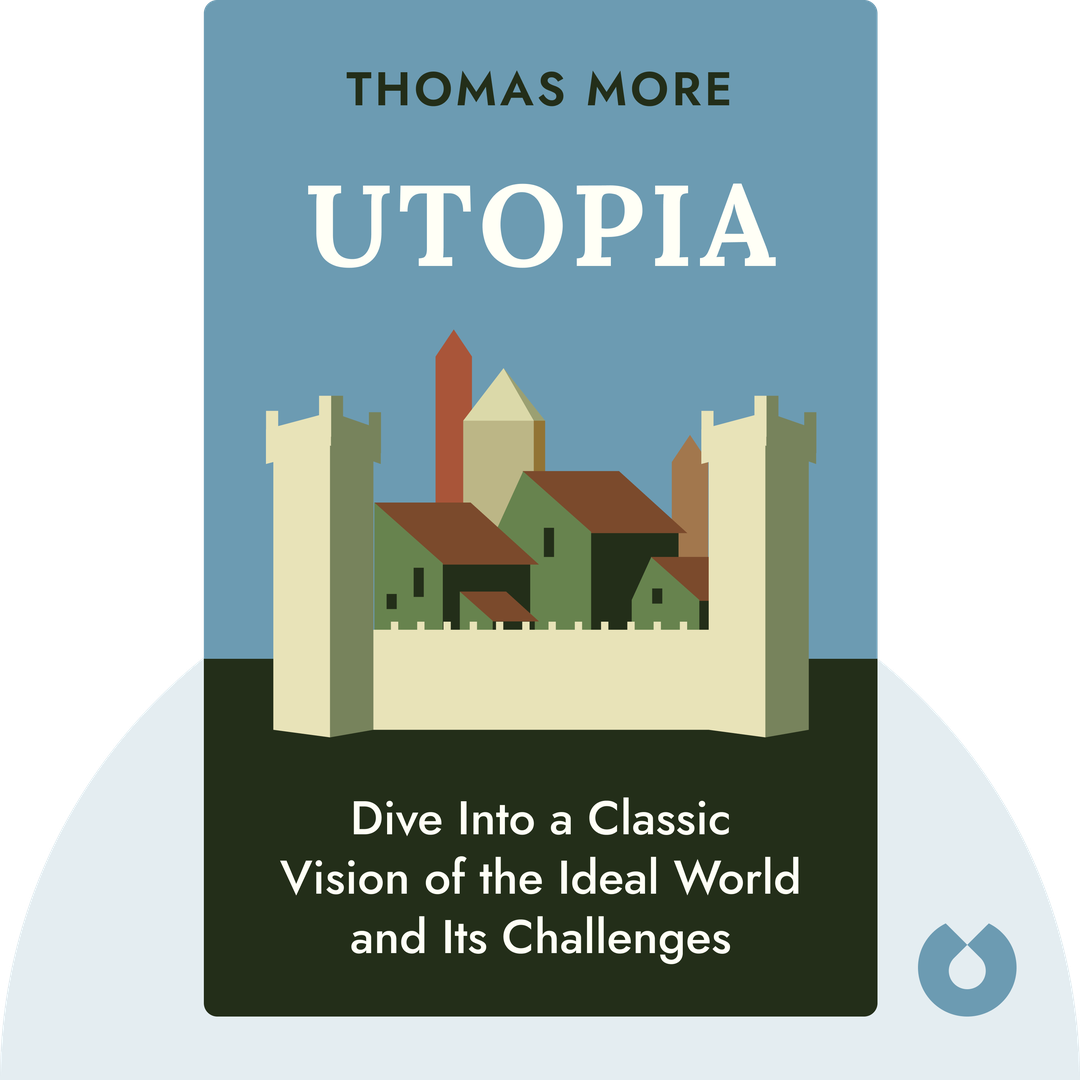
If You're Curious About These Questions...
You should listen to this audiobook
- Why do the citizens of Thomas More's ideal society use gold and silver to make chamber pots and chains for criminals?
- How did a 500-year-old book predict modern debates around the six-hour workday, universal healthcare, and voluntary euthanasia?
- What hidden meanings lie behind the names 'Utopia' and 'Raphael Hythloday,' and how do they reveal the author's true intentions for this perfect world?
Listen to Utopia — Free Audiobook
Loading player...
Key Takeaways from Utopia
- Written in 1516, Thomas More's 'Utopia' introduced the concept of an idealized society through a fictional island nation that challenged the harsh realities of Tudor England.
- The Utopian society operates without money or private property, ensuring equitable distribution of resources and mandating only a six-hour workday for its citizens.
- Centuries ahead of its time, the book proposed radical concepts such as universal education, free healthcare, religious tolerance, and even mutual divorce.
- Instead of hereditary monarchies, Utopia is governed by a system of elected representatives and views war as an absolute last resort.
- Despite its progressive ideals, the society contains intentional contradictions—like reliance on enslaved labor—serving as a complex thought experiment rather than a flawless blueprint.
Learning Tools
Reinforce what you learned from Utopia
Mind Map
Utopia by Thomas More
Origins & Concept+
Society & Economy+
Governance & Power+
Revolutionary Policies+
War & Foreign Relations+
Contradictions & Ambiguity+
Legacy & Modern Relevance+
Quiz — Test Your Understanding
Question 1 of 7
What is the dual meaning of the Greek roots used to create the word 'Utopia,' and what purpose did this linguistic trick serve?
Question 2 of 7
How does Utopian society handle the concepts of private property and material wealth?
Question 3 of 7
What is the standard workday for an able-bodied citizen in Utopia, and what is the primary reason for this structure?
Question 4 of 7
Which of the following social policies exists in Thomas More's fictional Utopia, standing in stark contrast to sixteenth-century European norms?
Question 5 of 7
How do the Utopians approach warfare and international conflicts?
Question 6 of 7
Despite its many progressive and egalitarian ideals, what significant contradiction exists within Utopian society?
Question 7 of 7
What was the ultimate fate of Thomas More, the author of Utopia?
Utopia — Full Chapter Overview
- 1Recommendation
- 2The origin of Utopia
- 3A voyage to a perfect society
- 4Radical concepts in an ancient world
- 5Wealth, conflict, and authority
- 6The enduring impact of Utopia
Utopia Summary & Overview
Utopia (1516) is a fictional account of an ideal island nation that radically reimagines society without private property, money, or religious intolerance. This influential work explores revolutionary concepts like universal education, health care, and democratic governance while using irony and ambiguity to challenge assumptions about the nature of a perfect world.
Who Should Listen to Utopia?
- Philosophy enthusiasts – especially those intrigued by social and political philosophy
- Social critics analyzing contemporary issues through historical lenses
- Anyone curious about influential ideas that have shaped modern debates about society
Books Similar to Utopia
Readers who enjoyed this also liked these titles.