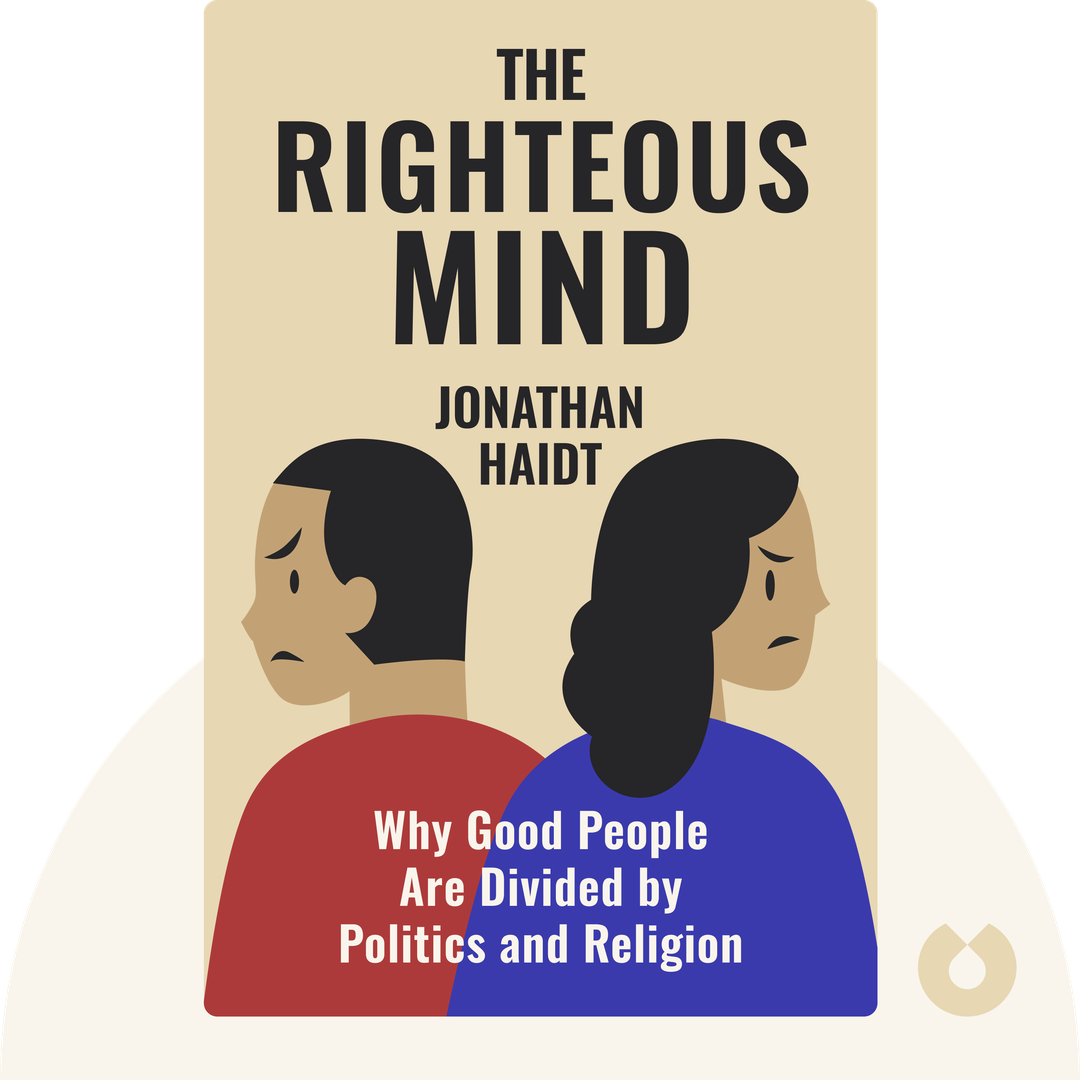
If You're Curious About These Questions...
You should listen to this audiobook
- Have you ever wondered why smart people can't seem to agree on politics or religion, even when presented with the same set of facts?
- Did you know that your moral decisions are actually driven by gut instincts rather than logic—and that your brain only uses reason to justify what you've already decided?
- What if the secret to understanding our divided world lies in realizing that morality is designed to both bind us together into groups and blind us to the truth of others?
Listen to The Righteous Mind — Free Audiobook
Loading player...
Key Takeaways from The Righteous Mind
- Discover why emotion, not rational logic, is the true driver of our moral judgment, and how your feelings play an essential role in processing everyday information.
- Learn how initial 'gut feelings' dictate our moral decisions long before logic kicks in, causing us to use rational reasoning merely to justify our intuitions rather than form them.
- Understand the hidden ways that self-interest and a subconscious desire to protect your reputation can easily sway your supposedly objective moral reasoning.
- Explore the Moral Foundations Theory to see how universal evolutionary concepts, like fairness and authority, create shared moral instincts that manifest in wildly different ways across cultures.
- Find out why Western, Educated, Industrialized, Rich, and Democratic (WEIRD) cultures are actually psychological outliers whose highly individualistic moral values do not represent the broader human population.
Learning Tools
Reinforce what you learned from The Righteous Mind
Mind Map
The Righteous Mind
Intuition Over Reason+
Cultural & Evolutionary Roots+
Group Dynamics & Religion+
Political Morality+
Practical Applications+
Quiz — Test Your Understanding
Question 1 of 10
According to the text, what is the primary role of logical reasoning in moral decision-making?
Question 2 of 10
What did neuroscientist Antonio Damasio discover about patients with brain damage that reduced their emotionality to nearly zero?
Question 3 of 10
How does the anticipation of having to justify our moral decisions to others affect our behavior?
Question 4 of 10
Why are people from WEIRD (Western, Educated, Industrialized, Rich, and Democratic) cultures considered outliers when it comes to morality?
Question 5 of 10
From an evolutionary perspective, what is the primary advantage of the 'hive switch'?
Question 6 of 10
According to the text, what is a major advantage of religion that scientific skeptics often overlook?
Question 7 of 10
Why might conservative politicians have an advantage over liberal politicians when appealing to voters' moral interests?
Question 8 of 10
How do conservatives complement the liberal strength of caring for victims of oppression, according to the text?
Question 9 of 10
Based on the book's conclusions, what is the most effective way to persuade someone to change their mind about a moral issue?
Question 10 of 10
According to the final summary, where does human happiness primarily come from?
The Righteous Mind — Full Chapter Overview
- 1Recommendation
- 2Intuitions lead and reasoning follows in our moral choices.
- 3Self-interest and reputation powerfully shape the way we reason about morality.
- 4Moral concerns differ across cultures but rest on shared core foundations.
- 5WEIRD societies are moral outliers in the human family.
- 6Evolution has shaped us to be both selfish and selfless.
- 7Our “hive switch” can intensify our feeling of unity with a group.
- 8Faith can foster tightly knit, generous and morally guided communities.
- 9Conservatives draw on more moral foundations than liberals when courting voters.
- 10Rising polarization endangers sound policy, so both sides must offer their strengths.
The Righteous Mind Summary & Overview
The Righteous Mind (2012) explores how moral decisions are made, concluding that moral judgments stem from intuitions, not logic. The author draws on his background in social psychology and 25 years of groundbreaking research to explain how morality both binds us and divides us and how religion and politics create conflicting communities of shared morality.
Who Should Listen to The Righteous Mind?
- Anyone who wants to learn how moral decisions are made
- Anyone interested in understanding how our moral interests both unify and divide us
Books Similar to The Righteous Mind
Readers who enjoyed this also liked these titles.